Anconeus
Musculus anconeus
Overview
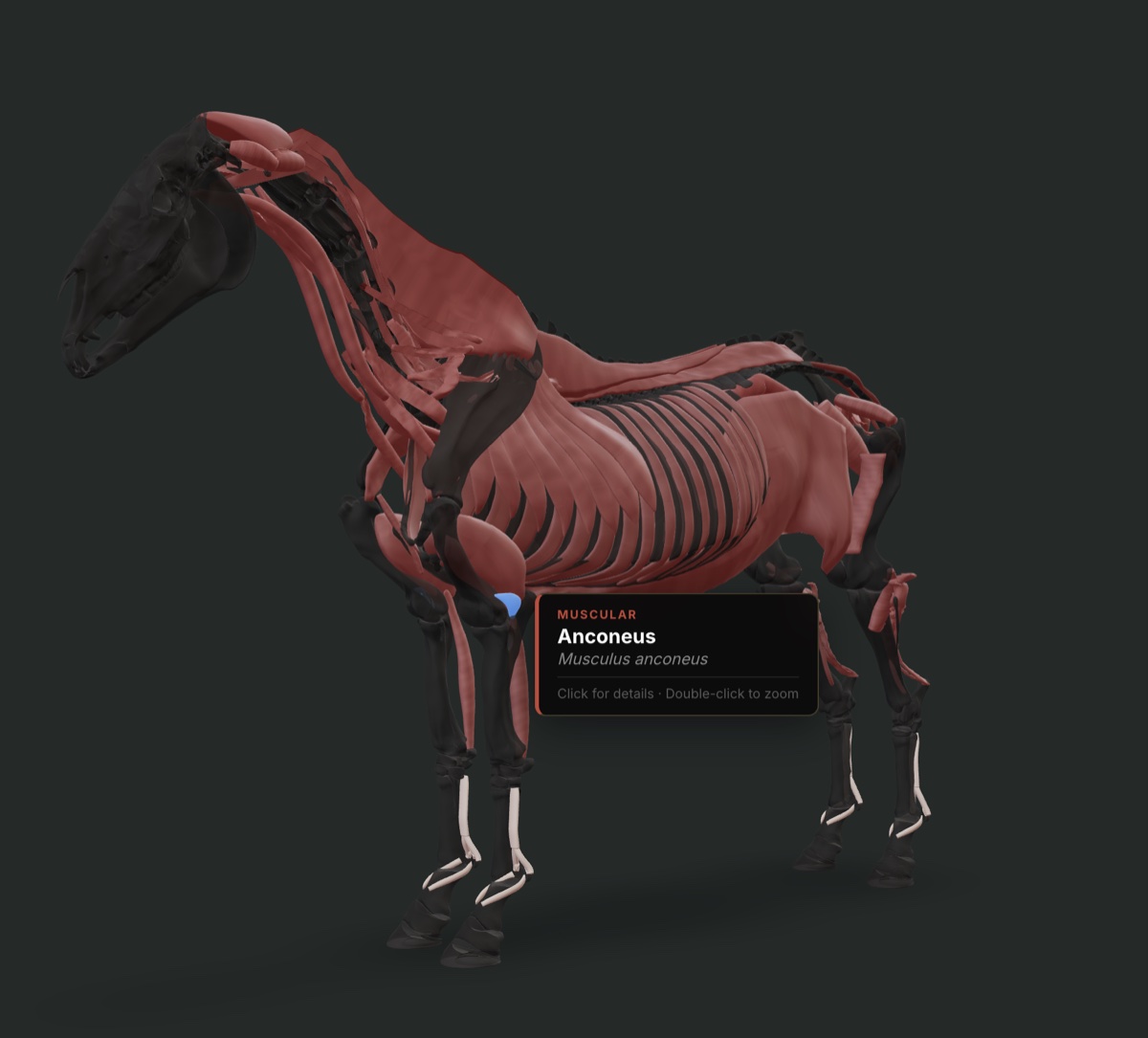
The anconeus (musculus anconeus) is a small, triangular muscle located on the caudal aspect of the elbow joint. It originates from the caudal border of the olecranon fossa and the lateral epicondyle region of the humerus and inserts on the lateral surface of the olecranon process of the ulna. In the horse it is not easily separated from the lateral head of the triceps brachii and is often considered a deep subdivision of that muscle. Its primary actions are to assist in extension of the elbow and, importantly, to tense and elevate the caudal joint capsule during extension, thereby preventing the capsule from being pinched between the olecranon and the humerus. Innervation is via the radial nerve (C7–T1). Blood supply comes from branches of the collateral ulnar and recurrent interosseous arteries. Because of its small size and intimate association with the triceps, isolated clinical problems are uncommon; however, it contributes to overall elbow stability and capsule health. In cases of elbow osteoarthritis, capsulitis, or olecranon bursitis the anconeus may become secondarily inflamed or fibrotic. Palpation is difficult because of overlying triceps mass; ultrasound can visualize the muscle and its relationship to the joint capsule. Functionally it works in concert with the triceps heads to produce powerful elbow extension during the propulsive phase of the stride. Any radial-nerve deficit that weakens the triceps will also affect the anconeus, contributing to the characteristic dropped-elbow posture.
Anatomical Details
Origin: Lateral epicondyle of the humerus
Insertion: Lateral surface of the olecranon
Action: Extends and stabilizes the elbow joint
Innervation: Radial nerve (C7-T1)
Clinical Significance
Rarely a primary source of lameness. May be involved in generalized elbow-joint capsule inflammation or in radial-nerve injuries that affect the entire triceps group. Diagnosis of elbow pathology relies on palpation, flexion tests, radiography, ultrasound, and occasionally arthroscopy or CT. Treatment addresses the underlying joint or nerve problem rather than the anconeus specifically.
Common Conditions & Injuries
Elbow joint stabilization issues
## Overview Elbow joint stabilization issues refer to minor instability or soft-tissue dysfunction around the elbow that may contribute to subtle forelimb lameness or a clicking sensation. True isola
What Horse Owners Should Know
Elbow problems usually show as swelling, heat, or reluctance to fully extend the leg. Because the anconeus is deep, owners cannot isolate it by feel; any persistent elbow lameness or swelling should be examined by a veterinarian.
Frequently Asked Questions
What is Elbow joint stabilization issues in horses?
## Overview Elbow joint stabilization issues refer to minor instability or soft-tissue dysfunction around the elbow that may contribute to subtle forelimb lameness or a clicking sensation. True isolated instability is uncommon; most elbow problems involve osteoarthritis, fracture, or collateral ligament injury. ## Causes Ligament strain, developmental variation, or secondary to other elbow pathology. ## Diagnosis Lameness examination, manipulation, radiographs, and ultrasound. Advanced imaging if needed. ## Treatment Rest, anti-inflammatories, and treatment of any concurrent joint disease. Significant instability is rare and managed case-by-case. ## Recovery and Prognosis Generally good for mild soft-tissue issues. ## Prevention Avoidance of trauma and balanced conditioning. Signs include: minor elbow instability; subtle forelimb lameness; clicking during flexion or extension
What are the clinical concerns for the Anconeus?
Rarely a primary source of lameness. May be involved in generalized elbow-joint capsule inflammation or in radial-nerve injuries that affect the entire triceps group. Diagnosis of elbow pathology relies on palpation, flexion tests, radiography, ultrasound, and occasionally arthroscopy or CT. Treatment addresses the underlying joint or nerve problem rather than the anconeus specifically.
What should horse owners know about the Anconeus?
Elbow problems usually show as swelling, heat, or reluctance to fully extend the leg. Because the anconeus is deep, owners cannot isolate it by feel; any persistent elbow lameness or swelling should be examined by a veterinarian.
Explore This Structure in 3D
See the Anconeus on our interactive 3D horse model. Open 3D Model