How to Assess a Horse's Legs Before You Buy |
You have driven three hours. The horse is exactly the color you wanted, he has kind eyes, and the seller is standing there watching you.
This is the worst possible mental state in which to evaluate a leg, and it is the state almost every buyer is in. Most of us decide with our hearts and then look for reasons.
So learn the legs before you go. Not so that you can play vet. So that you know what you are looking at, which lumps to walk away from, which ones do not matter, and which questions to make sure the vet answers before you write a check.
Quick Answer
Assessing a horse's legs before buying involves three things: looking at conformation from the side and the front, putting your hands on every structure from the knee and hock down, and watching the horse move. You are looking for conformation faults that predispose to injury (particularly back at the knee, sickle hocks, and post-legged hind limbs), and for heat, swelling, or old damage over specific structures. None of this replaces a veterinary pre-purchase exam. It tells you whether the horse is worth paying for one.
Why Conformation Matters: The Concussion Line
Every time a hoof hits the ground, force travels up the limb.
If the bones stack and articulate correctly, that force distributes evenly all the way up. Kylee Jo Duberstein, PhD, of the University of Georgia, describes it as a line of concussion running up the leg. When the bones line up, the whole limb shares the load. When they do not, one area of bone, joint, or soft tissue takes an excessive share of every single impact, for the horse's entire working life.
That is the whole theory of conformation, and it is why this matters more than aesthetics. A crooked leg is not ugly. A crooked leg is a structure where one part is doing more than its share, thousands of times a day.
Two caveats before we go further, and both come from the veterinarians who study this.
Perfect conformation is not a guarantee of soundness. Plenty of beautifully built horses break. Plenty of crooked ones work happily into their twenties.
Severity is everything. A mild deviation is usually manageable. The same deviation in a severe form is a different animal entirely. Do not treat these as pass or fail. Treat them as a question of degree, and of what you are asking the horse to do.
Looking at the Front Legs
From the side
Stand the horse up square on level ground and look at the line of the front leg.
Back at the knee (calf-kneed). The knee appears set back, so the leg has a slight backward bend to it, like the letter C in reverse. This is the one to take seriously. It puts extra strain on the flexor tendons running down the back of the cannon bone, and it exacerbates hyperextension of the knee, which is exactly what happens when a horse fatigues at speed. Duberstein specifically flags it as a fault to avoid in racehorses for this reason. If you are buying an athlete, a markedly calf-kneed horse is a real risk.
Over at the knee (bucked knees). The knee appears to bulge slightly forward. It looks alarming and it is usually the milder problem of the two. Unless it is severe, horses over at the knee generally perform perfectly well.
Pastern angle. The pastern is a shock absorber. Too upright and it stops absorbing, sending concussion straight up the limb into the joints. Too long and sloping and it puts extra strain on the flexor tendons and the suspensory apparatus. A pastern angle in the region of 45 degrees from the ground is commonly cited as ideal, though sources vary and the right answer shifts by discipline and by breed. What you are really looking for is that the pastern angle roughly matches the shoulder angle, and that neither pastern is dramatically different from its opposite.
From the front
Stand directly in front of the horse and drop an imaginary line from the point of the shoulder to the ground. Ideally it bisects the leg.
Toed-in (pigeon-toed) and toed-out. The toes turn in or out. The horse will swing the leg in an arc rather than moving it straight, which is called paddling or winging. Here is the surprise: mild toeing-in usually does not affect soundness. It is a very common finding and by itself it is not a reason to walk away. Toeing out is somewhat more concerning, because the swing brings the limb inward and the horse can strike his opposite leg.
Offset (bench) knees. The cannon bone is set to the outside of the knee rather than centered under it. This loads the inside of the limb unevenly and is associated with splints on the inside splint bone.
Looking at the Hind Legs
The hind legs are where money gets lost, because hind limb faults tend to be quieter and more expensive.
Sickle hocks. Too much angle in the hock, so the cannon bone slopes forward and the hind foot sits too far under the body. It strains the structures at the back of the hock, and it is strongly associated with curbs, which are a thickening of the ligament at the back of the hock that shows as a visible swelling.
Worth knowing: sickle hocks are actually desirable in some disciplines. A reining horse has to sit down and slide, and a Tennessee Walking Horse needs enormous hind-leg reach. Conformation is not universal. It is relative to the job.
Post-legged (over-straight hind leg). The opposite problem. Too little angle between femur and tibia, so the hind leg is nearly a vertical post. This one makes vets nervous. It concentrates strain on the hock and the stifle, it is associated with bog spavin and bone spavin, and it is implicated in suspensory problems and upward fixation of the patella.
Here is the important bit: a post-legged horse can trot up perfectly sound at the vetting and still worry a good vet. The concern is not what he is today. It is what the structure predicts about him in three years.
Cow hocks. Hocks turn inward, toes turn outward. Common, often mild, and generally the least alarming of the hind limb faults, though a severe version grinds the hock joints in a way they were not designed for.
Discipline changes the calculus. Jumpers, reiners, and cutting horses are prone to hock arthritis, which makes straight or sickle-hocked conformation a genuine liability for those jobs specifically.
Feeling the Legs: What Your Hands Should Tell You
Now stop looking and start touching. Both sides. Every leg. Take your time and do not let the seller rush you.
You are asking three questions at every point: is it hot, is it swollen, does it hurt?
Work down systematically:
- The knee and hock. Feel for effusion, which is fluid distension of the joint. A soft, squishy swelling on the front of the hock is a bog spavin.
- The tendon line. Run your fingers down the back of the cannon bone. It should be cool, tight, and the same on both legs. Any thickening, any heat, any bowing outward is significant.
- The suspensory ligament. Deeper, running down the back of the cannon underneath the flexor tendons. This is a structure that hides. Absence of swelling here means less than you would like.
- The splint bones. Down each side of the cannon bone. A hard bony lump is a splint. The critical question is whether it is hot. A cold, settled, hard splint is usually an old healed blemish. A warm, painful one is an active injury.
- The fetlock and sesamoids. Feel for heat and for filling. Soft puffiness just above the fetlock on either side of the tendons is a windpuff, and windpuffs are usually cosmetic.
- The pastern and coronary band. Feel for bony enlargement, which can indicate ringbone.
- The back of the hock. Feel for the thickening of a curb.
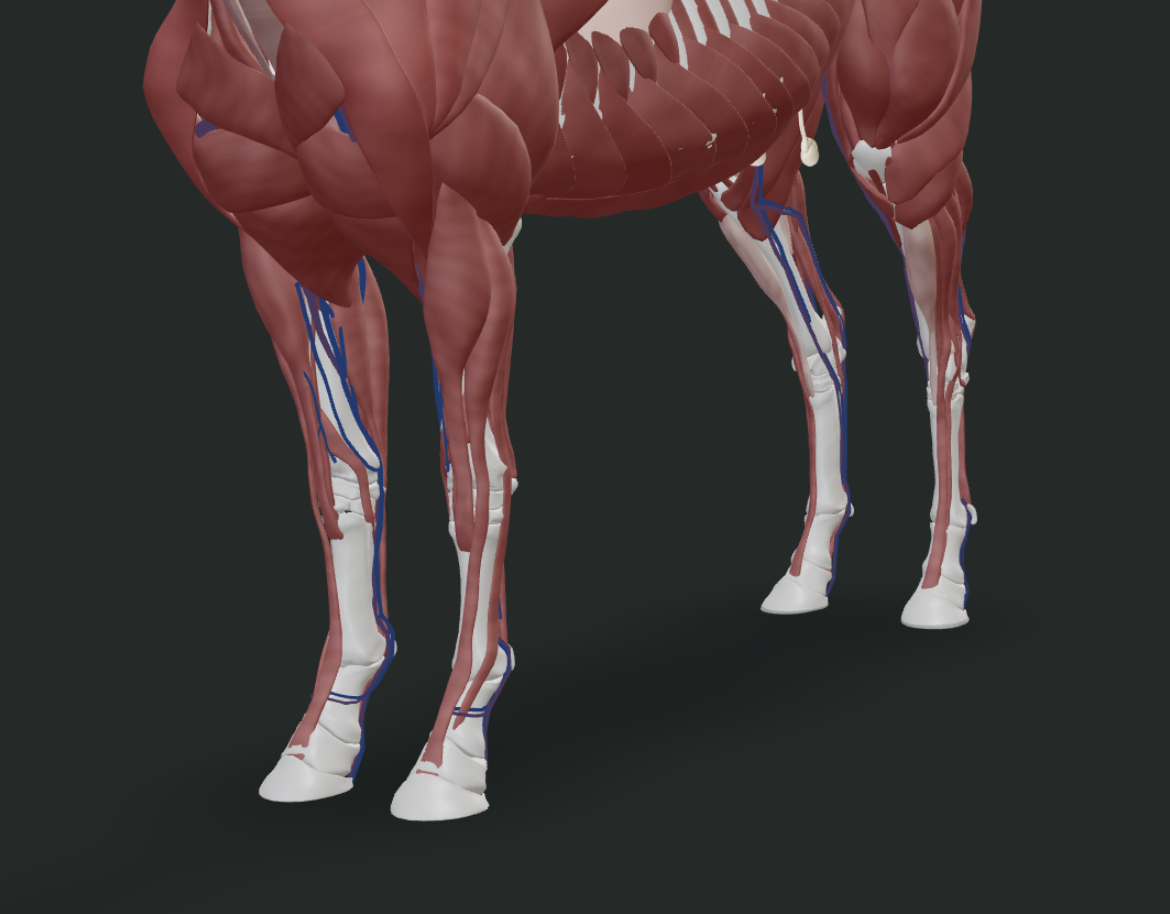
The reason to know your anatomy before you go is that every lump you feel sits over something specific. A hard lump halfway down the cannon on the inside means one thing. The same lump behind the tendon line means something completely different. If you cannot place what is underneath your fingers, you cannot interpret what you are feeling. It is worth twenty minutes in the 3D explorer with the skeletal layer on the lower limb before you go and look at a horse, so that when your hand finds something you know exactly what it is sitting on.
Blemish or Unsoundness?
This is the distinction that decides the purchase.
| Blemish | Unsoundness | |
|---|---|---|
| What it is | Cosmetic. Evidence of an old, healed event | An active problem, or a structure that will cause one |
| Heat | None | Often present |
| Pain on pressure | None | Often present |
| Affects the horse's way of going | No | Yes, now or in future |
| Examples | Cold set splint, old scar, windpuffs, small bony lump that has been there for years | Hot splint, active tendon thickening, joint effusion with lameness, significant conformation fault for the intended job |
An old cold splint on a horse who has been in work for five years and is sound is a blemish. Buyers walk away from these constantly and it is often a mistake.
A conformation fault, on the other hand, does not heal. It is a permanent feature of the machine, and it will be there for every stride you ever ask of the horse.
Watching Him Move
Have him trotted up in hand, on hard, level ground, away from you and back. Then in a circle on both reins.
You are not trying to diagnose lameness. You are watching for whether he is the same on both sides, whether he tracks straight, whether the head bobs, whether he swings a limb, and whether the hind legs come through evenly. The equine lameness guide covers how lameness actually presents and how a vet localizes it.
Watch him walk away from you at the end of the viewing, when everybody has relaxed and nobody is showing him off. That is often the most honest look you get.
The Pre-Purchase Exam Is Not Optional
Everything above tells you whether to spend money on a vetting. It does not replace the vetting.
Flexion tests, hoof testers, and radiographs find things that no amount of looking and feeling will ever find. A horse can pass everything your hands can do and have significant changes in a hock that only show up on an x-ray.
Two rules people break and regret:
Use your own vet, not the seller's. This should not need saying and it does.
Tell the vet what the horse is for. A conformation fault that is irrelevant for a trail horse can be a serious liability for a jumper. The vet is not answering "is this horse sound." The vet is answering "is this horse sound enough for what you intend to do with him," and they cannot answer that if you do not tell them the question.
And if you find something worrying and you are already in love, get a second opinion before you talk yourself into it. Everybody does it. Almost nobody admits it.
Frequently Asked Questions
What conformation faults should stop me buying a horse?
Severity and intended use matter more than the fault's name. That said, markedly back at the knee (calf-kneed) is a serious fault, because it strains the flexor tendons and worsens knee hyperextension. Severe sickle hocks and post-legged hind limbs both predispose to hock and stifle problems. Mild toeing-in, by contrast, is common and usually does not affect soundness.
Is a splint on a horse's leg a problem?
It depends entirely on whether it is active. A cold, hard, settled splint is an old healed injury and is generally a cosmetic blemish. A warm, painful splint is an active inflammatory process and needs veterinary attention. Location matters too, and a splint sitting close to the suspensory ligament or a joint is more concerning than one that is not.
Can a horse with bad conformation still be sound?
Yes. Many horses with conformation faults work soundly for their whole lives, and many horses with excellent conformation break down. Conformation shifts the odds. It does not determine the outcome. What it does reliably tell you is which structure is likely to take the excess load if a problem develops.
What is the difference between a blemish and an unsoundness?
A blemish is cosmetic evidence of an old, healed event. It is cool, painless, and does not affect the horse's way of going. An unsoundness is an active problem, or a structural feature that will predictably cause one. Old cold splints and windpuffs are commonly blemishes. Heat, pain, joint effusion with lameness, and significant conformation faults are not.
Do I still need a vet check if the legs look clean?
Yes. Radiographs and flexion tests routinely find changes that no hands-on examination can detect, particularly in the hocks and feet. A clean-legged horse can have significant radiographic changes. The purpose of your own assessment is to decide whether the horse is worth the cost of a vetting, not to replace it.
Are windpuffs a reason not to buy a horse?
Usually not. Windpuffs are soft fluid swellings above the fetlock around the flexor tendon sheath, they are cool and painless, and in most horses they are cosmetic and permanent, especially in older horses and horses in hard work. A windpuff that is hot or painful is a different matter and warrants examination.
Want to evaluate soundness like a professional?
Our Lameness course teaches limb assessment, red flags, and pre-purchase considerations.
Explore the Lameness CoursePro members only. Try Pro free for 7 days.