Best Horse Breeding Practices: Tips & Strategies

Healthy mating in horses rests on planning, veterinary care, ethical selection, and patient management before, during, and after breeding. The goal is not simply to produce a foal. It is to protect the mare, the stallion, and the future offspring while improving soundness, temperament, and suitability for purpose. Whether you manage one mare or a larger program, the best results come from responsible decisions made well before mating day.
What makes a horse breeding program healthy?
A healthy breeding program starts with a clear reason for breeding and a realistic view of the animals involved. Breeders should weigh conformation, fertility, behavior, genetic risks, performance suitability, and long-term care before pairing a mare and stallion. Good planning reduces avoidable problems and gives the foal a better chance of growing into a sound, useful, well-adjusted horse.
Healthy breeding is also a welfare commitment. The mare must be fit enough to carry a pregnancy, the stallion must be managed safely, and the breeder must be ready for foaling, veterinary support, nutrition, handling, and eventual placement of the foal.
A simple foundation includes:
- A clear breeding objective (sport, work, showing, endurance, leisure, or breed preservation)
- Veterinary assessment of reproductive health, body condition, vaccination status, and overall fitness
- Sound pairing decisions that avoid serious inherited defects, chronic unsoundness, or unsafe temperaments
- Safe handling facilities with secure areas, non-slip footing, strong fencing, and experienced people
- A foal-care plan covering pregnancy monitoring, foaling, early nutrition, parasite control, and socialization
These basics apply across breeds and regions. They are the core of the practical advice shared by veterinarians and experienced stud managers.
Responsible selection starts before mating
The first major decision is whether the mare and stallion should be bred at all. A beautiful horse is not automatically a good breeding candidate. Look beyond appearance to health history, temperament, movement, reproductive soundness, and whether the animal represents qualities worth passing on.
For mares, age, body condition, previous reproductive history, and general health matter. An underweight, chronically lame, poorly managed, or highly stressed mare faces higher risk during pregnancy and foaling. For stallions, semen quality, libido, manners, and physical soundness should be evaluated before any breeding use.
Temperament deserves special attention. A horse that is dangerously reactive, difficult to handle, or consistently aggressive creates management risks and can pass on traits that make the next generation harder to train. Responsible programs favor horses that are trainable, manageable, and suited to the environment where their offspring are likely to live.
When assessing physical structure, understanding common conformation faults helps breeders avoid pairing horses that share the same structural weaknesses — doubling down on problems that affect soundness for life.
Core health checks every breeder should plan
Veterinary involvement is one of the most important parts of sound breeding practice. A veterinarian can identify reproductive issues, advise on timing, and help prevent problems that are not obvious from the outside. This is especially useful for maiden mares, older mares, stallions new to breeding, or any horse with prior fertility concerns.
A practical pre-breeding checklist often includes:
- General physical exam covering heart, lungs, teeth, limbs, body condition, and overall fitness
- Reproductive examination for the mare (ultrasound when available) to evaluate the uterus and ovaries
- Breeding soundness evaluation for the stallion if fertility is unknown or inconsistent
- Vaccination and parasite-control review based on veterinary guidance and local disease risks
- Nutrition assessment so the mare is neither too thin nor carrying excess weight
- Hoof and dental care, because discomfort affects condition, movement, and stress
- Biosecurity precautions when horses travel, meet outside stallions, or enter shared facilities
These checks are not about complicating the process. They help avoid preventable disappointment and protect the animals. Skipping screening may save time short-term but often creates costly and distressing problems later.
How breeders choose the right mating method
The healthiest mating method is the one that protects both horses and is managed by skilled people. Natural cover may be appropriate in some settings. Artificial insemination can offer better control, reduced injury risk, or access to suitable stallions without transporting the mare. The choice depends on animal safety, fertility goals, facility quality, veterinary access, and handler experience.
In natural cover, careful introduction matters. Hand breeding, where handlers control both horses, is commonly preferred over loose pasture breeding in managed programs because it allows closer supervision. Pasture breeding reduces human interference but makes timing, injury prevention, and parentage control harder unless the setup is carefully managed.
Artificial insemination can reduce travel stress and allow more precise timing, but it requires veterinary support, correct semen handling, and solid knowledge of mare cycling. Best practices are defined by how safely and thoughtfully the chosen method is carried out, not by the method itself.
Timing, cycle tracking, and mare comfort
Good timing improves the chance of conception and reduces unnecessary repeated attempts. Mares are seasonal breeders; fertility is influenced by light, health, body condition, stress, and individual variation. Observing behavior can help, but veterinary monitoring is often more accurate than relying on signs alone.
Common heat signs include more frequent urination, a raised tail, relaxed posture near a stallion, and interest in breeding. Some mares show only subtle signs, and others are inconsistent. Ultrasound and professional reproductive management help identify the best breeding window and confirm ovulation.
Mare comfort should never be secondary. A frightened, sore, poorly restrained, or repeatedly bred mare can become stressed or injured. Calm handling, appropriate restraint, experienced staff, and avoiding excessive breeding attempts are part of responsible care.
Understanding reproductive anatomy makes cycle tracking far more meaningful. Our interactive 3D anatomy explorer lets you visualize the structures involved in equine reproduction and see how form connects to function.
Practical strategies for safer outcomes
Healthy breeding is easier when the program follows a repeatable system. Written records, consistent routines, and honest evaluation help breeders make better decisions year after year. Even small breeders benefit from documentation because memory is unreliable during a busy season.
Useful strategies include:
- Keep detailed records of heat cycles, veterinary findings, breeding dates, stallion used, pregnancy checks, medications, and foaling notes
- Match strengths and weaknesses so the pairing improves the next generation rather than doubling the same faults
- Limit overuse of any one horse so neither mare nor stallion is pushed beyond healthy management
- Plan for emergencies with veterinary contacts, transport options, clean bedding, and foaling supplies ready
- Review outcomes honestly; if a pairing produces poor conformation, weak temperament, or health concerns, do not repeat it without expert advice
These steps create a program that learns from experience instead of relying on luck.
Breed improvement without compromising welfare
Many breeders aim to improve stock over generations by selecting stronger stallions, retaining better fillies, or using proven lines. The challenge is to improve desired traits without ignoring health, genetic diversity, and long-term welfare.
Grade-up breeding (breeding mares of mixed or lower-grade background to higher-quality or registered stallions over successive generations) is one approach. When considering it, focus on soundness, fertility, temperament, and suitability rather than pedigree or popularity alone.
Sound grade-up decisions include:
- Choosing stallions that correct weaknesses instead of simply adding fashion
- Avoiding close inbreeding unless guided by expert genetic knowledge
- Evaluating each generation as an individual, not just as a step toward a label
- Keeping fillies only when they genuinely improve the program
- Prioritizing usable, healthy horses over exaggerated traits
Improvement should never produce foals with predictable health or management problems. A responsible breeder is willing to say no to a fashionable cross if it is not in the animals' best interest.
When breeding should be delayed
Sometimes the healthiest practice is to wait. A short pause for treatment, recovery, or better planning protects the mare, stallion, and future foal far better than forcing a breeding that is unlikely to succeed safely.
Delay or reconsider if:
- The mare is very thin, obese, ill, lame, or recovering from serious stress
- The stallion is difficult to handle safely or has unknown fertility
- There is a history of repeated pregnancy loss without veterinary investigation
- The horses may carry serious heritable problems
- Facilities are unsafe (slippery footing, weak fencing, or inexperienced handlers)
- The breeder is not prepared for pregnancy care, foaling, or raising the foal
This kind of caution is responsible management. Strong programs are built by people who know when to proceed and when to step back.
A simple framework for better breeding decisions
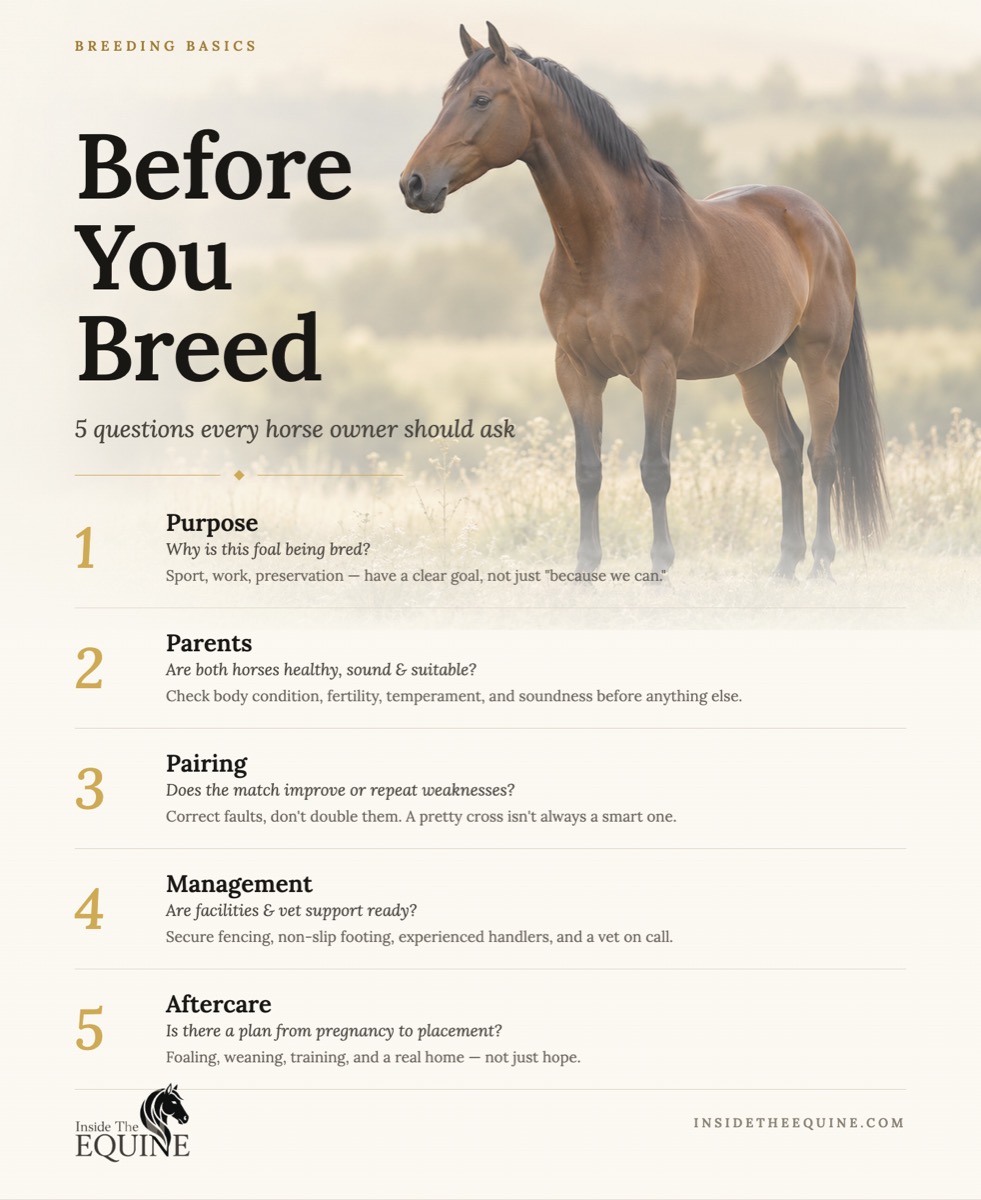
Before every mating, run through these questions:
- Purpose: Why is this foal being bred, and is there a real need for it?
- Parents: Are both horses healthy, sound, fertile, and suitable in temperament?
- Pairing: Does the match improve the likely outcome, or does it repeat weaknesses?
- Management: Are the facilities, handlers, and veterinary support adequate?
- Aftercare: Is there a plan for pregnancy, foaling, weaning, training, and long-term placement?
If any answer is weak, improve the plan before breeding. This framework turns responsible practice into everyday action and helps avoid decisions based only on convenience, emotion, or market trends.
Final takeaway
Healthy mating practices come from preparation, not guesswork. The most reliable breeding tips are simple but demanding: select sound parents, involve a veterinarian, manage timing carefully, protect the animals during mating, keep records, and plan for the foal's future. Breeding horses is a privilege that carries long-term responsibility. The best outcomes come when welfare and quality guide every decision.
Want to deepen your understanding of the structures that matter most in breeding selection? Explore our equine anatomy courses to build the knowledge that supports better decisions at every stage.
Frequently Asked Questions
When is the best time of year to breed a horse?
Mares are seasonal breeders and are most fertile in spring and summer when day length increases. Many breeders target early spring so foals are born early the following year, but the healthiest timing is the one that matches the mare's body condition, cycle quality, and the breeder's ability to support the pregnancy and foal.
Should every nice horse be bred?
No. A horse that is beautiful, talented, or popular is not automatically a good breeding candidate. Health, soundness, fertility, temperament, and the likelihood of producing a useful, manageable foal matter more than appearance or market demand.
Is artificial insemination safer than natural cover?
It can be, especially for reducing injury risk and travel stress, but only when handled by people with the right skills and veterinary support. Natural cover under experienced handlers in safe facilities can also be appropriate. The method matters less than the competence of the people managing it.
How important is temperament in breeding decisions?
Very important. Temperament has a heritable component, and a dangerously reactive or aggressive horse creates real management and training risks for the next generation. Responsible breeders treat stable, trainable temperament as a core selection criterion alongside soundness and fertility.
What should I do if a mare loses pregnancies repeatedly?
Stop breeding and involve a veterinarian for a full work-up. Repeated pregnancy loss can have infectious, anatomical, or other causes that need diagnosis and treatment before any further attempts. Continuing without investigation wastes time and increases risk to the mare.
Sources
- American Association of Equine Practitioners (AAEP). Guidelines on equine breeding soundness and reproductive management. aaep.org.
- Samper, J.C. (ed.). Equine Breeding Management and Artificial Insemination (2nd ed.). Saunders Elsevier.
- McCue, P.M. & Ferris, R.A. Practical guides to mare and stallion breeding soundness examination. Colorado State University Equine Reproduction Laboratory.
- Ginther, O.J. Ultrasonic imaging and animal reproduction. Widely used reference for equine reproductive physiology and cycle monitoring.
- British Equine Veterinary Association. Welfare and biosecurity in breeding operations. beva.org.uk.