How Many Bones Does a Horse Have?
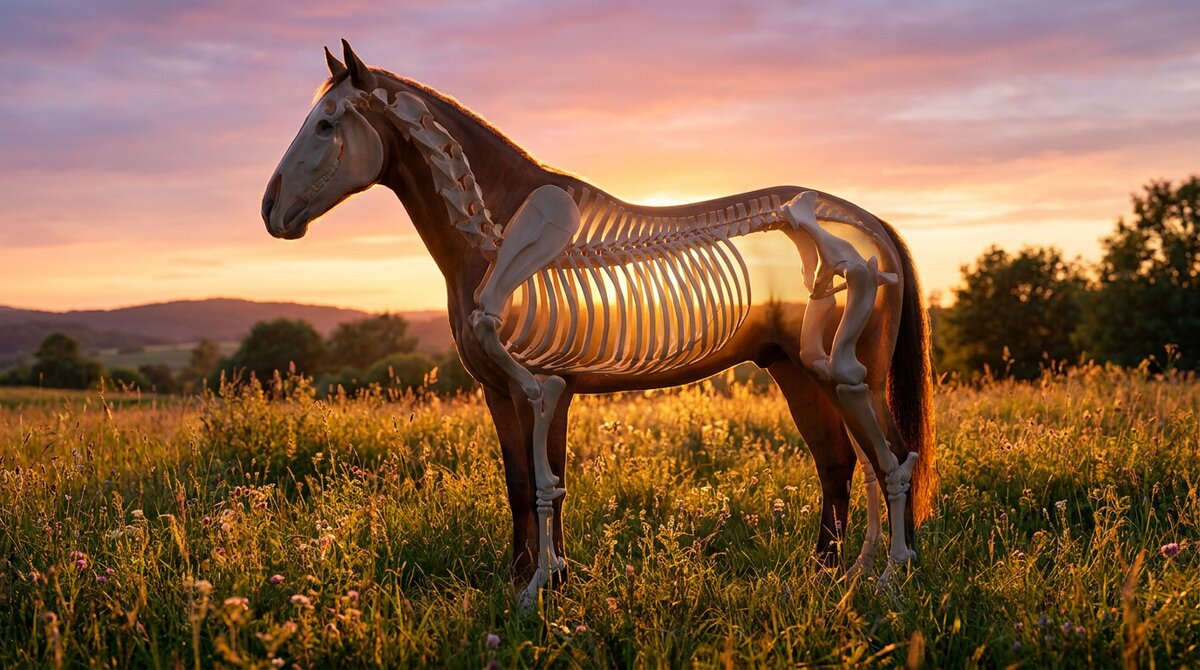
The Number, and Why It Moves
205 is the number you will find in almost every reference, and it is a perfectly good answer. A horse has about 205 bones.
But "about" is doing real work in that sentence, and the reasons are worth knowing, because they are more interesting than the number itself.
Breed variation. Some Arabians are famously built a little differently. They may carry 17 pairs of ribs instead of the usual 18, and have a shorter thoracic and lumbar spine, giving them their characteristic short back and high tail carriage. That alone changes the count.
Fusion with age. Bones that are separate in a foal fuse together in an adult. The sacrum, for instance, is five vertebrae that fuse into one solid bone. Count a young horse and an old horse the same way and you can get different totals, because bones have merged.
How you count. Even anatomists differ slightly on the exact tally for a single limb, depending on how they treat tiny fused elements. Sources you can trust land on slightly different numbers for the same horse.
So 205 is a reference point, not a law. That uncertainty is normal in biology, and a source that admits it is being more honest than one that gives you a confident exact figure.
Where the Bones Are
The skeleton splits into two parts.
The axial skeleton is the central column: the skull, the spine, the ribs, and the sternum. The appendicular skeleton is the limbs.
Roughly, the count breaks down across the skull, the vertebral column running from the neck through the tail, around 18 pairs of ribs, and the four limbs, which between them account for a large share of the total. Each limb contains roughly 20 bones, most of them concentrated down in the lower leg anatomy and the complex of small bones in the knee and hock.
You can click through every one of them, region by region, in the Inside The Equine 3D explorer with the skeletal layer on.
What a Horse Has That You Don't
No collarbone. This is the big one. A human has a clavicle bolting each arm to the trunk. A horse has nothing there. The entire front end, both forelimbs, is attached to the body only by muscle anatomy, tendon, and connective tissue, in a structure called the thoracic sling. The rib cage effectively hangs in a muscular hammock between the two shoulder blades. This is not a small detail; it is why a horse can absorb the shock of galloping, and why building the muscles of the sling matters so much for a riding horse.
A single toe per limb. The horse stands on the tip of one finger, or one toe. What looks like the lower leg is bones that in your hand would be the palm and a single finger. The reason horses have hooves instead of toes is a story of 55 million years of evolution, and the splint bones running down each side of the cannon are the leftover remnants of the toes the horse used to have.
Seven neck vertebrae, same as you. For all the difference in neck length, a horse has exactly seven cervical vertebrae, the same as a human and the same as a giraffe. The bones are just far bigger.
What a Horse Is Missing
Besides the collarbone, the horse has done away with a lot of the small bones that give other animals flexible feet and grasping hands. Where you have five fingers, the horse has functionally one, with the vestiges of two more as the splint bones. Evolution stripped the horse's limbs down to the lightest, fastest possible column of bone, because for a prey animal on open ground, speed is survival.
That stripping-down is the whole theme of the horse skeleton. It is a skeleton built for one thing above all: running away, efficiently, for a long time.
Why the Skeleton Is Shaped This Way
Every unusual feature of the count comes back to the same pressure. Long limbs made of few, light bones swing fast. A rib cage slung on muscle instead of bolted on with a collarbone absorbs concussion. A single toe per foot is the lightest possible foot. Grinding teeth that keep erupting outlast a lifetime of chewing grass.
The number 205 is trivia. The design behind it, a large animal reduced to the essentials of eating grass and outrunning danger, is the actually interesting thing, and it is easiest to appreciate when you can see the whole skeleton and turn it around. The complete horse anatomy reference puts the skeleton in the context of every other system.
A horse has approximately 205 bones. The exact number varies slightly between individual horses and breeds. Some Arabians have 17 pairs of ribs rather than 18, and bones fuse as a horse ages, so 205 is a standard reference figure rather than a fixed count.
Do horses have a collarbone? No. Horses have no clavicle. The forelimbs are attached to the body entirely by muscle, tendon, and connective tissue in a structure called the thoracic sling, rather than by bone. This lets the rib cage act as a shock absorber between the shoulder blades.
How many bones are in a horse's leg? Each limb contains roughly 20 bones, though sources differ slightly on the exact figure depending on how small fused bones are counted. Many of these are concentrated in the lower limb and in the complex of small bones that make up the knee and hock.
Do horses have more bones than humans? Yes. A human has about 206 bones and a horse has about 205, which sounds nearly identical, but they are distributed very differently. The horse has lost the collarbone and reduced each foot to essentially a single toe, while devoting many bones to a long spine, a large rib cage, and long limbs.
Why do horses have splint bones? The splint bones are the remnants of toes the horse's ancestors used to have. They are the reduced second and fourth foot bones, left over from when early horses had multiple toes. They now sit as small bones along each side of the cannon bone.
The Axial Skeleton: Skull to Tail
The axial skeleton runs from the tip of the skull to the last tail bone and forms the central framework of the horse. It includes the cranium, 7 cervical vertebrae, 18 thoracic vertebrae, 6 lumbar vertebrae, the sacrum (5 fused vertebrae), and 15 to 21 coccygeal vertebrae in the tail. Add in 18 pairs of ribs, the sternum with its 7 sternebrae, and the hyoid apparatus that supports the tongue and larynx.
The skull alone contains over 34 bones, though many fuse as the horse matures. Foals have more individual skull bones than adult horses because the sutures have not yet closed. This is actually important for birth, as slight skull compression helps the foal pass through the birth canal.
The Appendicular Skeleton: Built for Speed
The legs are where things get fascinating. The forelimb starts at the scapula (no collarbone in horses, which is a key difference from humans), continues through the humerus, radius and ulna, then into the carpus with its 6 to 8 small carpal bones. Below the carpus sits the cannon bone, two vestigial splint bones, the pastern bones (P1 and P2), and the coffin bone (P3).
The hindlimb includes the pelvis, femur, tibia, and fibula (vestigial in horses). The hock contains 6 tarsal bones that act as a shock-absorbing complex. Below that, the bone arrangement mirrors the forelimb with cannon bone, splints, pasterns, and coffin bone.
Each foot also contains the navicular bone (distal sesamoid) and two proximal sesamoid bones at the back of the fetlock. These sesamoids redirect tendon forces and are critical to the stay apparatus that lets horses lock their legs and sleep standing up.
Why Bone Count Matters for Soundness
Understanding your horse's skeletal anatomy is not just trivia. Knowing that the coffin joint sits inside the hoof anatomy capsule helps you understand why hoof balance affects everything above it. A long toe shifts stress onto the deep digital flexor tendon and the navicular apparatus. Correct hoof-pastern axis alignment distributes load evenly across joints and soft tissue.
The horse's skeleton is designed for straight-line speed, not lateral agility. That is why lateral work requires careful conditioning. The joints in the lower limb move primarily in a sagittal plane (forward and back). Asking for too much lateral movement before the supporting muscles are strong enough puts those joints at risk.
Bone density responds to progressive loading, a principle called Wolff's law. Young horses that are gradually introduced to work develop denser, stronger bones than those started too fast. This is why understanding leg anatomy matters for every training program.