Kissing Spines in Horses: Back Pain Signs Riders Miss
Kissing Spines in Horses: Back Pain Signs Riders Miss
You've tried three saddle fitters. Switched bits twice. Bought the expensive magnetic blanket. Your horse still pins his ears when you tighten the girth, hollows his back the moment you sit, and last Tuesday threw in a bronc move on the left lead canter that nearly put you in the arena dirt. Your trainer says he needs more leg. Your barn friends say he needs a chiropractor. Your gut says something is actually wrong.
Your gut might be right. Spinous process impingement is one of the most underdiagnosed sources of back pain in ridden horses, partly because the symptoms look exactly like what we call "attitude" and partly because we've spent decades blaming the horse before investigating the spine.
The Anatomy You Need to Understand
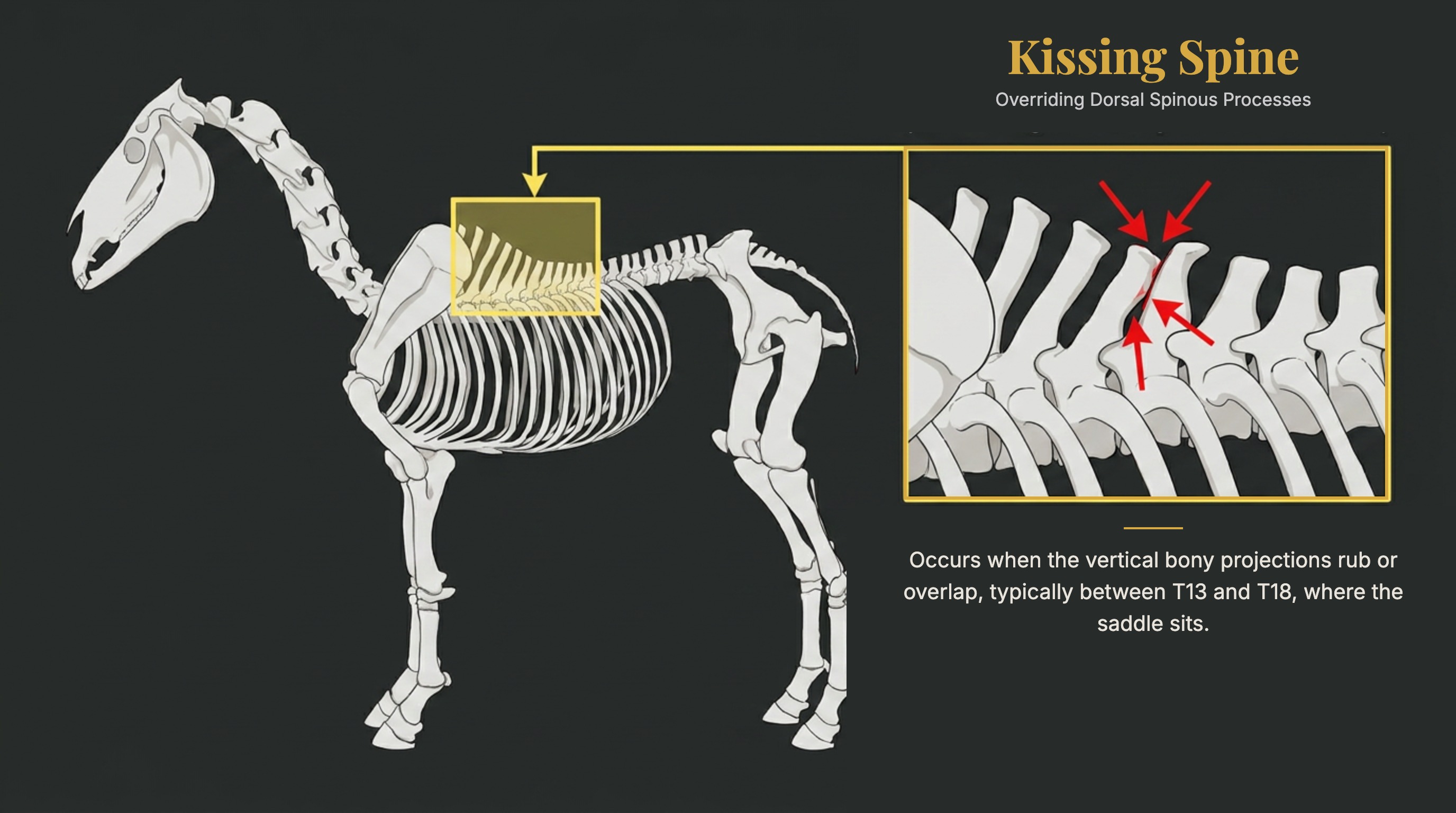
Every thoracic vertebra has a dorsal spinous process: a bony fin that projects upward from the top of the vertebral body. In the horse, there are 18 thoracic vertebrae, and these spinous processes are what create the "topline" you can feel under the saddle area. The tallest ones sit around T3-T5 (the withers), and they gradually shorten as you move toward the lumbar spine.
Normally, there's a gap between adjacent spinous processes filled with the interspinous ligament. In overriding dorsal spinous processes (ORDSP), that gap narrows or disappears entirely. The processes touch (impingement), overlap, or develop bony remodeling at their tips where they grind against each other. The most commonly affected region is T13-T18, which sits directly under where most saddles sit and where the rider's weight concentrates.
The thoracic vertebrae form the structural backbone of the horse's weight-carrying capacity. The supraspinous ligament runs along the tips of the spinous processes like a cable on a suspension bridge. When impinging spinous processes develop, this ligament often becomes inflamed too, compounding the pain. You can view the dorsal spinous processes and thoracic vertebrae in our 3D explorer to see how closely these structures sit under the saddle area.
How Common Is It, Really?
More common than most people think. A widely cited 2018 study by Zimmerman et al. found radiographic evidence of kissing spines in approximately 39% of horses examined, including horses with no reported clinical signs. That number shook a lot of people. Nearly four in ten horses have some degree of spinous process crowding on X-ray.
But the critical point: radiographic impinging spinous processes does not automatically mean clinical pain from spinous process impingement. Plenty of horses have touching spinous processes and perform at high levels without any apparent pain. The challenge is determining which horses have incidental findings and which are genuinely hurting. This is where the clinical picture, the ridden behavior, the response to palpation, and diagnostic blocks become more important than the X-ray alone.
Thoroughbreds and warmbloods appear overrepresented, though that may partly reflect referral bias (these horses tend to be in demanding work where subtle performance issues get investigated). Short-backed horses with close-coupled conformation may be predisposed simply because their spinous processes have less room.
The Signs Riders Misread
This is the section that might change how you look at your horse. Thoracolumbar impingement pain rarely presents as obvious lameness. It presents as behavior.
Cold-backed behavior. The horse dips, flinches, or tries to walk out from under you when you mount. He's stiff and hollow for the first 10-15 minutes of work, then gradually loosens up (or doesn't). Many riders accept this as "he just needs to warm up." Some horses do need a warm-up. But a horse that consistently reacts to the rider's weight with evasion is telling you his back hurts.
Bucking at the canter. Not the playful kick-up on a cold morning. A repeated, specific buck during upward transitions to canter, especially on one lead. The canter requires significant engagement of the thoracolumbar musculature, and if the spine hurts, the horse's most effective strategy is to get the rider off.
Won't go forward. You apply leg, and instead of a willing response, you get ear-pinning, tail-swishing, or a sluggish, behind-the-leg feeling that no amount of "ride more forward" fixes. This is the horse that gets labeled lazy or stubborn. He might be neither. He might be protecting his back.
Girthiness. Sensitivity to girth tightening can have multiple causes (ulcers, rib pain, skin sensitivity), but chronic girthiness in combination with ridden performance issues is a red flag for back pain. The girth sits near T14-T16, right in the thoracolumbar impingement danger zone.
Resistance to collection and lateral work. Collection asks the horse to round through the back, lifting the thoracolumbar spine. If that lifting motion causes the spinous processes to crowd together more, the horse braces against the contact instead. What the rider feels is a horse that won't come "through" or "connect." What the horse feels is pain.
Cross-cantering, difficulty with lead changes, refusing or stopping at fences. All of these require explosive use of the back musculature. A horse with spinous process impingement may perform these movements inconsistently, fine one day and terrible the next, or deteriorate progressively as the condition worsens.
The pattern that should trigger a vet call: multiple behavioral issues from this list that appeared gradually, haven't responded to training changes, and seem worst under saddle. If the same horse is perfectly pleasant on the longe line without a rider (no weight compressing the spine), that asymmetry is clinically significant.
| Sign | What Riders Often Think | What It May Actually Mean |
|---|---|---|
| Cold-backed when saddling | "He's always been like that" | Pain response to pressure on affected vertebrae |
| Reluctance to bend | Training / attitude issue | Spinous processes impinging during lateral flexion |
| Bucking under saddle | Fresh / naughty behavior | Pain from rider weight compressing affected area |
| Hollow back during work | Needs more training | Horse protecting painful area by avoiding engagement |
| Poor topline despite work | Needs more protein / conditioning | Can't build muscle over painful structures |
Getting a Diagnosis
A thorough back examination starts with observation and palpation. Your vet will run their hand along the horse's back, pressing on the spinous processes and the longissimus dorsi muscles on either side. A horse with ORDSP pain will often flinch, dip, or try to move away from pressure over the affected area. Some react dramatically; others are more stoic.
Radiographs are the primary diagnostic tool. Standing lateral films of the thoracolumbar spine show the spinous processes clearly and reveal impingement, bony remodeling, and sclerosis (increased bone density at contact points). Your vet will typically image T10-L2, the region most commonly affected.
But remember: abnormal X-rays alone don't close the case. To confirm that radiographic kissing spines are the source of the horse's clinical signs, many vets will perform interspinous local analgesia, injecting local anesthetic between the affected spinous processes. If the horse's ridden behavior improves significantly under saddle after the block, the diagnosis is confirmed. This step is important because it separates "your horse has touching spinous processes" from "your horse's spinous processes are causing the problem."
Ultrasound can evaluate the interspinous ligaments and identify inflammation. Nuclear scintigraphy (bone scan) highlights areas of active bone remodeling and can identify affected regions before radiographic changes become obvious.
Treatment Options: From Conservative to Surgical
Conservative Management
The first-line approach for mild to moderate cases focuses on building the muscles that support the spine, reducing inflammation, and modifying the horse's work.
Targeted exercise is the cornerstone. The goal is to strengthen the multifidus, longissimus dorsi, and the core abdominal muscles that act as a "sling" supporting the spine from below. When these muscles are strong, they lift and stabilize the thoracolumbar spine, creating more space between the spinous processes. Specific exercises include:
- Carrot stretches (baited stretches) to lateral flexion and ventral flexion, 5 repetitions each direction, held for 5 seconds, daily
- Ground poles and cavaletti work at walk and trot to encourage back lift and engagement
- Hill work at walk, which engages the hindquarters and lifts the back without the compressive load of collection
- Long-and-low ridden work, encouraging the horse to stretch over the topline rather than working in a shortened, hollow frame
Research by Stubbs, Hodges, Jeffcott, and colleagues demonstrated that a 3-month program of dynamic mobilization exercises (carrot stretches) measurably increased the cross-sectional area of the multifidus muscle. The equine muscle anatomy guide covers how these muscle groups interact during movement, and understanding how the walk works biomechanically can help you visualize what "working over the back" actually means in practice.
Saddle fit matters enormously. A saddle that bridges (doesn't make contact in the middle of the back) concentrates pressure on the withers and the cantle area. A saddle that's too narrow pinches the spinous processes. Get a qualified saddle fitter who uses pressure-mapping technology, not just eye and feel. For a kissing spines horse, this is not a luxury.
Adjunct therapies including therapeutic ultrasound, laser therapy, chiropractic adjustment (properly credentialed equine chiropractor), and acupuncture may provide pain relief and improved mobility for some horses. Evidence varies, but many owners report meaningful improvement, particularly when combined with a structured exercise program.
Corticosteroid Injections
For horses that aren't responding to conservative management alone, interspinous corticosteroid injections can provide significant relief. Your vet injects corticosteroid (commonly triamcinolone or methylprednisolone) directly into the interspinous spaces under ultrasound guidance. Relief typically lasts 2-6 months and allows the horse to work more comfortably, which in turn lets the exercise program build muscle more effectively.
Some horses need repeat injections every 6-12 months. Others improve enough with one round that the exercise program takes over. The injections are not a standalone cure; they're a window of reduced pain that enables rehabilitation.
Mesotherapy
Mesotherapy involves multiple intradermal injections of a medication cocktail (typically a local anesthetic, corticosteroid, and sometimes a muscle relaxant) along the back. It targets pain at the skin and superficial tissue level. Some horses show dramatic improvement; others are non-responders. It's most effective for the muscular component of back pain rather than the bony impingement itself.
Surgery
When conservative management fails, two surgical options exist:
Interspinous Ligament Desmotomy (ISLD) involves cutting the interspinous ligaments between affected processes. This is performed standing, under sedation and local anesthesia, through small incisions. Recovery time is typically 2-3 months before returning to ridden work, with a progressive rehabilitation program. Published success rates range from 60-75% return to previous level of work.
Subtotal ostectomy involves removing portions of the impinging spinous processes. This is a more invasive procedure, performed under general anesthesia, with a longer recovery (4-6 months). Success rates in the literature range from 70-85%, with some studies reporting even higher. It's generally reserved for cases with severe impingement, significant bony remodeling, or failure of ISLD.
Both surgeries require committed post-operative rehabilitation. The surgery creates space, but the rehabilitation builds the muscular support that prevents recurrence. Skipping the rehab phase is the most common reason for disappointing surgical outcomes.
Kissing Spines Treatment Options Compared
| Treatment | Approach | Success Rate | Cost Range |
|---|---|---|---|
| Rehab + Exercise | Core strengthening, dynamic mobilization, saddle fit | Effective for mild to moderate cases | $500-$2,000 (diagnostics + training) |
| Interspinous Injections | Corticosteroid between affected processes | Temporary relief, 2-6 months | $300-$800/session |
| ISLD (Standing Surgery) | Cut interspinous ligaments | 60-75% return to previous work | $2,000-$4,000 |
| Subtotal Ostectomy | Remove portions of impinging processes | 70-85% return to previous work | $5,000-$10,000+ |
The Rider's Role in Recovery
Whether your horse's kissing spines is managed conservatively or surgically, the rider's approach to training shapes the outcome more than any single treatment.
Stop asking the horse to work in a frame that compresses the back. Stop drilling collection. Stop ignoring the flinch when you mount. Start riding forward and down, encouraging topline stretch. Start incorporating pole work, hill work, and varied terrain. Start thinking of every ride as physical therapy, not performance training.
The horses that improve the most are the ones whose riders fundamentally change how they ride. That's not a criticism. It's a reality. The horse was hurting in a certain way of going. Returning to that way of going will recreate the problem.
Read about kissing spines as a clinical condition on our conditions page for additional reference.
When to Suspect Kissing Spines vs. Other Back Pain
Not all back pain is kissing spines. Sacroiliac dysfunction, thoracolumbar muscle strain, rib fractures, gastric ulcers (which cause back sensitivity through referred pain), ovarian pain in mares, and poorly fitting saddles can all produce overlapping symptoms. Your vet's job is to differentiate, and that usually requires a systematic workup rather than jumping straight to "it's kissing spines" based on behavior alone.
A good rule of thumb: if your horse has persistent performance or behavioral issues that are worst under saddle, start with a thorough veterinary evaluation that includes back palpation and, if indicated, diagnostic imaging. Don't self-diagnose. Don't let anyone tell you your horse "just needs more training" without ruling out pain first.
Frequently Asked Questions
Can you still ride a horse with kissing spines?
Many horses with kissing spines continue in comfortable ridden work with appropriate management. Conservative treatment (exercise rehab, injections, saddle fit optimization) keeps many horses working at moderate levels. Some return to competition. The key is adapting the work to what the horse can do comfortably and maintaining the muscular support that stabilizes the spine. Your vet should guide return-to-work decisions.
Is kissing spines progressive?
It can be, but it's not inevitable. In horses that continue working in a hollow, braced frame with poor muscular support, the impingement and associated bony changes may worsen over time. However, horses managed with appropriate exercise that builds core and topline strength can stabilize or even improve clinically, even if the radiographic appearance doesn't change dramatically.
Does kissing spines affect certain breeds more than others?
Thoroughbreds, warmbloods, and dressage-type horses appear overrepresented in the literature, but this likely reflects both conformational predisposition (taller spinous processes, shorter backs) and referral bias (these breeds tend to be in performance careers where subtle issues get investigated). Kissing spines has been documented in virtually every breed, including Quarter Horses and ponies.
How much does kissing spines treatment cost?
Diagnostic workup (exam, radiographs, possible ultrasound or bone scan) typically runs $500-$1,500. Interspinous corticosteroid injections cost $300-$800 per session. Mesotherapy runs $200-$500. ISLD surgery is approximately $2,000-$4,000. Subtotal ostectomy under general anesthesia at a referral hospital may cost $5,000-$10,000+. Ongoing rehabilitation (targeted exercise program, saddle fit adjustments, periodic veterinary reassessment) adds ongoing costs but is essential to long-term success.
Can kissing spines be prevented?
Not entirely, since conformation plays a significant role. However, you can reduce risk by maintaining strong core and topline musculature through proper training that emphasizes working over the back, ensuring excellent saddle fit, building fitness gradually rather than pushing young or unfit horses into demanding work, and incorporating regular cross-training that engages the back muscles in varied ways (hacking, hills, ground poles, varied terrain).
My horse was diagnosed on X-ray but seems fine. Should I treat?
If your horse is performing well, moving comfortably, and showing no behavioral signs of back pain, radiographic kissing spines alone may not require treatment. Discuss monitoring with your vet. Many horses live and work comfortably with radiographic changes that never become clinically significant. Treatment targets pain, not pictures.
Sources
- Zimmerman, M., Dyson, S., & Murray, R. (2012). Close, impinging and overriding spinous processes in the thoracolumbar spine: the relationship between radiological and scintigraphic findings and clinical signs. Equine Veterinary Journal, 44(2), 178-184.
- Coomer, R.P.C., McKane, S.A., Smith, N., & Henson, F.M.D. (2012). A controlled study evaluating a novel surgical treatment for kissing spines in standing sedated horses. Veterinary Surgery, 41(7), 890-897.
- Clayton, H.M., Stubbs, N.C., Lavagnino, M., & Kaiser, L.J. (2012). Swing phase kinematic and kinetic response to weighting the hind pasterns. Equine Veterinary Journal, 44(S43), 6-14.
- Stubbs, N.C., Kaiser, L.J., Hauptman, J., & Clayton, H.M. (2011). Dynamic mobilisation exercises increase cross-sectional area of multifidus. Equine Veterinary Journal, 43(5), 522-529.
- Walmsley, J.P., Pettersson, H., Winberg, F., & McEvoy, F. (2002). Impingement of the dorsal spinous processes in 215 horses: case selection, surgical technique, and results. Equine Veterinary Journal, 34(1), 23-28.
- Turner, T.A. (2011). Overriding spinous processes (kissing spines) in horses: diagnosis, treatment, and outcome. Proceedings of the AAEP, 57, 423-430.
- Merck Veterinary Manual: Vertebral and Spinal Cord Disorders in Horses. Available at merckvetmanual.com.
Ready to connect back pain to performance issues?
Our Lameness course covers spinal conditions, diagnosis, and treatment options.
Start the Lameness CoursePro members only. Try Pro free for 7 days.