Lateral Work for Beginners: Leg Yields, Shoulder-In, and Why They Transform Your Horse
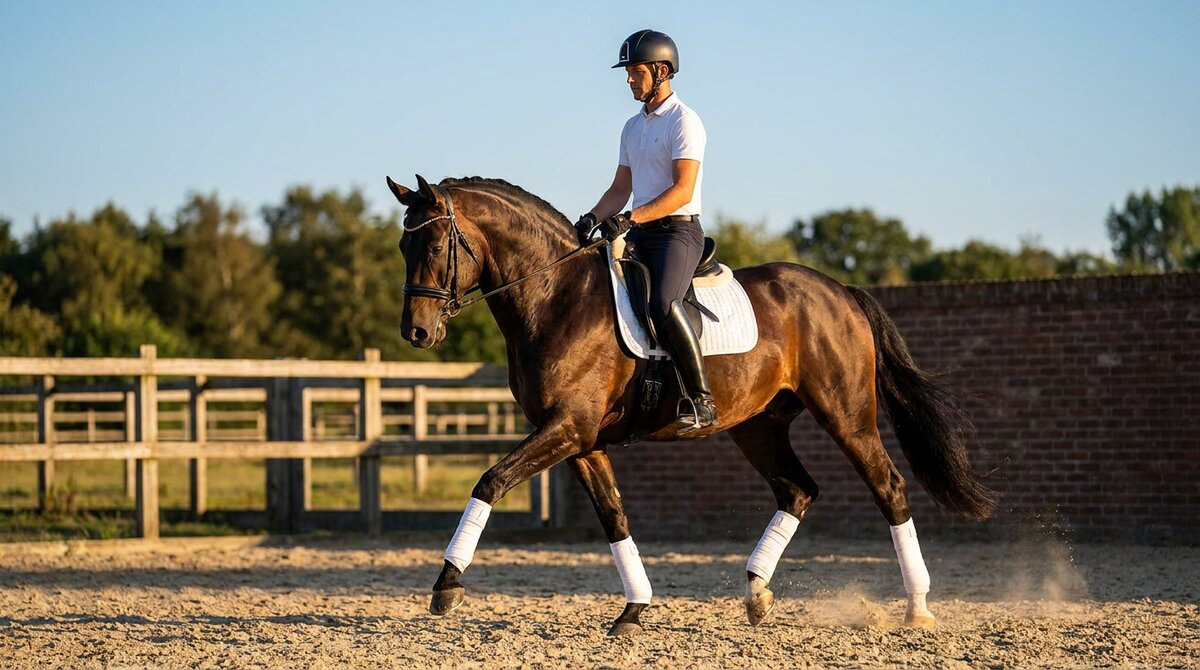
Your horse travels in straight lines like a bus. You nudge with your inside leg and nothing happens except maybe an ear flick that says "yeah, I heard you, not interested." Sound familiar? Lateral work fixes this. It is the single most effective toolbox for building responsiveness, balance, and genuine throughness, and you do not need to be a dressage rider to benefit from it.
What Counts as Lateral Work?
Any movement where the horse's hind feet do not follow the same track as the front feet qualifies. The horse bends, or stays straight, while traveling at an angle to the direction of movement. The FEI recognizes four primary lateral movements at the collected gaits: shoulder-in, travers (haunches-in), renvers (haunches-out), and half-pass. The leg yield, while technically not a classical lateral movement because it lacks bend toward the direction of travel, is universally used as the introduction to sideways work.
Every single one of these movements builds something different. Some develop engagement. Some improve suppleness. All of them force the horse to actually listen to your seat and legs instead of just barreling forward on autopilot.
The Leg Yield: Your Starting Point
What It Looks Like
The horse moves forward and sideways simultaneously while remaining nearly straight through the body, with only a slight flexion at the poll away from the direction of travel. The inside legs cross in front of the outside legs. Think of it as the horse stepping diagonally across the arena while looking slightly away from where it is going.
How to Ride It
Start at the walk. Seriously, do not skip the walk. Ride down the quarter line. Apply your inside leg at the girth with a clear sideways-pushing pressure. Your outside leg stays quietly behind the girth to prevent the haunches from leading. Maintain a slight inside flexion, just enough to see the corner of the horse's inside eye. Your outside rein catches the forward energy and guides the direction.
The biggest mistake beginners make: pulling the inside rein. Your inside rein creates flexion. That is all. The moment you pull it across the neck, the horse's outside shoulder escapes and the movement falls apart. Let your leg do the talking. If the horse does not respond, sharpen the ask with a tap from a whip behind your inside leg rather than hauling on the rein.
Aim for 3 to 5 steps of leg yield initially. Then ride straight. Then try again. Building endurance in the movement comes after the horse understands the concept. Attempting 20 meters of continuous leg yield on day one produces tension and resistance, not learning.
Common Problems
Haunches leading: The horse swings its hindquarters sideways faster than the shoulders. Fix this by using more outside leg and less inside leg. The shoulders should arrive at the rail slightly before or simultaneously with the haunches.
Loss of forward momentum: Sideways replaces forward. You need both. If the horse stalls, ride straight ahead for several strides, re-establish energy, then ask again.
Tilting the head: The horse tips its nose sideways but does not actually step over. This usually means too much hand, not enough leg. Release the inside rein slightly and increase your leg pressure.
Quick Reference Table
| Exercise | Angle | Bend | Tracks | Primary Benefit | Difficulty |
|---|---|---|---|---|---|
| Leg Yield | Variable | Slight flexion away from travel | 2-4 | Lateral responsiveness to leg | Beginner |
| Shoulder-In | 30 degrees | Uniform bend toward inside | 3 | Engagement, straightness, collection | Intermediate |
| Haunches-In (Travers) | 30 degrees | Bend toward direction of travel | 3-4 | Hind leg engagement, collection prep | Intermediate |
| Renvers (Haunches-Out) | 30 degrees | Bend toward direction of travel | 3-4 | Suppleness, confirm haunches-in | Intermediate-Advanced |
| Half-Pass | 30-45 degrees | Bend toward direction of travel | 4 | Collection, expression, balance | Advanced |
Shoulder-In: The Mother of All Lateral Movements
The French riding master Francois Robichon de la Gueriniere called shoulder-in "the first and last lesson" for the horse. He was not being dramatic. This single exercise, when ridden correctly, develops engagement, straightness, balance, and collection basics. It has been the cornerstone of classical training since the 18th century.
What It Looks Like
The horse travels along the rail with its forehand brought slightly to the inside, creating a 30-degree angle to the wall. The horse bends uniformly from poll to tail around the rider's inside leg. When viewed from the front, you see three tracks: the outside hind leg on one track, the inside hind and outside fore sharing a track, and the inside fore on a third track. Some schools teach a four-track shoulder-in at a steeper angle, but three tracks is the FEI standard and where beginners should start.
How to Ride It
Establish a good corner. As you come out of the corner, maintain the bend you already have. Instead of letting the horse straighten onto the long side, keep the shoulders on the track they were following through the turn. Your inside leg at the girth maintains the bend and drives the horse forward. Your outside leg behind the girth prevents the haunches from swinging out. The inside rein suggests flexion. The outside rein controls the degree of angle and the speed.
Here is the part nobody tells you: the outside rein is the most important aid in shoulder-in. Without it, you just have a horse falling in on a circle. The outside rein limits how far the shoulders come in, maintains tempo, and half-halts the horse into balance. If you can only feel one rein working, make sure it is the outside one.
Walk first. Always walk first. When the horse can maintain shoulder-in at the walk for 10 to 15 meters without losing angle, bend, or rhythm, introduce it at the trot. The sitting trot is preferable because it gives you more precise control of your seat and weight aids.
Why Shoulder-In Works
The inside hind leg has to step further under the body. Physics demands it. That increased engagement lifts the forehand, lightens the shoulders, and develops the carrying power of the hindquarters. Over weeks and months, this transforms the horse's natural balance from heavy-on-the-forehand to something approaching self-carriage.
Straightness improves because most horses naturally carry their shoulders slightly to one side. Shoulder-in teaches both horse and rider to control exactly where the shoulders go. A horse that can perform shoulder-in on both reins can be genuinely straightened, which is why it appears at Second Level in USDF tests.
Haunches-In (Travers): Turning Up the Heat
What It Looks Like
The inverse of shoulder-in. The shoulders stay on the track while the haunches come to the inside. The horse bends in the direction of travel, which is the key difference from leg yield. Four tracks are visible from the front: each leg occupies its own track at the standard angle of about 35 degrees.
How to Ride It
This one is easier to initiate than shoulder-in for most horses, which is exactly why it is more dangerous for beginners. Horses figure out they can just swing their hips in and avoid genuine engagement. Ride it from a 10-meter circle. As you return to the rail, maintain the bend and ask the haunches to stay on the inner track while the shoulders follow the wall. Inside leg at the girth for bend. Outside leg behind the girth actively pushes the haunches in. Both reins maintain the flexion and control tempo.
Only introduce haunches-in after your horse has a confirmed shoulder-in. The muscular demands are greater, and without the foundation of shoulder-in, most horses compensate by twisting through the ribcage instead of bending correctly.
Putting It All Together: A Sample Lateral Work Session
Warm up for 10 to 15 minutes with forward, rhythmic work on circles and straight lines. Then try this sequence at the walk:
Leg yield from the quarter line to the rail, both directions (3 repetitions each way)
Shoulder-in on the long side, 10 to 15 meters, straighten, then proceed on a 20-meter circle (both reins)
Transition to trot. Repeat shoulder-in at the trot for shorter segments, 8 to 10 meters
If your horse is ready: haunches-in at the walk on the long side, 8 to 10 meters (both reins)
Finish with free walk on a long rein to let the horse stretch and process
Total lateral work time: 15 to 20 minutes. That is plenty. These exercises are mentally and physically demanding. Overdoing them creates a sour, resistant horse who associates sideways work with exhaustion.
When Lateral Work Goes Wrong
Tension is the enemy. If your horse pins its ears, swishes its tail repeatedly, or grinds its teeth during lateral work, something is off. Either the exercise is too difficult for the horse's current level of fitness and understanding, or the rider's aids are confusing or too strong.
Back up a step. Literally. Return to the previous movement the horse could do well and rebuild from there. A confirmed, relaxed leg yield is worth infinitely more than a tense, crooked shoulder-in. Quality always beats ambition in training.
Physical issues also cause lateral work problems. A horse with hock soreness will resist haunches-in. One with back pain may refuse to bend through the ribcage. If you hit a wall that better riding cannot fix, call your vet before blaming the horse's attitude.
Frequently Asked Questions
At what level should I start lateral work?
Once your horse responds to basic leg aids, moves forward from light pressure, and can maintain a steady rhythm at walk and trot, you are ready for leg yields. Most horses can begin simple leg yields within their first year of training. Shoulder-in typically comes 6 to 12 months later.
Can Western riders benefit from lateral work?
Hugely. Ranch riding, reining, and trail classes all reward horses that can move their shoulders and haunches independently. The terminology differs, but the biomechanics are identical. A leg yield is a leg yield regardless of what saddle you are sitting in.
How often should I practice lateral work?
Two to three sessions per week is ideal for developing horses. Each session needs only 15 to 20 minutes of actual lateral exercises. Doing it every day risks mental and physical burnout, especially in horses under age 6 whose bodies are still developing.
My horse bends its neck but not its body. What am I doing wrong?
You are using too much inside rein and not enough inside leg. The bend must come from the leg, wrapping the horse around it like bending a garden hose. If you see more than a slight glimpse of the inside eye, you have too much neck bend. Straighten the neck, apply more inside leg, and let the bend develop through the ribcage.
📝 Explore more in our Courses. Check it out here.
Sources
- De la Gueriniere, F.R. "Ecole de Cavalerie." 1733. Translated by Tracy Boucher, 2012.
- German National Equestrian Federation. "The Principles of Riding." Kenilworth Press, 2017.
- USDF. "Glossary of Judging Terms." United States Dressage Federation. usdf.org
- Clayton, H.M. "The Dynamic Horse." Sport Horse Publications, 2004.
- FEI. "Dressage Rules." Federation Equestre Internationale, 2024. fei.org
Last reviewed: April 2026