Screwworm in Horses: The Complete 2026 Guide
For nearly 60 years, the New World screwworm was something American horse owners read about in history books. That changed in June 2026, when the USDA confirmed the first U.S. cases since 1966. A parasite that eats living flesh is back on American soil, and every horse owner needs to understand what it is, how to spot it, and how to protect their animals.
This guide combines everything you need in one place: the biology, the 2026 outbreak timeline, the warning signs, the step-by-step response plan, and the prevention checklist. Whether you are in South Texas or a thousand miles away, the information here applies to you.
What Is the New World Screwworm?
The New World screwworm (Cochliomyia hominivorax, a species name that literally means "man-eater") is a parasitic fly native to the Americas. The adult fly looks unremarkable: a metallic blue-green body, roughly the size of a common housefly, with three dark stripes down its back. But the adult is not what does the damage. The larvae are.
Here is the detail that makes the screwworm different from the dozens of ordinary flies buzzing around your barn: its larvae feed on living tissue. Most maggots you might find in a wound are "secondary invaders" that eat dead, necrotic flesh. Unpleasant, sure, but in a strange way they keep a wound clean. Screwworm larvae do the opposite. They burrow head-down into healthy, living tissue, twisting deeper as they feed. That corkscrew motion is where the name "screw-worm" comes from. The wound does not heal. It gets bigger, deeper, and more painful by the hour.
That single biological fact is the reason this parasite is treated as a serious, reportable threat rather than a seasonal nuisance.
The Life Cycle: Why a Small Wound Becomes a Crisis
Understanding the screwworm's life cycle is the key to understanding why early detection matters so much. Each stage moves fast, and the clock starts ticking the moment a female fly finds a wound.
- Egg-laying. A female screwworm fly is drawn to open wounds and moist body openings: the nose, eyes, ears, genitalia, or even something as small as a tick bite, a scratch from a fence, or the navel of a newborn foal. She lays a tight cluster of 200 to 300 creamy-white eggs along the edge of the wound.
- Hatching. Within roughly 12 to 24 hours, the eggs hatch into first-stage larvae.
- Feeding. The larvae immediately burrow into living tissue and feed for about five to seven days, enlarging the wound dramatically. A single wound can attract multiple females, meaning hundreds of larvae may be feeding at once.
- Pupation. Engorged larvae drop to the ground, burrow into the soil, and pupate.
- Emergence. Adult flies emerge, and within days the females are ready to mate and find the next wound.
One crucial detail: the female screwworm fly mates only once in her lifetime. That seems like a footnote, but it became the basis for one of the most successful pest-eradication programs in history. More on that below.
Left untreated, a screwworm infestation can kill a horse within one to two weeks through tissue destruction, secondary infection, and the systemic toll of a wound that simply will not close.
Why Horses Are Especially Vulnerable
It is easy to assume screwworm is a "cattle problem." Cattle are indeed the most commonly affected species. But horses check every box that makes an animal high-risk:
- Horses get wounds constantly. Fence cuts, kicks, scrapes, surgical sites, gelding wounds, and hoof injuries are part of normal horse life. Each one is a potential egg-laying site.
- Horses travel. Show circuits, sales, trail trips, and interstate moves carry horses across regions. That is exactly how a localized outbreak spreads.
- Horses live on mixed-species properties. A barn that also has cattle, goats, dogs, or wildlife nearby has more exposure vectors.
- Foals are uniquely exposed. A newborn's healing navel is a classic infestation site. In fact, the very first 2026 U.S. case was a three-week-old calf with larvae in its umbilical area.
- Thin-skinned areas are plentiful. Horses are already prone to various skin conditions. The skin around a horse's eyes, ears, and muzzle is delicate and frequently exposed to flies.
None of this means panic is warranted. It means awareness is.
The 2026 Outbreak: What Has Happened So Far
On June 3, 2026, the USDA confirmed the country's first case of the current outbreak: a three-week-old calf in Zavala County, Texas, with larvae in its navel, roughly 50 miles inside the border. Within days, more cases followed. A second calf was confirmed in the same county. By June 8, the USDA had reported additional detections, including a calf in La Salle County and a dog in Andrews County, with further cases extending into Lea County, New Mexico.
The pattern matters. A leading veterinary parasitologist publicly warned that the Texas case likely signals the beginning of reestablishment, not an isolated incident. After the wave of infestations across Panama, Central America, and Mexico, there are probably far more flies present than the confirmed case count suggests.
This did not come out of nowhere. The outbreak has been building since 2023, when an unusual surge of cases appeared in Panama. From there it spread through every Central American country and into Mexico, re-emerging in Chiapas in late 2024. Across Mexico and Central America, well over 185,000 animal cases and more than 2,000 human cases have been reported during this outbreak.
Warning Signs and Symptoms
The Single Most Important Sign: A Wound That Gets Worse, Not Better
Healthy wounds heal. They scab, shrink, and granulate. A screwworm wound does the opposite, and that reversal is your clearest red flag.
Because screwworm larvae feed on living tissue, an infested wound enlarges and deepens day by day rather than closing. If you treated a cut three days ago and it now looks bigger, rawer, and angrier than when you started, stop assuming it is slow healing. Start considering screwworm.
This is true regardless of the wound's original size. A tiny scratch from a fence wire. A small nick from a hoof pick. Even a tick bite that barely broke the skin. Any of these can become an entry point.
Warning Signs Checklist
Watch for any combination of the following:
- A wound that is enlarging or deepening instead of healing.
- Visible larvae (maggots) in the wound, often packed in tightly, burrowed head-down so only their tail ends show.
- A distinctive foul odor. Screwworm-infested wounds have a characteristic strong, rotten smell that owners and vets describe as unmistakable.
- Bloody or serous discharge draining from the wound.
- Creamy-white eggs laid in a shingled cluster along the wound's edges.
- Obvious pain and agitation: head-shaking, stamping, biting at the area, restlessness (learn more about recognizing pain in horses).
- Behavioral and systemic change. A horse that goes off feed, becomes lethargic, or just "isn't right" as the infestation takes a toll.
Pay special attention to moist body openings: the nostrils, eyes, ears, sheath or vulva. Also check the navel of newborn foals. These are favored egg-laying sites even when there is no obvious injury.
Where to Look: High-Risk Areas on Your Horse
Screwworm flies are opportunistic, but they do have preferences. Knowing where to focus your daily inspection saves time and catches problems early.
The head and face. Horses frequently have small cuts around the jaw, poll, and ears from halters, bridles, or mutual grooming. The eyes produce moisture that attracts flies. Check around the tear ducts, inside the ears, and along the nostrils every day.
The legs and hooves. Horses with hoof injuries, cracked heels, or scratches from pasture debris are at risk. Run your hands down each leg during grooming and look closely at any wound, no matter how minor.
The belly, sheath, and udder. These areas stay warm and moist. Gelding sites, even long-healed ones that develop a small abrasion, can attract egg-laying females.
Surgical sites and recent injuries. Any horse recovering from surgery, a laceration repair, or a procedure like castration needs extra wound monitoring during fly season.
Screwworm vs. Ordinary Maggots: How to Tell the Difference
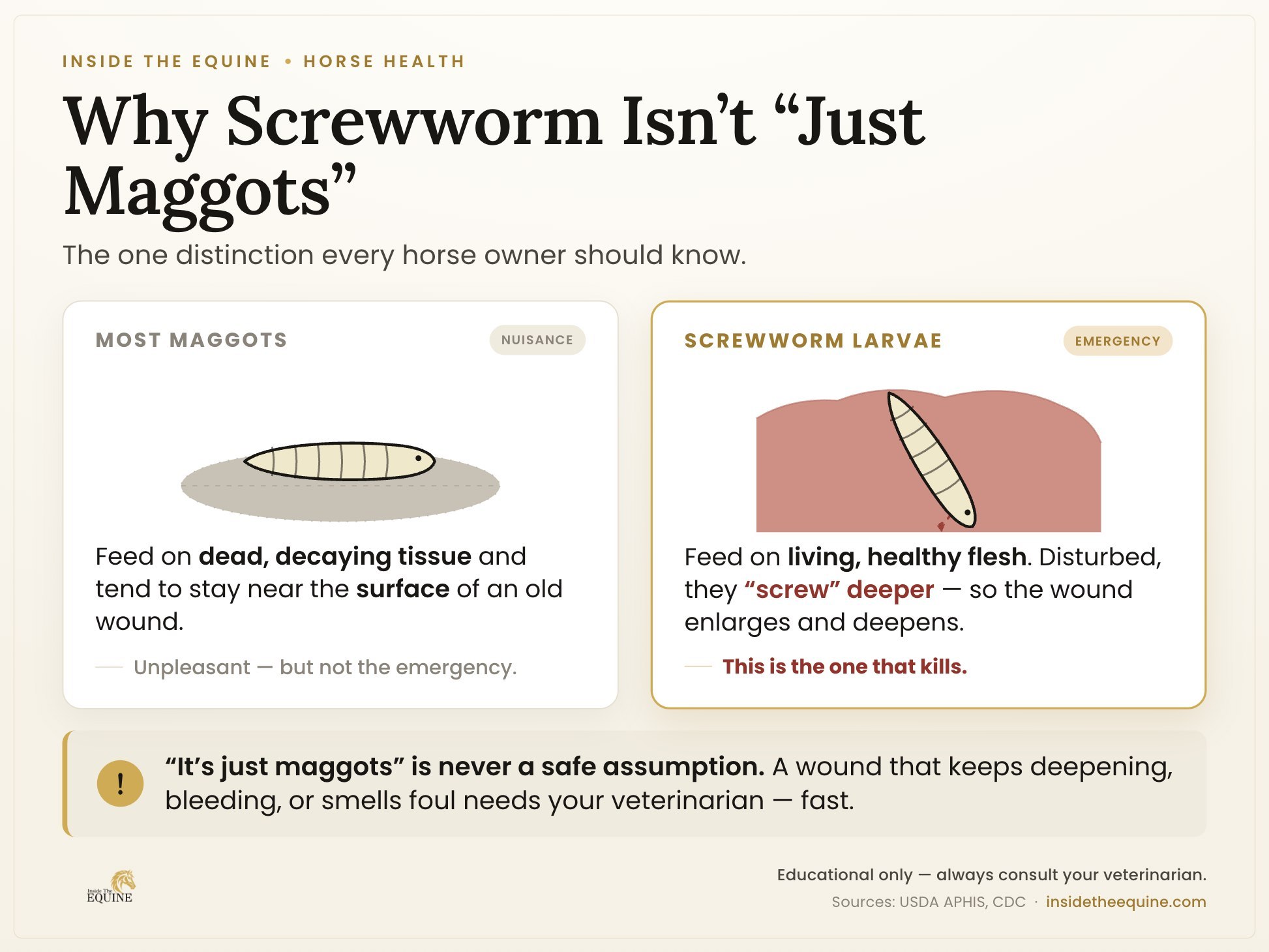
This is the distinction every horse owner should internalize. Many wounds attract common "blow fly" maggots that feed only on dead tissue. They look alarming but are usually a secondary issue. Screwworm is different.
| Feature | Ordinary Maggots | Screwworm Larvae |
|---|---|---|
| What they eat | Dead or necrotic tissue only | Living, healthy tissue |
| Effect on wound | Stays stable or may improve | Enlarges, deepens, worsens rapidly |
| Pain level | Variable, often mild | Severe, progressive, worsening |
| Smell | Mild to moderate odor | Strong, foul, distinctive stench |
| Burrowing | Feed at the surface | Burrow head-down into living tissue |
| Urgency | Routine wound care | Veterinary and regulatory emergency |
The practical rule: if a wound with maggots is painful, deepening, foul-smelling, and getting worse, do not dismiss it as "just maggots." Treat it as a possible screwworm case.
What to Do If You Suspect Screwworm: Step by Step
Screwworm is a reportable disease. That means your job is not to quietly treat it and move on. You need to act fast and alert the authorities who can contain it. Here is the order of operations.
- Isolate the horse. Grab your equine first aid kit. Move the affected animal into the most enclosed, fly-controlled space you have available. This reduces the chance of more flies laying eggs and prevents larvae from spreading.
- Do not delay over identification. You do not need to be certain. Suspicion is enough to make the calls below.
- Call your veterinarian immediately. This is the single most important step. Screwworm response is time-sensitive and vet-directed.
- Report it. Contact your state animal health official or the USDA. In Texas, suspected livestock cases go to the Texas Animal Health Commission (TAHC). Reporting is what triggered the sterile-fly response that has contained outbreaks before.
- Preserve a sample if instructed. Vets and officials may ask you to collect some larvae into 70% alcohol for laboratory confirmation. Follow their guidance rather than improvising.
- Follow the treatment plan. Confirmed cases are handled with thorough wound cleaning, removal of all larvae (sometimes requiring surgical debridement), antiseptics to prevent secondary infection, and approved larvicides or topical treatments. The AAEP has noted an emergency-use authorization for a topical powder for screwworm in horses. Your vet will choose the appropriate, currently approved product.
The encouraging news: with prompt, proper treatment, the prognosis for an infested horse is generally good. The danger lies almost entirely in delay.
What Not to Do
- Do not try to "wait and see" on a worsening wound during fly season. Every hour matters.
- Do not simply pick out the visible maggots and assume you are done. Larvae burrow deep, and a missed cluster keeps the infestation alive and growing.
- Do not move the horse across county or state lines if you suspect screwworm. Movement controls exist precisely to stop spread, and you could be violating quarantine rules.
- Do not rely on a single home remedy in place of veterinary care. This is a parasite that can kill within two weeks. Home treatment alone is not sufficient.
Your Screwworm Prevention Checklist
You do not need exotic measures. You need consistency on the basics during fly season.
Wound Vigilance
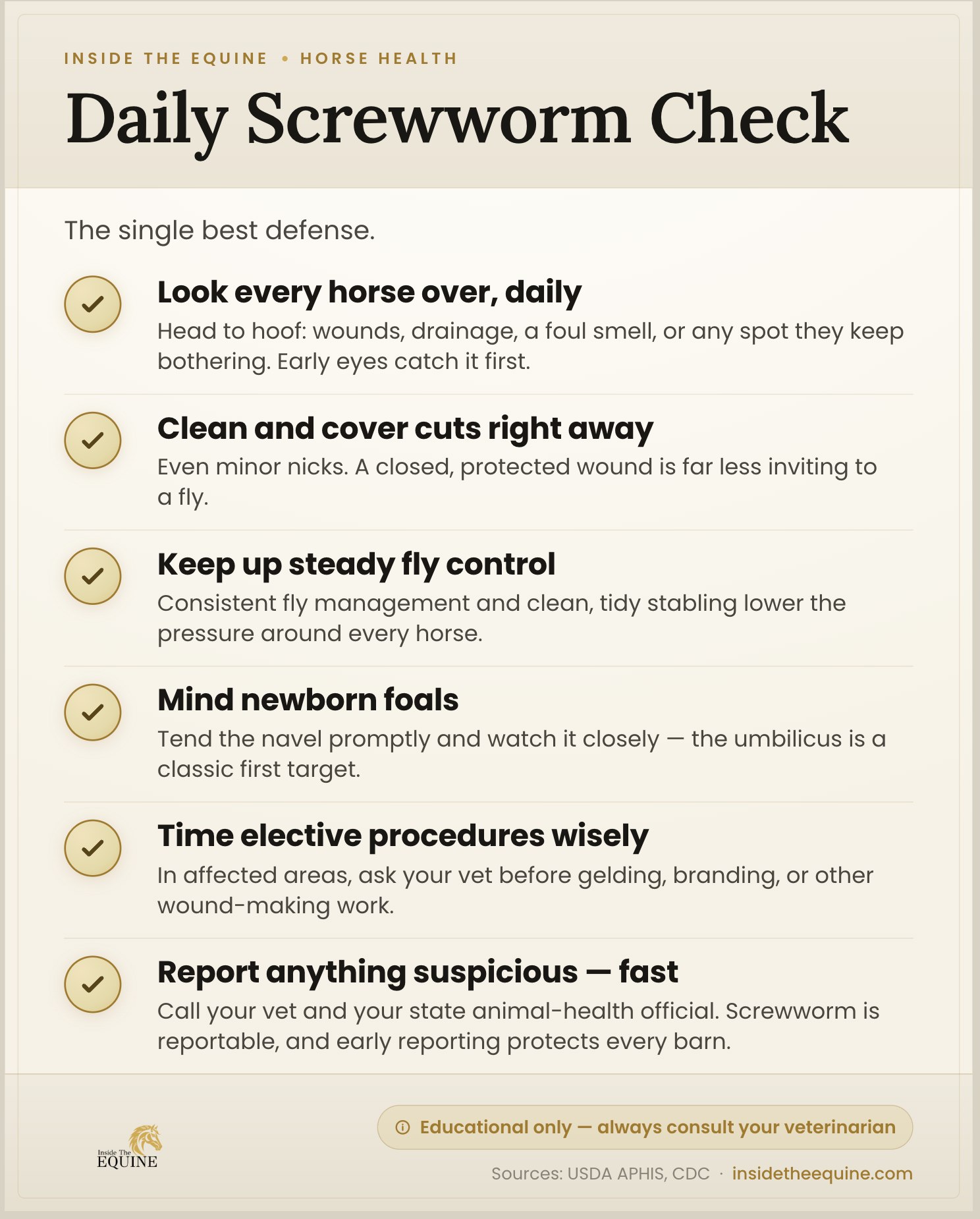
- Inspect every horse daily. Pay attention to any cut, scrape, surgical site, or gelding wound.
- Treat and protect open wounds promptly. A covered, clean wound is a far less attractive egg-laying site.
- Check moist body openings (nose, eyes, ears, sheath, vulva). For breeders, monitor newborn foals' navels closely.
Fly Control
- Use approved fly repellents and keep a strong barn fly-control program running throughout the season.
- Remove manure and decaying organic matter regularly to cut down on fly breeding habitat.
- Use traps and consider fans at stall and barn entrances to disrupt fly access.
Biosecurity for Traveling Horses
- If you show, sell, or trail-ride across regions, know the movement rules and any quarantine zones before you haul.
- Be extra cautious with horses recently moved across state lines, imported, or coming from higher-risk areas.
- On mixed-species properties, apply the same vigilance to cattle, goats, dogs, and any wildlife exposure.
Know Your Reporting Chain
- Build a first-aid kit and save your veterinarian's number and your state animal health official's contact before you ever need them.
- Screwworm is reportable. If you suspect it, you are expected to call it in. Doing so quickly is what protects the whole region, not just your horse.
How the U.S. Beat Screwworm Before
The screwworm was once endemic across the American South and Southwest, causing staggering losses. A single 1976 Texas outbreak is estimated to have cost the state's livestock economy around $1.8 billion in today's dollars. The parasite killed calves, weakened herds, and made routine ranch work genuinely dangerous.
The solution came from two USDA scientists, Edward Knipling and Raymond Bushland, who pioneered the Sterile Insect Technique (SIT). The logic was elegant. Since female screwworms mate only once, if you flood an area with sterilized male flies, most wild females will mate with a sterile male, lay eggs that never hatch, and the population collapses on itself. Males were sterilized using radiation and released by aircraft in the hundreds of millions.
The program worked. The U.S. was declared free of self-sustaining screwworm populations in 1966. The same technique was then used to push the parasite's range south through Mexico and Central America, eventually holding a barrier near Panama's Darien Gap. A small outbreak in the Florida Keys in 2017 was stamped out the same way, within months.
How Officials Are Fighting Back Now
The 2026 response is built on the same proven strategy. Within hours of confirming the first Texas case, the USDA began aerial releases of sterile flies over the detection zone. The agency has described dispersing millions of sterile flies in the area each week, both by air and through ground release chambers. Alongside the sterile flies, officials established a controlled "infested zone" featuring quarantines, animal movement restrictions, and heightened surveillance.
There is an honest caveat worth knowing: ramping sterile-fly production up to full capacity is not instant. Officials have indicated that fully scaling new production facilities could take many months. So while the playbook is proven, this will be a sustained effort, not an overnight fix.
That history is genuinely reassuring. We have a proven playbook. But it also explains why the 2026 detections are being taken so seriously: the barrier that held for decades has been breached, after the parasite marched north through Central America and Mexico beginning in 2023.
What the Timeline Looks Like from Here
Eradication will not happen in weeks. The 1966 campaign took years. The 2017 Florida Keys response was faster because the area was small and isolated. Texas is neither.
What you can expect over the coming months:
- Expanding surveillance. More traps, more inspections, and possibly expanded quarantine zones as officials map the fly population's true range.
- Sterile fly releases at increasing scale. As production ramps up, the number of sterile males released weekly will grow into the tens of millions.
- Movement restrictions that may tighten before they loosen. If you plan to haul horses through or out of South Texas, build in time for compliance checks and health certificates.
- Seasonal pressure through fall. Screwworm thrives in warm, humid conditions. The peak risk window runs through the summer and into early fall in southern states.
Horse owners outside Texas should not be complacent. Flies do not respect state lines. A horse transported from an infested area can carry eggs or larvae to a new region. The prevention checklist above applies everywhere.
Building a Daily Wound-Check Routine
The best defense against screwworm is a habit, not a product. Build a simple wound-check into your daily routine and you will catch problems before they become emergencies.
Morning feed time. While your horse eats, run your hands over the body. Feel for heat, swelling, or moisture that could indicate a wound. Lift the tail. Check the sheath or udder.
Grooming. Use grooming as an inspection opportunity. Pay attention to areas where tack sits, where the skin folds, and where flies tend to congregate.
Evening check. A quick visual scan before lights-out catches anything that developed during the day. Bring a flashlight. Wounds are easier to miss in dim barn light.
This takes five minutes. It could save your horse's life.
Frequently Asked Questions
Is the New World screwworm dangerous to humans?
It can infest people, but human cases are rare and the current risk in the U.S. is considered very low. It is primarily an animal-health threat. As with animals, the parasite targets open wounds.
Is this a food safety problem?
No. The USDA has been clear that screwworm does not affect the safety of the U.S. food supply. It does not infest meat, produce, or other food products.
How is screwworm different from regular maggots in a wound?
Ordinary maggots feed on dead tissue, and a wound generally stays the same size or improves. Screwworm larvae feed on living tissue, so the wound enlarges, deepens, bleeds, and smells foul. If a wound with maggots is getting worse instead of better, treat it as a possible screwworm case and call your vet.
Can my horse get screwworm if it never leaves my property?
Yes. The fly comes to the horse, not the other way around. Any open wound during fly season is a potential target, which is why routine wound care and fly control matter for every horse, regardless of location.
How long does it take for screwworm to kill a horse?
An untreated infestation can become fatal within one to two weeks. However, with prompt veterinary treatment, the prognosis is generally good. The real danger is delay. Know your horse's normal vital signs so you can spot problems early.
What does a screwworm wound smell like?
Owners and veterinarians describe a strong, foul, rotten odor that is noticeably different from a normal healing wound. The smell is often what draws attention before the larvae are even seen.
How fast does screwworm progress in a horse?
Quickly. Larvae begin feeding within hours of hatching, and a wound can enlarge dramatically over just a few days. Untreated infestations can become fatal within one to two weeks. The first 24 to 48 hours are critical.
Can I treat screwworm myself?
No. While good wound care is part of the response, screwworm is a reportable disease that requires a veterinarian and notification of animal health authorities. Self-treatment risks missing burrowed larvae and delays the containment response.
My horse has maggots in a wound but seems fine. Is it screwworm?
Maybe not, but do not assume. Common maggots feed on dead tissue and the wound usually is not worsening. If the wound is deepening, painful, and foul-smelling, treat it as a suspected screwworm case and call your vet.
Should I collect a sample of the larvae?
Only if instructed by your vet or animal health official. If they ask, place a few larvae in a small container with 70% rubbing alcohol. Do not use formalin. Proper identification requires intact specimens.
Where has screwworm been found in the U.S. so far?
As of mid-June 2026, confirmed cases are concentrated in South Texas, including Zavala, La Salle, Andrews, and Gillespie counties, with detection extending into Lea County, New Mexico. This is an evolving situation. Check the USDA's Screwworm.gov for the current case map before relying on any single figure.
Is it safe to travel or compete with my horse?
It depends on where you are and where you are going. Movement restrictions apply within and around the infested zone, and equestrian organizations are coordinating with animal health officials on safe movement protocols. Always check current quarantine and movement rules before hauling.
Will the sterile fly program work again?
The technique has a strong track record. It eradicated screwworm from the U.S. in 1966 and cleared the 2017 Florida Keys outbreak. The main challenge this time is scale and speed, since production capacity takes time to ramp up. But the science is sound.
Should I change anything if I am not in Texas?
Yes. Adopt the prevention basics now regardless of your location. Wound vigilance and fly control are good practice everywhere. Getting into the habit before the parasite reaches your area is far easier than reacting after the fact.
How will I know if the quarantine zone expands?
The USDA and state animal health commissions issue updates through official channels, including Screwworm.gov and direct notifications to veterinarians. Follow your state vet's office on social media or sign up for their email alerts to stay current.
Inside The Equine builds interactive, anatomy-first education for horse owners, students, and equine professionals. Explore how skin and wound tissue actually heal in our interactive 3D anatomy explorer, and download our free Horse Vital Signs Cheat Sheet to know exactly what's normal before something goes wrong.
This article is for educational purposes and is not a substitute for veterinary care. If you suspect screwworm, contact your veterinarian, your state animal health official, or the USDA immediately. For the latest case data and instructions, consult Screwworm.gov.
Want to stay informed on emerging equine threats?
Our Health course covers parasites, infectious diseases, and biosecurity protocols.
Explore the Health CoursePro members only. Try Pro free for 7 days.