Thrush in Horses: Prevention and Treatment Guide
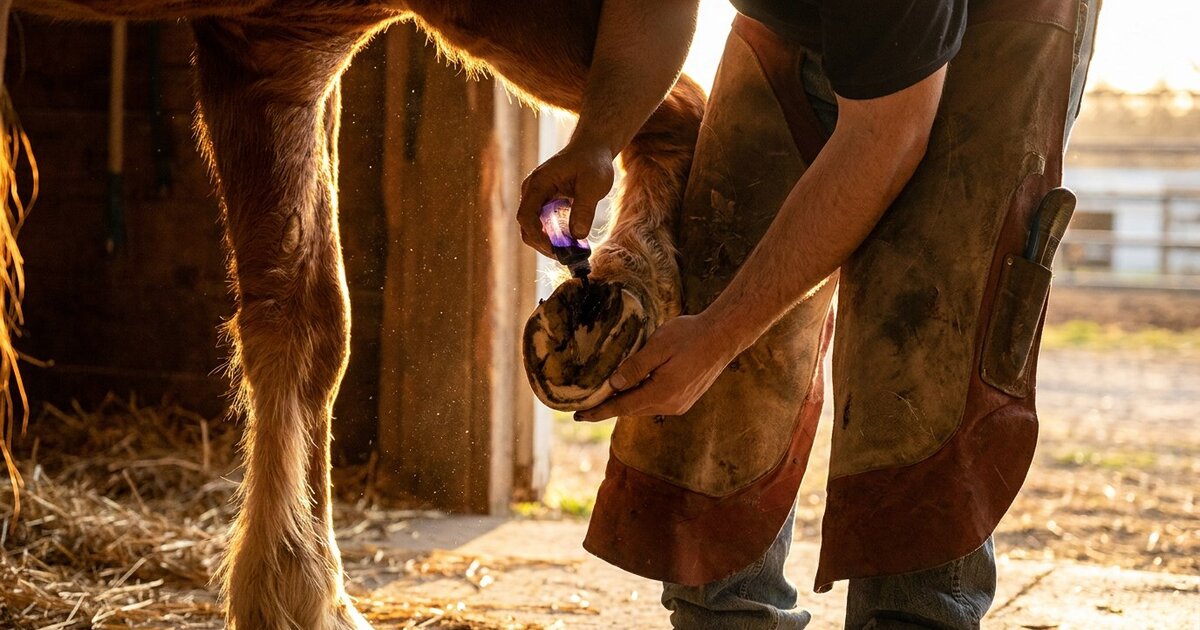
You pick up the foot to clean it and the smell hits you. That unmistakable, rotten-cheese-meets-death odor wafting up from the frog. Black gunk oozes from the sulci. Your hoof pick comes away coated in dark, tarry discharge that you'd rather not examine closely. Congratulations. You've got thrush. And you're definitely not alone. It's one of the most common hoof conditions in domesticated horses, it shows up in every climate and every management system, and it's almost always related to how the horse is being kept rather than some mysterious pathogen that wandered in from nowhere.
What Causes Thrush
Thrush is a bacterial and sometimes fungal infection of the frog, particularly the central sulcus and collateral sulci. The primary culprit is Fusobacterium necrophorum, an anaerobic bacterium, meaning it thrives in environments with little to no oxygen. Those deep grooves in the frog, the ones that get packed tight with mud and manure during turnout? That's exactly the low-oxygen environment this organism has been exploiting for as long as horses have been standing in their own waste. According to UC Davis, F. necrophorum is also implicated in foot rot in cattle and liver abscesses in feedlot animals, so it's not a specialist. It's an opportunist that attacks compromised tissue wherever it finds it.
But thrush isn't simply about the bug being present. F. necrophorum exists in the environment of virtually every horse farm on the planet. What determines whether a horse actually develops thrush is whether conditions in the hoof allow the bacterium to gain a foothold and multiply. The primary risk factors:
- Wet, unsanitary conditions. Horses standing in mud, wet bedding, or manure for prolonged periods. This is the single biggest risk factor and it's not close. Moisture softens the horn of the frog, making it more penetrable by bacteria, and wet manure provides both the organism and the anaerobic environment it needs to flourish. Texas A&M's equine program identifies chronic moisture as the number one predisposing factor in every published review of the condition.
- Lack of movement. Horses on regular turnout and exercise have natural frog compression and release with every stride. That mechanical pumping action helps shed dead tissue, circulate blood through the digital cushion, and maintain the sulci in a self-cleaning state. Stall-bound horses don't get this benefit, and their frogs often atrophy into soft, recessed targets.
- Poor hoof conformation. Deep, contracted sulci, especially a narrow central sulcus pinched tight between the heels, trap moisture and debris in places your hoof pick can't reach. Horses with contracted heels often have chronically deep central sulci that are functionally impossible to fully clean, creating a permanent anaerobic pocket.
- Infrequent hoof cleaning. Daily hoof picking removes the packed debris and manure that create the conditions thrush needs. Horses whose feet go days between cleanings accumulate the perfect bacterial incubator in every groove.
- Lack of frog contact with the ground. A frog that doesn't bear weight during locomotion becomes soft, recessed, and atrophied. Ground contact stimulates blood flow, toughens the tissue, and naturally wears away dead horn. The Merck Veterinary Manual notes that frog atrophy from lack of ground contact is a significant predisposing factor in chronic thrush cases.
The Organism Behind the Stink
Thrush isn't caused by a single organism working alone, but the primary culprit is Fusobacterium necrophorum, an anaerobic, gram-negative bacterium that also causes foot rot in cattle and liver abscesses in feedlot animals. "Anaerobic" is the key word. This bacterium thrives in environments with little to no oxygen, which is exactly the kind of environment created when a horse stands on packed manure and wet bedding, or when the sulci of the frog are deep, narrow, and filled with debris.
F. necrophorum produces leukotoxins and proteases that actively digest living tissue. It doesn't just sit on the surface passively. It invades. The necrotic, black material you see in a thrush-affected frog is the result of bacterial enzymatic destruction of the horn and, in severe cases, the sensitive tissue beneath it. Other organisms, including Bacteroides species and various fungi, often colonize alongside Fusobacterium, creating a polymicrobial infection that's more destructive than any single organism would be.
Understanding the anaerobic nature of the infection explains both why certain hooves are vulnerable and why treatment works the way it does. Anything that creates an oxygen-deprived environment in the sulci promotes thrush. Anything that opens those sulci to air inhibits it.
Why Certain Hooves Get Thrush and Others Don't
The standard explanation is "dirty stalls and wet conditions," and that's not wrong, but it's incomplete. Plenty of horses live in pristine barns with daily stall cleaning and still develop thrush. And some horses standing in mud all winter never get it. Environment matters, but hoof conformation and management play equally important roles.
Contracted heels: Horses with narrow, contracted heels have deep central and collateral sulci that trap debris and exclude air. The frog is compressed between the heels, creating crevices that are nearly impossible to clean thoroughly. These hooves are thrush incubators regardless of how clean the barn is. Contracted heels can result from genetics, improper trimming, or prolonged periods without adequate frog pressure (shoes that elevate the frog off the ground, for instance).
Lack of turnout and movement: The frog is designed to contact the ground with every stride. That contact compresses and expands the frog tissue, squeezing out debris and promoting blood flow. Horses that stand in stalls for extended periods lose that natural self-cleaning mechanism. The frog becomes recessed, soft, and susceptible.
Excess frog tissue and poor trimming: An overgrown frog with flaps of loose tissue creates pockets where anaerobic conditions develop. Regular trimming that maintains the sulci in an open, accessible state goes a long way toward prevention.
Wet bedding: Urine-soaked shavings or straw are particularly destructive. The ammonia from urine softens horn tissue and creates a chemically hostile environment for healthy tissue while being perfectly hospitable to anaerobic bacteria. Even if you clean stalls daily, a horse that lies in a urine-soaked spot overnight gets hours of exposure.
For a deeper look at how the hoof capsule is structured and why certain conformations predispose to infection, our hoof anatomy guide breaks it all down.
When Thrush Masks Something Worse
Here's what experienced farriers and veterinarians know that many horse owners don't: chronic thrush frequently coexists with and obscures deeper hoof pathology. A horse with long-standing heel contraction, digital cushion atrophy, or caudal hoof syndrome may have thrush as a visible symptom of a larger structural problem. Treating the infection without addressing the underlying conformation will result in endless recurrence.
Contracted heels reduce frog contact with the ground, which reduces blood flow to the digital cushion, which leads to atrophy of the cushion, which further narrows the heels. Thrush flourishes in the deep sulci that result. Treating the thrush temporarily clears the infection, but the cycle restarts within weeks because the conformational problem persists.
In these cases, a comprehensive approach is needed: therapeutic trimming to gradually widen the heels, frog support (pads or pour-in materials that encourage frog loading), and often a transition period where the horse may need boots or other protection while the hoof capsule remodels. This process takes months to a year, and thrush management is ongoing throughout.
If you suspect your horse's thrush keeps returning despite good treatment, the frog and heel conformation need evaluation, not just another bottle of thrush spray. Explore the structures involved in our 3D anatomy models.
Identifying Thrush
Mild thrush is easy to spot if you're picking feet regularly. You don't need a veterinary degree. You need a nose and a hoof pick. The telltale signs:
- Black, foul-smelling discharge from the sulci of the frog. The smell is distinctive and once you've encountered it you will never confuse it with anything else.
- Soft, crumbling, or mushy frog tissue that comes apart under light pressure from the hoof pick
- Dark discoloration of the frog, especially concentrated in the central and collateral sulci
- A deeper-than-normal central sulcus, sometimes with edges that peel back when probed
In mild cases, the horse isn't lame and doesn't react to hoof cleaning. The infection is superficial, affecting only the outer layers of the frog horn. Many horse owners catch it at this stage and treat it successfully at home without veterinary involvement. Good. That's the stage to catch it.
But mild thrush has a way of becoming decidedly not mild if ignored for a few weeks.
When Thrush Gets Serious
Advanced thrush penetrates deeper into the frog tissue, eventually reaching sensitive structures, the living tissue underneath the protective horn. When this happens, the entire dynamic shifts:
- The horse becomes sensitive to hoof picking. Flinching, snatching the foot away, pinning ears when you clean the sulci.
- The central sulcus develops into a deep crack, sometimes extending all the way down to the digital cushion, which is a soft tissue structure never meant to be exposed to the outside world.
- Bleeding may occur when cleaning the foot, indicating the infection has breached the boundary between insensitive and sensitive tissue.
- Lameness develops, often subtle at first, most noticeable on hard surfaces or tight turns.
- In severe neglected cases, the infection can undermine the entire frog structure, leaving it hanging by strips of necrotic tissue.
Deep central sulcus infections are particularly nasty. The crack essentially becomes a tunnel into the foot, harboring anaerobic bacteria in an environment that topical treatments can't easily penetrate. You squirt medication in the top of the crack and it never reaches the bottom where the bacteria are actually living. These cases frequently need veterinary attention. The sulcus may need to be carefully opened or debrided to allow air and medication to reach the infected tissue. Some vets and farriers pack these deep cracks with medicated cotton or gauze to hold the treatment in place and keep oxygen flowing into the wound.
In rare but documented cases, thrush can progress to involve the digital cushion, the lateral cartilages, and even the corium of the sole. At this point you're dealing with a genuine structural lameness problem that requires professional treatment and may take weeks or months to fully resolve. The AAEP categorizes severe thrush involvement of deep structures as a condition warranting immediate veterinary evaluation. Don't let it get here. It's almost entirely preventable with basic daily care.
Treatment Options
The foundation of thrush treatment is the same regardless of severity: clean the hoof, apply a topical antimicrobial, fix the environmental conditions that allowed the problem to develop, and repeat consistently until it resolves. There's no shortcut. No magic product that works once and you're done. Consistency wins this fight every single time.
Step 1: Clean the Foot Thoroughly
Pick out all debris. Every bit. Use a stiff brush to scrub the sole and frog after picking. You want to physically remove as much contaminated material as possible before applying anything medicinal. For deep sulci that your brush can't reach, a rolled-up piece of gauze, a cotton swab, or even a hemostat with a gauze tip can help clean areas the hoof pick and brush miss.
Step 2: Apply a Topical Treatment
There are more thrush remedies on the market than anyone could reasonably test in a lifetime, ranging from commercial products to home concoctions passed down through generations of barn managers. Here are the most common and effective options according to clinical practice and veterinary literature:
- Commercial thrush treatments like Thrush Buster, Kopertox, and Tomorrow (yes, the bovine mastitis treatment that horse people commandeered decades ago). These are readily available at any feed store and effective for mild to moderate cases. Thrush Buster is popular because it stains the tissue purple, making it easy to see exactly where you've applied it, and it doubles as a mild astringent that helps dry the tissue.
- Dilute bleach solution. Effective but controversial. Some farriers swear by it as the fastest way to knock thrush back. Others argue it's too harsh on healthy tissue and delays healing as much as it helps. A very dilute solution, roughly 1:10 bleach to water, can be applied with cotton to affected sulci. Not recommended for deep infections where sensitive tissue is exposed.
- Iodine (7% tincture or povidone-iodine). A solid middle-ground choice. Broad-spectrum antimicrobial activity without being overly caustic to surrounding tissue. Can be applied directly into affected sulci with a dropper or cotton swab. UC Davis equine podiatry references support iodine as a reasonable first-line topical for superficial thrush.
- White Lightning (chlorine dioxide). Applied as a soak using a hoof boot and plastic bag. The chlorine dioxide generates a gas that penetrates deep into sulci and kills anaerobic organisms on contact. Particularly effective for stubborn cases that haven't responded to surface-applied treatments. Requires proper application technique: the foot stays in the sealed boot for 20 to 45 minutes while the gas does its work.
- Venice turpentine. Old-school farrier remedy that predates commercial products by at least a century. It's an antiseptic derived from larch resin, and it dries tissue out aggressively, which can help in chronically wet frogs. Messy to apply, strong-smelling, and stains everything it touches, but some farriers consider it the gold standard for deep sulcus infections.
Step 3: Address the Environment
This is where most people fail and where most thrush treatment plans quietly collapse. You can treat thrush religiously twice a day with the most expensive product on the shelf, but if the horse walks straight back into a stall with wet, ammoniated bedding or a paddock that's six inches of soupy mud, the infection returns within days. Clean, dry footing is non-negotiable for resolution. That might mean more frequent stall mucking, adding a gravel pad to high-traffic areas around gates and water troughs, improving paddock drainage with French drains or regrading, or rotating turnout areas so horses aren't standing in the same destroyed ground week after week.
Step 4: Be Consistent
Thrush doesn't resolve overnight. Mild superficial cases might clear up in one to two weeks with daily treatment. Moderate cases involving soft, damaged frog tissue can take three to four weeks. Deep central sulcus infections where the crack extends into sensitive structures? Months. Literal months of consistent daily care. The most common reason thrush treatment fails isn't the choice of product. It's the owner who treats enthusiastically for five days, sees improvement, declares victory, and stops. Then acts surprised when it comes roaring back ten days later.
Prevention
Prevention is infinitely easier, cheaper, and less frustrating than treatment. It comes down to a handful of straightforward practices that every horse person should be doing anyway:
- Pick hooves daily. Every single day. No exceptions. Not "most days." Not "when I remember." This alone prevents the vast majority of thrush cases. It removes the packed debris that creates the anaerobic environment, and it forces you to actually look at the frog regularly so you catch problems at the earliest possible stage rather than three weeks into an established infection.
- Maintain dry footing. Stalls should be cleaned at least once daily with dry bedding underneath. Paddocks and sacrifice areas need adequate drainage. Standing water and deep mud are thrush factories operating around the clock.
- Encourage movement. Turnout, riding, lunging, hand-walking, ponying alongside another horse, whatever keeps the horse moving and that frog working. The mechanical action of the frog compressing against the ground with every step is naturally antimicrobial, promotes circulation, and helps the hoof self-clean.
- Maintain proper trim schedules. Overgrown hooves with deep, contracted sulci and long bars folding over the frog are thrush magnets. Regular trimming on a four-to-six-week cycle keeps the frog properly shaped, functional, and accessible to your hoof pick.
- Address contracted heels. If your horse has chronically narrow heels with a deep central sulcus that you can barely get a hoof pick into, work with your farrier to gradually expand the heels and open up the frog over successive trim cycles. This is a long-term project measured in months or even a year, but it makes an enormous difference in thrush susceptibility once the frog has room to function properly.
A Note on Draft Horses and Feathered Breeds
Breeds with heavy feathering, Clydesdales, Shires, Friesians, Gypsy Vanners, are notorious for chronic thrush problems. The feathering traps moisture against the frog like a wet blanket, prevents air circulation entirely, and hides the condition from view so owners don't notice until the horse is lame. According to the Merck Veterinary Manual, feathered breeds have significantly higher incidence rates of both thrush and pastern dermatitis compared to clean-legged breeds in identical management conditions. Owners of feathered breeds need to be extra vigilant about hoof hygiene, pick feet twice daily if possible, and some choose to trim the feathering short around the coronary band and ergot area to improve airflow. It's a cosmetic trade-off that many make willingly after battling their first winter of chronic thrush.
When to Call the Vet
Most mild thrush doesn't require veterinary involvement. A hoof pick, a bottle of Thrush Buster, and some discipline about daily cleaning will handle the majority of cases. But call your vet if:
- The horse is lame, even subtly
- There's bleeding from the frog area during routine cleaning
- The central sulcus is deeply cracked, sensitive, and won't respond to two weeks of consistent topical treatment
- You've been treating diligently for two-plus weeks with no measurable improvement
- The infection appears to involve tissue beyond the frog surface, spreading into the sole or digital cushion
- There's significant heat or swelling in the foot, which might indicate something else entirely like a subsolar abscess masquerading as thrush
Thrush is common, it's manageable, and it's almost entirely preventable. But it requires the kind of boring, unglamorous, daily consistency that separates horses who stay sound year after year from horses who develop chronic problems that compound over time. Pick the feet. Keep things dry. Pay attention. That's really all there is to it.
🔍 See the frog and sulci where thrush develops in our 3D Explorer. Check it out here.
Frequently Asked Questions
What causes thrush in horses?
Thrush is caused by anaerobic bacteria (primarily Fusobacterium necrophorum) and sometimes fungi that thrive in wet, oxygen-deprived environments. Standing in mud, manure, or wet bedding creates ideal conditions. Poor hoof care that allows deep sulci to pack with debris accelerates the problem.
What does thrush smell like?
Thrush has a distinctive, foul, rotten odor that is unmistakable once you have encountered it. The smell comes from the necrotic (dead) tissue being broken down by anaerobic bacteria. If you pick out a hoof and get hit with a strong putrid smell, you are almost certainly dealing with thrush.
How do you treat thrush in horses?
Trim away loose, necrotic frog tissue to expose the infection to air. Clean the sulci thoroughly, then apply a topical thrush treatment (chlorine dioxide, iodine-based products, or copper sulfate solutions). Move the horse to a clean, dry environment and pick hooves daily. Severe cases that invade sensitive tissue need veterinary attention.
Can thrush make a horse lame?
Yes. Mild thrush in the superficial frog tissue usually does not cause lameness, but once it penetrates to the sensitive corium beneath the frog, it becomes painful. Deep central sulcus infections are particularly prone to causing heel soreness and reluctance to land heel-first. Do not ignore thrush just because the horse is not limping yet.
How do you prevent thrush?
Clean, dry living conditions. Pick hooves daily. Schedule regular farrier visits every 5-8 weeks to maintain proper hoof balance and remove dead frog tissue. Fix drainage issues in paddocks and stalls. Horses with deep narrow sulci (common in contracted heels) need extra vigilance because those crevices trap moisture and debris.
Sources
- "Thrush in Horses" - Texas A&M Veterinary Medical Teaching Hospital vetmed.tamu.edu
- "Thrush" - Merck Veterinary Manual merckvetmanual.com
- "Hoof Conditions" - AAEP aaep.org
- "Hoof Health and Disease" - UC Davis Center for Equine Health ceh.vetmed.ucdavis.edu
- "Fusobacterium necrophorum and Hoof Infections" - Cornell University College of Veterinary Medicine cornell.edu
Want to understand every hoof condition?
Our Lameness course covers thrush, white line disease, and hoof-related lameness.
Start the Lameness CoursePro members only. Try Pro free for 7 days.