Trailering Safety: Loading, Hauling, and Emergency Preparedness
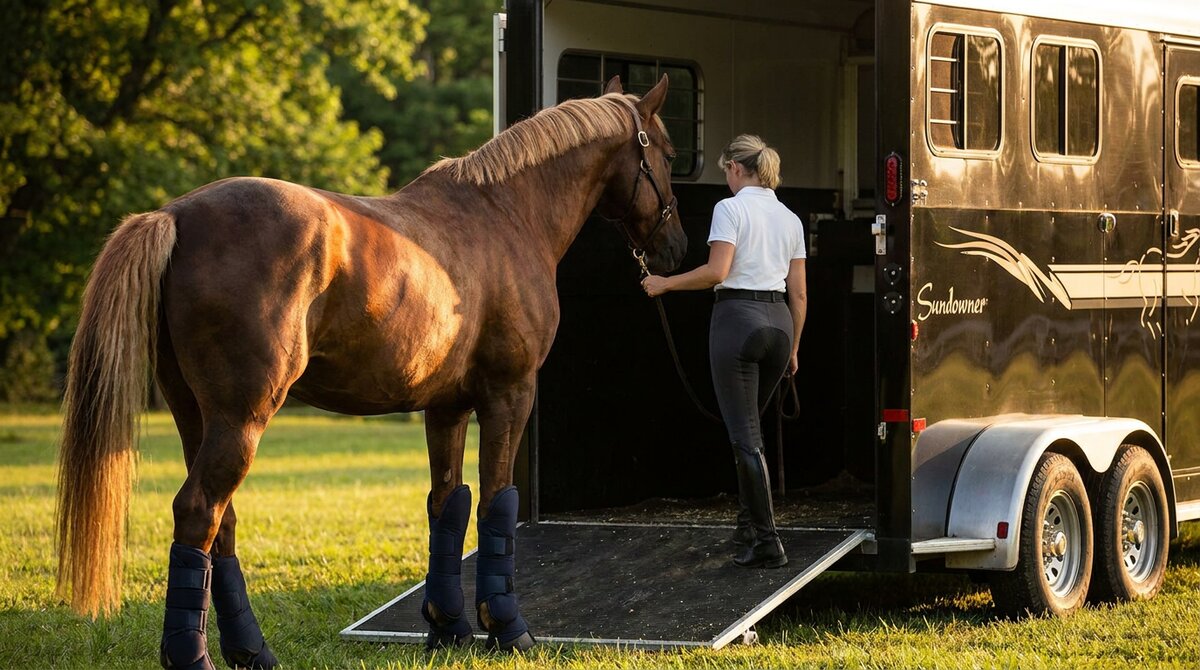
Every year in the United States, an estimated 30,000-plus horse trailer accidents occur on public roads. Some are fender benders. Some are catastrophic. And a disturbing number of them are entirely preventable with basic preparation, proper equipment maintenance, and a driver who understands that hauling a 1,200-pound animal in a metal box at highway speed demands respect. Trailering is the most dangerous thing most horse owners do on a regular basis, and too many people treat it casually.
Before You Load: Trailer Inspection
The Walk-Around Checklist
Before every single trip. Not once a month. Every time.
Tires: Check pressure with a gauge, not your eyes. Horse trailer tires are typically inflated to 50-65 PSI depending on the tire. Underinflated tires are the leading cause of trailer tire blowouts, and a blowout at 60 mph with a horse inside is exactly as bad as you're imagining. Check the DOT date code on the sidewall. Trailer tires should be replaced every 5-7 years regardless of tread depth, because UV degradation weakens the rubber structure even when the tire looks fine.
Lights: Have someone stand behind the trailer while you test running lights, brake lights, and turn signals. Both sides. It takes 90 seconds and it keeps you from getting rear-ended at dusk because nobody could see your trailer on the road.
Floor: This is the one that kills horses. Literally. A rotted trailer floor can give way under a shifting horse's weight, dropping a leg or an entire horse through the floor at highway speed. If you have a wood-floor trailer, get underneath it with a flashlight and a screwdriver at least twice a year. Probe the wood. If the screwdriver sinks in, that board needs replacement. Aluminum floors are more durable but still need inspection for corrosion, especially around bolt holes and welds.
Hitch and safety chains: The ball must match the coupler size exactly. A 2-inch ball in a 2-5/16 coupler will come off the ball on the first hard bump. Safety chains should cross under the tongue in an X pattern so they cradle the tongue if it separates. Breakaway brake cable must be connected and the battery charged.
ItemWhat to CheckWhy It Matters
TiresPressure with gauge (50–65 PSI typical); DOT date codeUnderinflation is #1 cause of blowouts; replace every 5–7 yearsLightsRunning lights, brake lights, turn signals — both sidesPrevents rear-end collisions at duskFloorProbe wood with screwdriver; check aluminum for corrosionRotted floors can collapse under a shifting horse at speedHitch & chainsBall/coupler size match; chains crossed in X; breakaway cable connectedMismatched ball/coupler separates on first hard bump
Tow Vehicle Capacity
This is where ego gets horses killed. Your tow vehicle's Gross Combined Weight Rating (GCWR) must exceed the total weight of the vehicle, passengers, cargo, trailer, and horses. Combined. A two-horse steel trailer with two average horses, hay, water, and tack can easily weigh 7,000-9,000 pounds. That half-ton pickup you bought because it "looks like it can pull" might be rated for 7,500 pounds max towing.
Tongue weight matters too. The trailer tongue should place 10-15% of the total trailer weight on the hitch. Too little tongue weight causes trailer sway. Too much overloads the rear axle of the tow vehicle and lightens the front end, reducing steering control. If you've never weighed your loaded trailer on a scale, you're guessing. Stop guessing.
Loading: Training, Not Wrestling
The Foundation
Loading problems are training problems. Period. A horse that won't load isn't "being stubborn." He's either never been properly taught, has had a bad experience, or is genuinely frightened. All three are fixable, but none of them respond to the "three guys pushing from behind" method that still gets used at every horse show parking lot in America.
Teach loading at home, with no time pressure and no destination. Open the trailer. Put hay inside. Let the horse investigate. Reward any forward movement. Pressure and release. Most horses can be loading willingly within 3-5 sessions of 15-20 minutes each if you're patient and consistent.
Self-Loading vs. Assisted Loading
The goal is a self-loading horse. You point at the trailer, the horse walks on. This requires trust that nothing bad will happen inside the trailer, which means your first several loading sessions should involve walking on, standing for a minute, getting a treat, and walking off. No closing the butt bar. No driving anywhere. Just on and off until it's boring.
For horses with established loading anxiety, consider these approaches:
Make the trailer the easy place to be. If the horse backs off, put him to work outside the trailer (circles, backing, lateral movement). When he faces the trailer, let him rest. The trailer becomes associated with relief, not pressure.
Use a butt rope (a lunge line behind the hindquarters, held by a helper on each side) instead of pushing. The rope provides consistent, impersonal pressure that the horse can't evade by swinging sideways. It's safer for the humans and less confrontational for the horse.
Trailer Loading Safety Rules
Never stand directly behind a horse being loaded. Kick zone. Always. Use the side door or escape door to enter the trailer before the horse if you need to tie or close the divider. Wear boots and gloves. Helmets aren't standard practice during loading, but honestly they should be, given how many head injuries happen in this exact scenario.
Never tie the horse's head before securing the butt bar or chain. If a horse panics and pulls back before the rear is secured, and his head is tied, you'll have a horse flipping over or pulling the tie ring out of the wall. Butt bar first, then tie. Reverse the order for unloading: untie first, then butt bar.
On the Road: Driving with Cargo That Breathes
Speed and Following Distance
Slow down. Seriously. The single most impactful safety measure for hauling horses is reducing speed. Drive 5-10 mph below the posted limit, especially on curves and downhill grades. Your stopping distance with a loaded trailer is roughly double that of your tow vehicle alone. At 60 mph, you need 300-400 feet to stop safely. That's a football field.
Increase your following distance to a minimum of 4-6 seconds. In rain or on mountain roads, increase to 8-10 seconds. Tailgating kills. Tailgating with 4,000 pounds of trailer behind you kills more creatively.
Cornering and Braking
Take turns wider and slower than you think you need to. The trailer tracks inside your tow vehicle's path, which means the trailer wheels cut corners tighter than your truck. A turn that's comfortable for your truck at 25 mph might slam your horse against the divider at the same speed.
Brake earlier and more gradually than normal. Horses can't grab onto anything. When you hit the brakes hard, a 1,200-pound horse slides forward into the manger or chest bar with all of that momentum. Smooth, gradual deceleration gives them time to brace. Think about carrying a full coffee cup on your dashboard. If you can keep the coffee in the cup, you're braking smoothly enough for your horse.
Rest Stops
On trips longer than 3 hours, stop every 2-3 hours to check on the horses. Offer water (many horses won't drink at rest stops, but offer it anyway). Check for sweating, injuries, or signs of distress. Ensure the trailer is ventilated adequately, especially in summer when interior temperatures can exceed ambient by 10-20 degrees Fahrenheit even with windows open.
Never leave a horse in a parked trailer in direct sun without airflow. Trailer interiors can reach 120+ degrees in summer conditions. If you stop for lunch, park in shade, open all vents and windows, and keep it short.
Emergency Preparedness: The Kit You Hope You Never Need
The Essentials
Every trailer should carry:
A sharp knife: To cut a lead rope or halter if a horse is tangled. A folding knife in your pocket, accessible within seconds. Not buried in a tack trunk.
Fire extinguisher: Minimum 5-pound ABC-rated, mounted inside the trailer or the tow vehicle's cab. Wheel bearing fires are more common than people realize, and they can engulf a trailer in minutes.
First aid kit: For both horse and human. Vet wrap, gauze pads, wound spray, bandaging scissors, thermometer, disposable gloves. Your vet's phone number and the closest emergency equine hospital for your route.
Flashlight and reflective triangles: A roadside breakdown at night is dangerous enough without horses. Reflective triangles placed 50, 100, and 200 feet behind your trailer warn approaching traffic.
Water: At least 5 gallons for the horse and drinking water for you. Dehydration makes everything worse.
Spare tire and the tools to change it: Do you know where your trailer's jack is? Have you ever actually changed a trailer tire? Practice at home.
Accident Protocol
If you're involved in a trailer accident:
Secure the scene first. Turn on hazards. Call 911. Do not open the trailer until you've assessed the situation. A panicking horse that escapes a trailer on a highway creates an exponentially worse situation.
If the horse is down inside the trailer and conscious, keep people away from the kick zone. Horses thrash when they're down and scared. Wait for professional help (fire department, vet, or experienced horse people) before attempting to extract a downed horse.
If the horse is standing and the trailer is stable, keep the horse inside until you've identified a safe, enclosed area for unloading. A grassy median is not enclosed. A nearby farm driveway with a gate is better. Think about containment before opening that door.
Breakdowns
A flat tire or mechanical failure on the roadside with horses requires calm decision-making. Pull as far off the road as possible. If you can safely change the tire with the horse inside, do so. Most horses tolerate this if they can see out and aren't panicking. If you can't safely change the tire or the breakdown is more serious, call roadside assistance that handles horse trailers (AAA covers some situations, but having a motor club membership that specifically covers equine transport is worthwhile, around $100-150/year).
Trailer Types and Safety Considerations
Bumper Pull vs. Gooseneck
Gooseneck trailers are inherently more stable than bumper pulls because the hitch point is over the rear axle of the truck rather than behind it. This reduces sway dramatically. For hauling two or more horses, a gooseneck is meaningfully safer. Bumper pulls work fine for lighter loads and short distances but are more prone to sway at highway speeds, particularly in crosswinds.
Slant Load vs. Straight Load
Research from the University of California, Davis found that horses traveling at a slight angle (facing between 30-45 degrees from straight ahead) maintained better balance and showed lower stress indicators than horses facing straight forward or straight backward. Slant loads accommodate this naturally. However, slant loads can be tighter for large horses (16.2+ hands, 1,300+ pounds), and some horses clearly prefer straight loads. Know your horse.
Stock Trailers
Open stock trailers provide excellent ventilation but zero protection from road debris and weather. Horses regularly arrive with small cuts and eye irritation from highway gravel in open stock trailers. If you use one, install face guards or at minimum use fly masks for road protection.
Trailer TypeProsCons
GooseneckMore stable; hitch over rear axle reduces sway; better for 2+ horsesRequires truck bed; higher costBumper PullWorks with more vehicles; lower costMore prone to sway at highway speeds, especially in crosswindsSlant LoadHorses balance better at 30–45° angle; lower stress indicatorsCan be tight for large horses (16.2+ hh, 1,300+ lbs)Straight LoadMore room for large horses; some horses prefer itHorses may have slightly more difficulty balancingStock TrailerExcellent ventilation; versatileNo protection from road debris/weather; risk of cuts and eye irritation
Legal Requirements
Requirements vary by state, but generally: trailer brakes are required for trailers over 3,000 pounds GVWR (most horse trailers). Breakaway brakes are required in 49 states. Safety chains are universally required. Some states require a separate CDL or endorsement for trailers over certain weight thresholds. Check your state's specific regulations before hauling across state lines.
Health certificates (Coggins test and health certificate from a veterinarian) are required for interstate transport in all 50 states. Getting pulled over at an agricultural checkpoint without papers means your horse gets quarantined until documentation is produced. That's a bad day for everyone involved.
Frequently Asked Questions
How long can a horse safely travel in a trailer?
Most healthy adult horses tolerate 8-12 hours of travel per day with rest stops every 2-3 hours. Beyond 12 hours, the risk of shipping fever (transport-related respiratory disease) increases significantly. Horses should be allowed to lower their heads periodically during travel, as this helps clear respiratory secretions. Tie ropes long enough to allow head lowering but not so long that a horse could get a leg over the rope. About 18-24 inches of slack is typical.
Should I feed hay during transport?
Yes, for trips over an hour. Hay keeps horses calm, encourages chewing (which produces saliva that buffers stomach acid), and provides distraction. Use a hay net with small openings (1.5-2 inch) tied at chest height. Never feed grain in a moving trailer because choking risk increases when a horse can't position his head normally.
Do horses need shipping boots or wraps?
For valuable sport horses and any trip over 2 hours, yes. Shipping boots protect the coronary band, heel bulbs, and lower legs from stepping-on injuries. Proper shipping boots extend from below the coronary band to above the knee/hock. Polo wraps are not adequate substitutes because they don't protect the coronary band and can unravel during transport.
What should I do if my trailer starts swaying?
Do NOT hit the brakes. Braking during a sway event makes it worse. Instead, gradually release the accelerator and let the vehicle slow naturally. If your trailer has electric brakes with a manual controller, apply a small amount of trailer-only brake to pull the trailer back in line. Grip the steering wheel firmly and steer straight. Do not try to correct by counter-steering. Once the sway stops, pull over and check your load distribution and tire pressures.
How do I prepare a young horse for their first trailer ride?
Start loading practice 2-4 weeks before you actually need to go anywhere. Park the trailer in a familiar area. Let the horse explore. Practice loading and unloading daily for short sessions. Take 2-3 very short trips (10-15 minutes) with calm, easy driving before attempting a longer haul. Pair the young horse with an experienced, calm traveling companion if possible. A relaxed buddy teaches a young horse more than any amount of human coaxing.
📝 Explore more in our Courses. Check it out here.
Sources
- Stull, C.L. (1999). Responses of horses to trailer design, duration, and floor area during commercial transportation to slaughter. Journal of Animal Science, 77(11), 2925-2933. University of California, Davis.
- AAEP (American Association of Equine Practitioners). Trailering and Transport Guidelines. aaep.org
- Merck Veterinary Manual. Transport-Related Conditions in Horses. merckvetmanual.com
- Clark, D.K., Friend, T.H., & Dellmeier, G. (1993). The effect of orientation during trailer transport on heart rate, cortisol and balance in horses. Applied Animal Behaviour Science, 38(3-4), 179-189.
- National Highway Traffic Safety Administration (NHTSA). Towing Safety Guidelines.
Last reviewed: April 2026