Clicker Training Horses: What the Science Says About Reward-Based Training
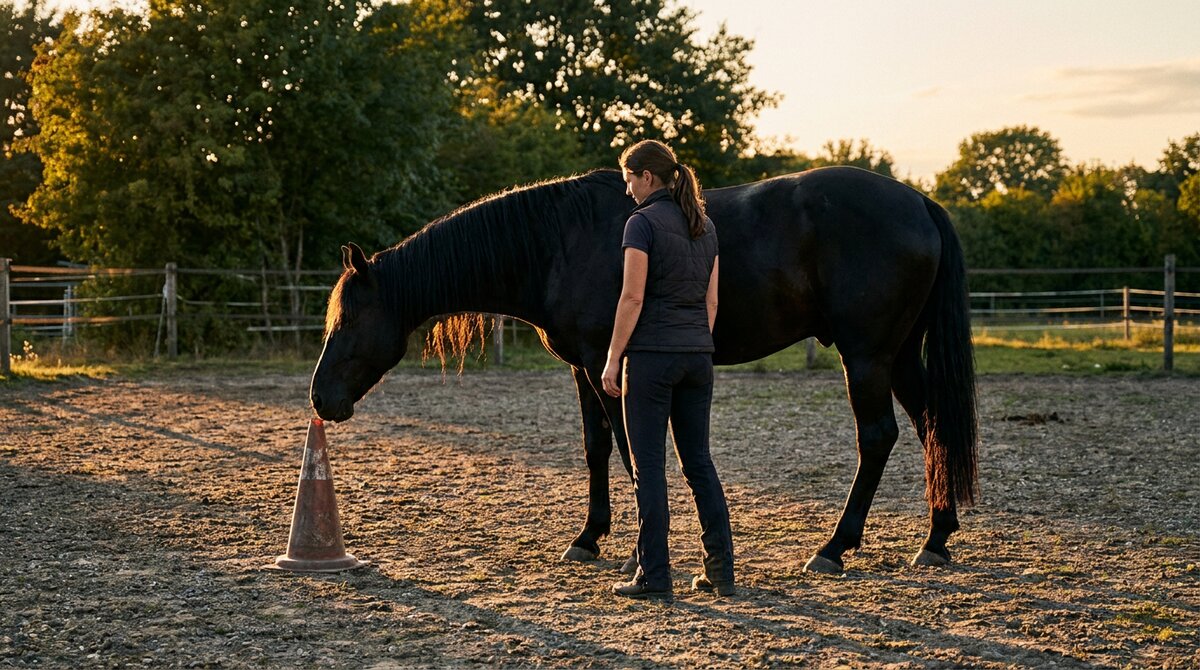
Picture two horses learning to stand still while you handle a leg. One learns because you release the pressure the moment he stops fidgeting. The other learns because a small click sound tells him "yes, that" and a bit of chopped hay follows. Both can work. But the horse learning for the click often does something the first one does not: he starts offering the behavior, ears forward, waiting to see what earns the next reward. That shift, from tolerating training to actively participating in it, is why reward-based training has moved from the fringes into serious equitation science. For more details, see our guide on Negative Reinforcement in Horse Training. You may also find our article on Cribbing in Horses helpful.
What is the difference between positive and negative reinforcement?
Both aim at the same goal, more of a behavior, but they get there in opposite ways. In learning theory, "positive" and "negative" are not value judgments. They are math: positive means something is added, negative means something is taken away.
Positive reinforcement (R+) adds something the horse wants after a behavior, usually food, so the behavior happens more often. Negative reinforcement (R-) removes something the horse wants to avoid, usually pressure, the moment the behavior happens. When you squeeze with your leg and stop as soon as the horse steps forward, that release is negative reinforcement. It is the engine under almost all traditional riding and handling, and done with good timing and light aids it is a legitimate, well-studied tool. For more details, see our guide on Correct Riding Position.
The catch is what each method does to the horse emotionally while it teaches. Pressure works by creating mild discomfort the horse learns to switch off. Reward works by creating anticipation the horse leans toward. Same learning, very different feeling, and that difference is where the research gets interesting.
| Feature | Positive reinforcement (R+) | Negative reinforcement (R-) |
|---|---|---|
| What happens | Something wanted is added (food, scratch) | Something aversive is removed (pressure) |
| Everyday example | Click and treat for touching a target | Release the rein when the horse gives to it |
| Emotional tone | Anticipation, seeking, interest | Relief from mild discomfort |
| Common failure mode | Mugging, pushiness if manners are skipped | Escalating pressure, dullness, bracing |
How does a clicker or marker actually work?
The click is not the reward. It is a promise that the reward is coming. On its own, a clicker means nothing to a horse. It becomes meaningful through classical conditioning, the same associative learning that makes a horse nicker at the sound of the feed cart. You pair the click with food over and over until the sound itself predicts food. Once that link is solid, the click becomes a secondary (or conditioned) reinforcer, a marker that carries the promise of the real reward.
Why bother with a middle step? Because timing is everything in learning, and food is slow. If a horse lifts his foot nicely and you fumble a treat out three seconds later, you may accidentally reward whatever he was doing then, like putting the foot down or swinging his head at you. A click is instant and precise. It pinpoints the exact half-second the hoof left the ground, and the food can arrive a moment later without muddying the message. Paul McGreevy, in his textbook Equine Behavior, describes this bridging function as the core value of a marker: it bridges the gap between the correct response and the delayed reward.
You do not strictly need a plastic clicker. A consistent tongue click or a short word like "yes" works the same way, as long as it is distinct, quick, and always followed by food during learning. The clicker is popular simply because it sounds identical every time and your voice does not.
What does the research say about reward-based training in horses?
This is where clicker training stops being an opinion and starts being evidence. Controlled equitation science studies comparing reward-based training against pressure-based or no training are consistent on three fronts: learning, memory, and the relationship with people.
On learning and memory, a study led by Carol Sankey and colleagues at the University of Rennes trained yearlings to stand still on a vocal cue during handling. Horses rewarded with food learned faster and behaved more calmly. Six months later, with no practice in between, they still stood significantly longer than untrained controls. In an open paddock test, about 60 percent of the reward-trained horses chose to stay within roughly half a meter of the trainer, compared with about 15 percent of controls, and they were friendlier toward strangers too.
On the human-horse relationship, a separate Sankey study in Animal Cognition showed the emotional cost of getting it wrong. Ponies trained to step backward using negative reinforcement showed rising heart rates, more ears-back and head-tossing, and afterward sought less contact with people. Ponies trained with positive reinforcement did the opposite: they showed more interest in humans and actively sought contact, and that impression was still measurable five months later. The method did not just teach a behavior. It changed how the horses viewed the person teaching it.
On welfare and motivation, Innes and McBride worked with previously neglected ponies and found that those trained with positive reinforcement were more motivated to take part in sessions and showed more exploratory, trial-and-error behavior in novel situations, which they read as a sign of reduced fearfulness. The pattern is hard to ignore: reward-based training tends to produce a horse that learns readily, remembers well, and wants to engage rather than escape.
How do you actually start clicker training a horse?
You start by giving the click meaning and teaching food manners at the same time, before you ask for any real behavior. The first stage installs two things: the click predicts food, and reaching for food is never how food arrives.
- Charge the marker. Stand with your horse, ideally with a barrier like a stall guard between you at first. Click once, then immediately deliver a small piece of food. Repeat 15 to 20 times. You are teaching the sound to mean "food is coming," nothing more yet.
- Feed away from your body. Deliver every treat to a neutral spot, straight down and slightly away from you, not up toward the horse's searching lips. This single habit prevents most pushiness before it starts.
- Reward the head turned away. If the horse swings his nose toward your pockets, wait. The instant he turns his head straight or away, click and feed. You are teaching that mugging never works and politeness pays.
- Introduce a target. Once the click is charged, hold out a simple object like a pool noodle or a lid. Most horses sniff it out of curiosity. The moment his nose touches it, click and feed. Within a few reps many horses touch it deliberately to earn the click. This is your first trained behavior and the foundation for leading, loading, and stationing later.
- Keep sessions short. Three to five minutes, a handful of times, beats one long grinding session. Horses in the Sankey work learned meaningful behaviors in sessions totaling only 5 to 15 minutes. End while your horse still wants more.
Use a low-value, high-fiber reward such as a pinch of chopped hay or a piece of a hay pellet. You will deliver a lot of them, so volume and sugar matter. If your horse is metabolic or overweight, ask your veterinarian what is safe to use.
What are the most common clicker training mistakes?
The two failures that sink most beginners are mugging and bad timing, and both are preventable. Mugging is the pushy nosing, lipping, or barging at your hands and pockets that happens when a horse learns pestering produces food. It is not rudeness. It is a horse doing exactly what got rewarded, usually by accident, when someone fed from the body or fed a nose that was already reaching. For more details, see our guide on Understanding Horse Body Language.
The fix is mechanical, not disciplinary. Never feed a searching mouth, always feed away from yourself, and reward calm, straight-ahead or turned-away head positions early and often. If mugging appears, you have almost always drifted on one of those rules. For more details, see our guide on Reading Horse Ear Positions.
Poor timing is the other big one. Because the click marks the behavior, a late or sloppy click teaches the wrong thing. If you click as the horse is already lifting his head away from the target, you rewarded the head lift, not the touch. Practice your timing without the horse first: bounce a ball and click the instant it hits the floor. A few more pitfalls worth naming:
- Rate of reinforcement too low. Early on, a horse should be earning clicks almost constantly. Long gaps create frustration, which looks like pawing, pinned ears, or mugging. When in doubt, make it easier and click more.
- Raising the bar too fast. Reward-based training relies on shaping, reinforcing small steps toward the goal. Ask for too much too soon and the horse stops offering. Break every behavior into the smallest piece he can succeed at.
- Clicking more than once per behavior. One behavior, one click, one reward. Machine-gun clicking blurs the marker's precision.
- Training a hungry horse. A horse who has not eaten is too fixated on food to think. Train after hay, not before.
Where does clicker training fit alongside pressure-release?
It is not a replacement for pressure-release, and the best trainers rarely treat it as either-or. Riding fundamentally relies on the horse yielding to pressure: leg, rein, and seat aids all work through negative reinforcement, and you cannot click your way to a canter transition while mounted. What positive reinforcement adds is a second channel that is especially good at certain jobs.
Reward-based training shines for husbandry and cooperative care: standing for the farrier, accepting the clippers, loading calmly, holding still for injections or eye treatment, and generally turning "things done to the horse" into "things the horse chooses to allow." It is also excellent for rehabilitating fearful or shut-down horses, exactly the population Innes and McBride studied, because it builds confidence rather than teaching a horse to endure.
The International Society for Equitation Science, in its training principles, does not tell you to abandon pressure. It tells you to use whichever reinforcement you choose with clean timing, to shape in small achievable steps, to minimize delays between response and reward, and to favor combined reinforcement, pairing a well-timed pressure release with a reward, over harsh or escalating pressure. In practice that looks like a horse who yields softly to a light rein, then gets a click and a scratch for the try. The two systems are not rivals. Used well, they reinforce each other, and the horse ends up calmer, quicker to learn, and more willing to offer.
Frequently Asked Questions
Will clicker training make my horse pushy or nippy?
Only if food manners are skipped. Pushiness comes from feeding a searching mouth or feeding from your body, which accidentally rewards mugging. Feed every treat to a neutral spot away from yourself, and reward a straight or turned-away head from the first session. Done that way, clicker-trained horses are typically more polite around food, not less.
Do I have to use food, or can I reward with scratches?
Food is the most reliable primary reinforcer for most horses because it is clearly wanted and quick to deliver. Wither scratches and grooming can also be rewarding, and research on positive interactions supports their value, but they are slower and not every horse finds them motivating in a training moment. Many people use food to teach a behavior, then maintain it with scratches and praise.
How long until I see results?
Most horses learn to touch a target within one or two short sessions, and in controlled studies horses learned solid behaviors in sessions totaling just 5 to 15 minutes. More impressively, those lessons stuck: reward-trained horses in the research still performed months later with no practice in between. Short, frequent sessions build faster than long ones.
Can I combine clicker training with regular riding?
Yes, and most people do. Riding relies on pressure-release for the aids, while clicker training is ideal for groundwork, husbandry, loading, and cooperative vet and farrier care. Equitation science recommends combined reinforcement, pairing a light, well-timed pressure release with a reward, so the two support rather than contradict each other.
Is clicker training suitable for a nervous or previously mistreated horse?
It is one of the better tools for these horses. Studies with previously neglected ponies found that reward-based training increased their motivation to engage and their willingness to explore novel situations, both signs of reduced fear. Because the horse participates for something good rather than to escape something unpleasant, it builds confidence. Work slowly and keep sessions easy and successful.
Sources
- Sankey, C., Richard-Yris, M.A., Leroy, H., Henry, S., & Hausberger, M. (2010). Positive interactions lead to lasting positive memories in horses, Equus caballus. Animal Behaviour, 79(4), 869-875.
- Sankey, C., Richard-Yris, M.A., Henry, S., Fureix, C., Nassur, F., & Hausberger, M. (2010). Reinforcement as a mediator of the perception of humans by horses (Equus caballus). Animal Cognition, 13(5), 753-764.
- Innes, L., & McBride, S. (2008). Negative versus positive reinforcement: An evaluation of training strategies for rehabilitated horses. Applied Animal Behaviour Science, 112(3-4), 357-368.
- McGreevy, P. (2012). Equine Behavior: A Guide for Veterinarians and Equine Scientists (2nd ed.). Saunders Elsevier.
- International Society for Equitation Science. Principles of Learning Theory in Equitation (First Principles of Training). equitationscience.com.
- Loving, N.S. (2010). Training: Positive Reinforcement Improves Horse Memory. The Horse, reporting on Sankey et al. research, University of Rennes.