Eye Position and Vision When Jumping: How Horses See Fences
Ask any jumping trainer what separates a good round from a messy one, and somewhere in the conversation, they'll talk about eyes. Where you look when you jump affects everything: your balance, your horse's line, your ability to find distances, and honestly, your confidence too. And yet it's one of the hardest habits to build because your brain is screaming at you to look down at the giant solid object you're about to launch over.
The Basic Rule
Look where you're going, not where you are. Simple sentence. Maddening to execute when your mare is barreling toward three feet of painted poles and your survival instincts are hollering at you to stare straight at the thing you might die on.
Research out of Texas A&M's equine biomechanics program confirms what trainers have preached for decades: rider gaze direction measurably alters weight distribution in the saddle, with downward fixation shifting the rider's center of mass forward by several centimeters. That might not sound like much. It's enough to completely change a horse's jumping effort.
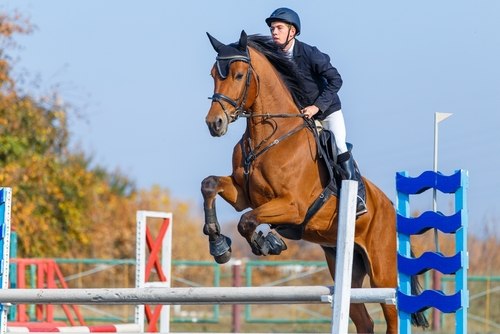
On approach to a fence, your eyes should be up and focused on a point beyond the jump or on your next fence in a course. Not on the top rail. Not at the base of the jump. Not at the ground. Up and ahead. Your chin should be level or slightly lifted, and your gaze should be soft, taking in the whole picture rather than laser-focusing on one spot.
Over the fence itself, you should already be looking at your next target. In a course, that means your eyes move to the next jump before you've even landed from the current one. On a single fence, look toward the end of the arena or wherever your track continues.
UC Davis researchers studying rider-horse interaction have noted that experienced riders fixate on the landing zone an average of two full strides earlier than novice riders. Two strides. In a 12-foot canter stride, that's 24 feet of visual planning difference. The horse knows.
This isn't just about looking pretty. Your body follows your eyes. Where your head goes, your shoulders go. Where your shoulders go, your weight shifts. Your horse feels every one of these shifts and adjusts accordingly. Look left, and you'll drift left. Look down, and you'll tip forward. Look up and ahead, and your body naturally stays in balance over the center of the horse. It's biomechanics, not magic, though it sometimes feels like magic when it finally clicks.
Common Eye Errors
Staring at the base of the jump. This is the most common mistake in beginner jumping. You fixate on the takeoff point because you're trying to figure out when the horse will leave the ground. Problem is, looking down tips your upper body forward, which loads the horse's forehand right when they need to lift it. You're literally making it harder for them to jump. It also creates a ducking motion over the fence that throws your whole position off and can catch you behind the motion on landing.
Looking at the top rail. Better than looking at the base, but still not great. When you focus on the rail, your eye stops there, and your body tends to freeze at the top of the arc. You lose the forward flow, and your horse can feel that hesitation. Some horses will stop or chip in an extra stride because the rider's body said "wait" without meaning to. The rail is not your business. Your business is what comes after it.
Dropping your head on landing. Even riders who look up on approach sometimes drop their chin on the landing side. This pitches your weight forward at exactly the wrong moment, when the horse needs to rebalance after landing. If you've ever felt like you're going to go over your horse's head on landing, check your eyes first. Nine times out of ten, the head dropped.
Turning your head too early. In courses with tight turns, some riders whip their head around to find the next jump before they've even completed the current one. A little anticipation is good. Necessary, even. But turning too aggressively shifts your weight and can cause your horse to drift, land on the wrong lead, or even run out at the next fence because the line got crooked. Think "glance," not "snap."
Closing your eyes. Don't laugh. It happens more than you'd think, especially with nervous riders or when fences get bigger. Some riders don't fully close their eyes but kind of glaze over, unfocusing to the point where they're not really seeing anything. If this is you, it's a confidence issue more than a technique issue, and the answer is to go back to a height where you feel solid and build back up. There's no shame in dropping the fences. There's plenty of shame in jumping blind.
Finding Distances
Cornell's equine sports science group published findings suggesting that rider visual fixation patterns predict refusal rates at fences above 1.1 meters. Riders who locked onto the top rail within five strides of the fence had refusal rates nearly triple those of riders whose gaze passed over and beyond the obstacle. Triple. The horse was reading the rider's commitment through body language that originated entirely from where the eyeballs pointed.
Now here's where eye position gets really interesting. "Seeing a distance," knowing whether you'll meet the jump at a good takeoff spot, is partly about experience and partly about how you use your eyes.
Good distance-finders don't calculate the exact stride. What they do is look at the fence with soft eyes from about six to eight strides out and develop a feel for the rhythm. They see whether the current canter rhythm will produce a comfortable distance or whether an adjustment is needed. It's more feeling than math, despite what those "count back from five" exercises suggest.
The key is seeing the jump early and then not fixating on it. You acknowledge the fence, assess the rhythm, make your adjustment (half halt to wait, or a little leg to move up), and then your eyes go past the fence to your landing target. Riders who stare at the jump tend to freeze and either bury their horse at the base or chase a long distance out of anxiety. The stare creates tension. Tension kills rhythm. Dead rhythm produces bad distances. It's a cascade.
One exercise that helps enormously: set a ground pole or small crossrail and canter over it on a circle. Don't worry about finding a distance. Just focus on keeping your eyes on a focal point across the arena and maintaining a consistent rhythm. Let the jump come to you. This teaches your brain that you don't need to "do" anything dramatic at the base. The rhythm does the work. Your eyes just keep moving forward.
Exercises to Improve Your Eye
The focal point drill. Pick a spot on the wall at the far end of the arena, a letter, a poster, a smudge, whatever. Keep your eyes on it while trotting or cantering toward a ground pole. Don't look at the pole at all. Notice how your body stays in better balance when you're not hunting for the distance. This exercise feels counterintuitive at first. Trust it.
Course walking with intention. When you walk a course before jumping it, don't just count strides. Stand at each fence and look at where your eyes need to go from that point. Find your next focal point from each jump. Memorize the eye plan, not just the track. The riders who walk courses efficiently aren't just pacing distances. They're mapping their visual sequence.
Grid work. Gymnastics and grid exercises are fantastic for eye training because the distances are set for you. You don't need to find anything; just maintain rhythm and keep your eyes up. It takes the anxiety out of distance-finding and lets you focus purely on position and eye discipline. Start simple. A trot-in to a one-stride to a small oxer. Eyes up the entire time.
Turn and look. On a figure-eight over two jumps, practice turning your head to find the second fence while still in the air over the first. Start with crossrails so the height isn't intimidating. This builds the habit of always seeking the next target, training your visual system to stay one step ahead of your body.
Peripheral vision training. Ride without looking directly at the jump at all. Use your peripheral vision to be aware of the fence while your central focus stays on a point beyond it. This is actually closer to what elite riders do naturally. They don't stare at fences. They're aware of them in their peripheral field while their direct gaze is already past the obstacle and onto the next task.
Mental Side of Looking Up
There's a psychological component to this that doesn't get discussed enough. Looking down is a fear response. When you're anxious, your brain wants to monitor the threat, and the threat, as far as your lizard brain is concerned, is that big solid thing in your path. Looking up requires trust: trust in your horse, trust in your training, trust that the distance will work out even if you're not micromanaging it.
This is why eye position often degrades as fences get bigger. At two feet, you're relaxed and looking ahead naturally. At three feet six, suddenly you're peeking at the top rail again. If you notice this happening, it's valuable information. It tells you where your confidence boundary is, and you can work systematically to expand it. Stay at the height where your eyes stay up, build confidence there, then inch the fences up gradually.
Some riders find it helpful to talk to themselves on course. Just a quiet "look up" or "eyes" before each fence. It sounds weird, but it gives your conscious brain a job to do instead of letting the anxious part take over. Others use breathing cues, exhaling on the approach to prevent the breath-holding that accompanies the downward stare.
AAEP sport horse committee publications emphasize that visual discipline separates competent jumping riders from truly effective ones. Your eyes orchestrate the entire kinetic chain. Shoulders, core, pelvis, leg position, rein contact: every single piece of your riding body takes directional cues from your skull, and your skull follows your gaze. The physics are relentless.
Veteran course designers know this too. They build tracks that punish wandering eyes. That bending line to the skinny vertical? It's testing whether your visual plan holds under pressure. The triple combination on a curve? Same thing. Courses at the upper levels are as much an exam of visual strategy as they are of athleticism. Horses rarely miss. Riders miss constantly, and it almost always starts with the eyes going somewhere useless.
The riders who make jumping look effortless? Watch their heads. Their eyes are always two steps ahead, calm and deliberate, guiding their body and their horse around the course. It's not something they were born with. It's something they practiced until it became second nature. And you can do the same thing, one ground pole at a time.
📝 Work on your jumping fundamentals in our Courses. Check it out here.
Jaynee's Note: My first real trainer taught me to look up and over the fence, never down at it. The day I stopped staring at the jump was the day my distances got ten times better.
Frequently Asked Questions
Where should I look when approaching a fence?
Look at the top rail of the fence during your approach to help judge the distance, then lift your eyes to look past the fence about two strides out. By the time you leave the ground, your eyes should already be focused on where you're going next, whether that's the next fence, a turn, or a line across the ring.
Why does looking down cause problems over fences?
Your head weighs about 10 to 12 pounds. When you drop your eyes and tip your head forward, that weight shifts your center of gravity ahead of the horse's motion. This pulls you onto the horse's forehand, makes it harder for the horse to use its back and bascule over the fence, and frequently causes you to get ahead of the motion or catch the horse in the mouth on landing.
How do I break the habit of looking down at fences?
Practice over ground poles and small crossrails where the stakes are low. Have someone stand past the fence holding up fingers and call out the number as you jump. Gymnastic exercises help because the distances are set for you, freeing your brain to focus solely on eye discipline. It takes conscious repetition, but most riders can retrain this habit in a few weeks of focused effort.
Does eye position really affect my horse's jump?
Yes. Where you look determines your upper body position, which directly affects your balance and weight distribution over the horse's back. Riders who look up and ahead stay centered in the saddle, allow the horse freedom through its back, and land in balance ready for the next element. Riders who look down collapse forward and interfere with the horse's jumping mechanics.
- "Rider Visual Focus and Its Impact on Equine Performance" - Texas A&M Equine Science tamu.edu
- "Biomechanics of the Rider Over Fences" - UC Davis Center for Equine Health ucdavis.edu
- "USHJA Trainer Certification Program - Jumping Position" - United States Hunter Jumper Association ushja.org
- "Sport Psychology for Equestrians" - AAEP Convention Proceedings aaep.org
- "Visual Search Strategies in Equestrian Sports" - Merck Veterinary Manual merckvetmanual.com
Sources
- "Rider Visual Focus and Its Impact on Equine Performance" - Texas A&M Equine Science tamu.edu
- "Biomechanics of the Rider Over Fences" - UC Davis Center for Equine Health ucdavis.edu
- "USHJA Trainer Certification Program - Jumping Position" - United States Hunter Jumper Association ushja.org
- "Sport Psychology for Equestrians" - AAEP Convention Proceedings aaep.org
- "Visual Search Strategies in Equestrian Sports" - Merck Veterinary Manual merckvetmanual.com