Chestnuts and Ergots on Horses: What Are They?
Somewhere on your horse's legs, weird little growths sit like they don't belong. Flat, waxy, sometimes flaky callus patches on the inside of the legs. Small nubs tucked into the fetlock hair at the back. If you've ever peeled one off during grooming and stared at it wondering what exactly you just pulled off your horse, join the club.
These structures are some of the most tangible evidence of equine evolution you can hold in your hand. Their story reaches back roughly 55 million years.
What Are Chestnuts?
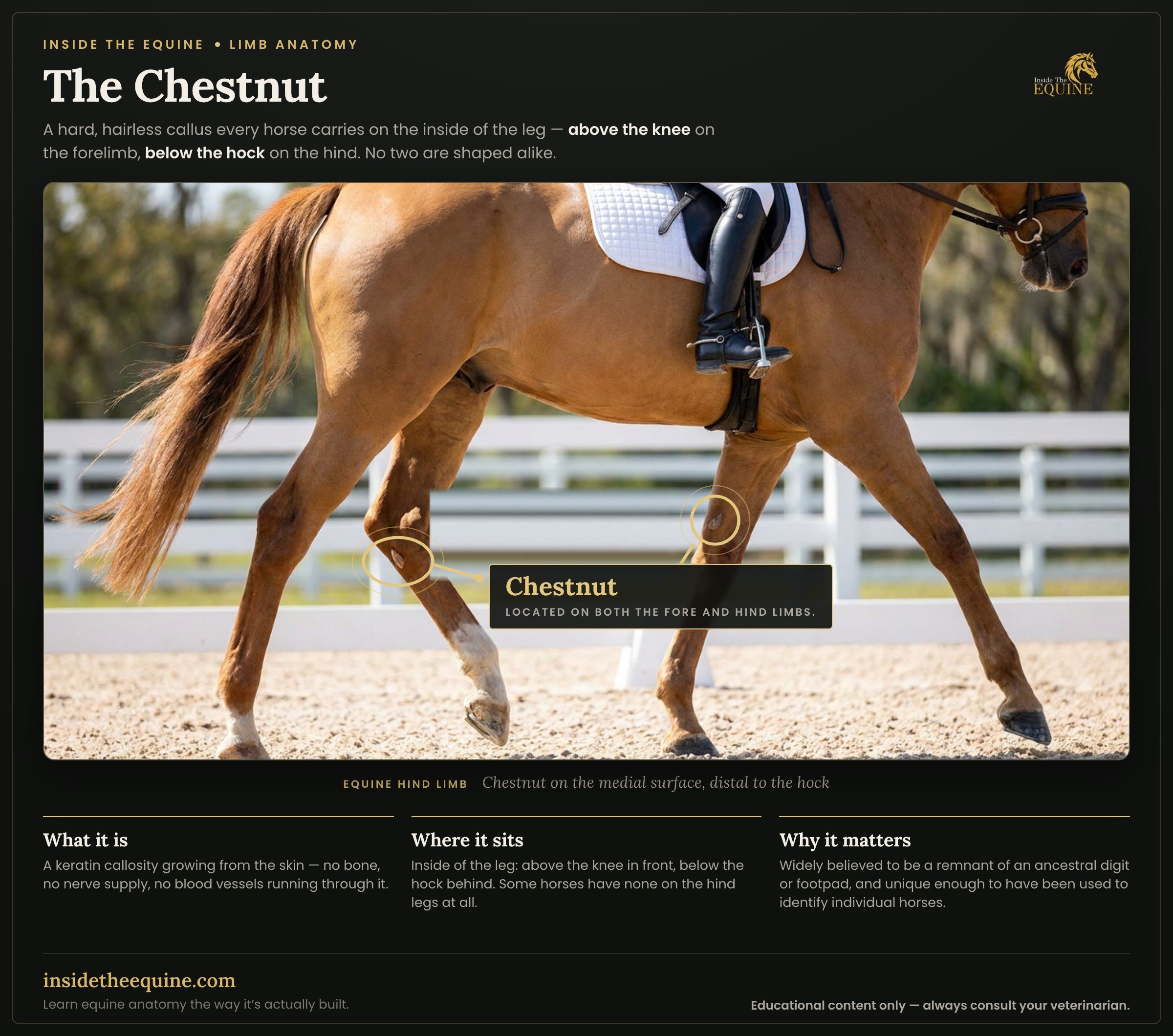
Chestnuts (sometimes called "night eyes" in older texts) are small, flat, irregular patches of tough, cornified epithelium on the medial surface of all four legs. Front legs: above the knee. Hind legs: below the hock. Some horses grow prominent ones that stick out like shelf fungi. Others have barely visible chestnuts lying nearly flush with skin. Mules frequently lack hind chestnuts entirely. Donkeys typically miss them on the hind legs too, one of those subtle anatomical markers distinguishing equid species.
The tissue resembles hoof horn: keratinized, hard, layered. It grows continuously, though slowly. Outer layers dry out periodically and can be peeled or flaked off without any pain, since there's no blood supply to the external portion. Like peeling a callus. Underneath the dry exterior sits a softer, living base. Leave that alone.
Size varies wildly. Between individuals, between breeds, even between legs on the same horse. One front chestnut the size of a quarter, the other half a playing card. Draft breeds and warmbloods tend toward larger, thicker chestnuts. Arabians lean smaller and flatter. Generalizations, both of them, with exceptions in every barn aisle.
What Are Ergots?
Ergots hide at the back of the fetlock joint, buried in the tuft of hair called the feather. On heavily feathered breeds like Clydesdales and Friesians, you have to dig through hair to find them. On lighter breeds, they may be small enough to ignore entirely.
Also keratinized tissue. Size ranges from tiny pea-sized nubs to surprisingly large, horn-like projections that look like something from a mythology textbook. Some horses grow them long enough to curl downward or sideways, acquiring a claw-like appearance that startles people unfamiliar with the structure.
All four fetlocks carry them, though hinds are sometimes smaller. Growth rate is typically slower than chestnuts, which explains why many owners go months without ever noticing.
Why Do Horses Have These?
Vestigial toes. That's the most widely accepted explanation.
Modern horses walk on a single digit, the third toe. But their distant ancestors, Hyracotherium (formerly Eohippus), had four toes on the front feet and three on the back. Over roughly 55 million years of evolution, shifting from forest-dwelling browsers to open-grassland runners, those extra toes gradually shrank. The modern equine skeleton still carries evidence: splint bones flanking the cannon bone are vestigial metacarpals from toes two and four. Chestnuts are thought to be remnants of footpads or scent glands associated with those vanished digits.
Ergots represent what's left of the footpad beneath the ancestral second and fourth toes. Their position at the back of the fetlock, approximately where those absent toes would have contacted ground, supports the theory. Comparative anatomists point to similar structures in other odd-toed ungulates (tapirs, rhinos) as further evidence of shared ancestry.
Not everyone agrees on exact homology. Some researchers suggest chestnuts are carpal and tarsal pad remnants (like a dog's wrist pad). Others link them to scent glands ancestral equids used for territorial marking. The ergot-as-footpad theory has broader consensus. Regardless, both structures are clearly vestigial. Leftovers from a body plan the horse outgrew but never fully shed.
Are They Unique to Each Horse?
Yes, and this is genuinely cool. Chestnut patterns appear to be unique to each individual horse, functioning somewhat like fingerprints. Shape, size, texture, ridge patterns: all individual-specific. Some breed registries historically used chestnut photographs for identification. The Jockey Club maintained records with detailed chestnut descriptions for Thoroughbred racing identification for decades.
Modern microchipping and DNA testing have reduced this practice. But chestnut morphology remains a testament to individual variation. No two horses share identical chestnuts, not even across their own four legs. Forensic and insurance identification work still occasionally references them when other records are incomplete.
Grooming and Maintenance
Neither structure demands much. Periodic attention keeps things tidy and prevents them from growing large enough to catch or cause discomfort.
Chestnuts: Easiest right after a bath when moisture has softened the keratinized layers. Grip the dried portion and gently pull or twist. It should come away in flakes or sheets. If it won't budge, it's not ready. Don't reach for a knife. You risk cutting into living tissue. Baby oil or mineral oil applied the night before softens stubborn ones. Some people swear by coconut oil. Whatever conquers your particular horse's brand of keratin stubbornness.
Ergots: Small ones can be left alone indefinitely. Larger ones trim easily with sharp nippers (hoof nippers work, or heavy scissors for small ones). Best done after bathing when the tissue has softened slightly. Trim conservatively. Just excess growth, don't excavate the base. If you're uncertain where insensitive tissue ends and sensitive begins, leave more. Your farrier will often trim them during regular visits without being asked.
For show horses, tidying chestnuts and ergots is standard. Gives the leg a cleaner look in the ring. For backyard horses, it's practical: large ergots collect mud in the fetlock hair, and oversized chestnuts can snag blanket straps. Neither structure causes problems if left alone. Purely cosmetic and comfort maintenance.
When Something Looks Wrong
- Sudden rapid growth. A chestnut that's always been small and starts growing quickly or changing texture warrants a vet conversation. Abnormal keratinization can occasionally signal metabolic changes, including Cushing's disease (PPID), which disrupts keratin production system-wide.
- Bleeding or sensitivity. Tenderness, bleeding, or infection at a chestnut or ergot site isn't normal. Ergots near the fetlock sit close to the coronary band and other sensitive structures. Horses occasionally catch an ergot on something and partially tear it off. Bleeds impressively for a minor injury.
- Absence. Missing hind chestnuts in donkeys, mules, and some individual horses is completely normal. If a previously present chestnut gets rubbed or torn off, the base typically regenerates new keratinized tissue over several months.
- Horn-like ergot overgrowth. Some horses grow substantial ergots that curve and harden like miniature hooves. Can crack or snag on things. Regular trimming prevents this.
- Warty or irregular texture. Sarcoids and other skin tumors can develop near chestnut or ergot sites. Any growth that looks markedly different from normal keratinized tissue, especially pink, ulcerated, or growing in an unusual pattern, needs veterinary examination.
A Window Into Deep Time
What makes chestnuts and ergots genuinely fascinating isn't the grooming or the identification angle. It's that every time you peel one off your horse's leg, you're touching a structure connecting directly to an animal 55 million years gone. A small, dog-sized creature with multiple toes, padding through subtropical forests, eating leaves off low branches.
Evolution doesn't always clean up after itself. Sometimes it just shrinks things. Tucks them away. Leaves calling cards. The splint bones. The chestnuts. The ergots. Receipts from a very long journey. Whales still carry vestigial pelvic bones buried in muscle. Humans have an appendix that mostly causes trouble. Horses have these odd keratinized bumps, quiet reminders of a body plan that served perfectly well for millions of years before grasslands replaced forests and running replaced hiding.
Next time you're picking feet or bathing legs, look at these structures for real. They're easy to overlook. But 55 million years of story deserve a second glance. You can explore more equine anatomy to see how other structures tell their own evolutionary tales.
🔍 See where chestnuts and ergots sit relative to other limb structures in our 3D Explorer. Check it out here.
Jaynee's Note: I remember being a little kid grooming a horse for the first time and asking my mom what the weird crusty things on the legs were. She had no idea either — we had to ask the barn manager.
Frequently Asked Questions
Is it safe to peel off a horse's chestnuts?
Yes. The outer layers of a chestnut are dead, keratinized tissue with no blood supply or nerve endings. Peeling them off is painless, like removing a callus. The best time is after bathing when moisture softens them. Never cut into the softer living base underneath. If a chestnut doesn't peel easily, leave it for another day or soften it with baby oil overnight.
Do all horses have chestnuts and ergots?
Almost all horses have both. However, donkeys and mules commonly lack hind chestnuts, and some individual horses have very small or nearly invisible chestnuts or ergots. All four legs typically carry both structures in domestic horses, though size varies dramatically between breeds, individuals, and even between legs on the same animal.
Can chestnuts be used to identify a horse?
Yes. Chestnut patterns are unique to each horse, similar to human fingerprints. The Jockey Club historically used detailed chestnut descriptions and photographs as part of Thoroughbred identification for racing. Modern microchipping and DNA testing have largely replaced this method, but chestnut morphology still serves as supplementary identification in forensic and insurance contexts.
Why is my horse's chestnut suddenly growing faster?
Sudden changes in chestnut growth rate or texture can occasionally indicate metabolic disorders, particularly Cushing's disease (PPID), which affects keratin production throughout the body. If a previously small chestnut begins growing rapidly or changes in appearance, mention it to your veterinarian during the next visit. It may be nothing, but it's worth ruling out systemic causes.
Should I trim my horse's ergots?
Only if they've grown large enough to cause practical problems, such as collecting mud and debris in the fetlock hair, catching on things, or curling into uncomfortable shapes. Small ergots can be left alone indefinitely. When trimming is needed, use sharp nippers or heavy scissors, trim conservatively, and stop well short of the sensitive base tissue. Your farrier can handle this during regular visits.
- "Equine Evolution and Vestigial Structures" - Texas A&M College of Veterinary Medicine tamu.edu
- "The Evolution of the Horse" - Cornell University cornell.edu
- "Equine Limb Anatomy" - UC Davis Center for Equine Health ucdavis.edu
- "Description and Physical Characteristics of Horses" - Merck Veterinary Manual merckvetmanual.com
- AAEP - "Equine Dermatology" aaep.org
Sources
- "Equine Evolution and Vestigial Structures" - Texas A&M College of Veterinary Medicine tamu.edu
- "The Evolution of the Horse" - Cornell University cornell.edu
- "Equine Limb Anatomy" - UC Davis Center for Equine Health ucdavis.edu
- "Description and Physical Characteristics of Horses" - Merck Veterinary Manual merckvetmanual.com
- AAEP - "Equine Dermatology" aaep.org
Curious about more anatomical features?
Our Anatomy course covers external landmarks, skeletal structure, and body systems.
Explore the Anatomy CoursePro members only. Try Pro free for 7 days.