Desensitizing a Horse Done Right: Habituation, Not Just Wearing Them Out
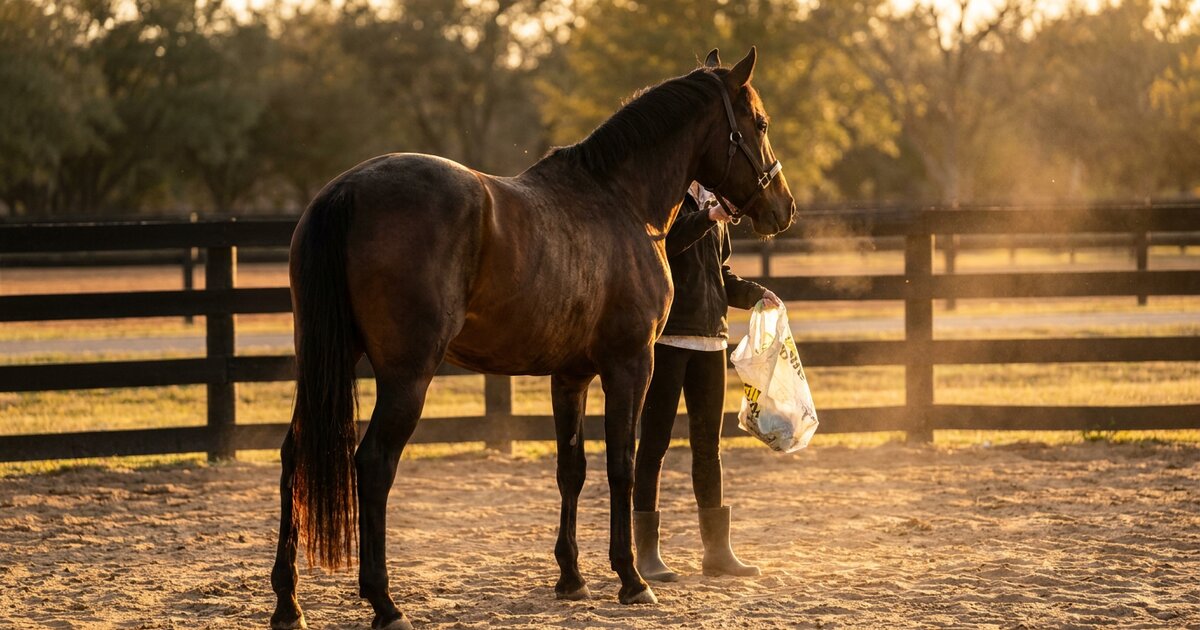
You have seen it at almost every barn. Someone snaps a tarp over a tied horse, waits out the panic, and calls the horse "desensitized" the moment it stops thrashing. From the outside it looks like a win. The horse is still. But standing still and feeling safe are two completely different things, and the gap between them is where a lot of well meaning training quietly goes wrong. Real desensitization is not about outlasting a horse's fear. It is about changing how the horse feels in the first place, one manageable step at a time. For more details, see our guide on Negative Reinforcement in Horse Training. You may also find our article on Reading Horse Ear Positions helpful.
What does desensitizing a horse actually mean?
Desensitizing means reducing a horse's reaction to something it currently finds alarming, until that thing becomes background noise. The underlying mechanism is called habituation, which behavior scientists define as the progressive decrease in the strength or frequency of a response after repeated exposure to a stimulus. In plain barn terms, the horse learns that the plastic bag, the clippers, or the umbrella is not worth reacting to. You may also find our article on Cribbing in Horses helpful. You may also find our article on Correct Riding Position helpful.
One detail that surprises people is that habituation is stimulus specific. A horse that has calmly accepted a blue tarp on its left has not automatically accepted a flapping raincoat, or even the same tarp coming from behind. The brain habituates to the exact thing it was exposed to, not to "scary objects" as a category. That is why thorough desensitization means working through many objects, angles, sounds, and locations rather than assuming one success covers everything.
It also matters that desensitization is an emotional process, not just a behavioral one. You are not only trying to stop the spook. You are trying to change the horse's internal assessment from "threat" to "no big deal." When you get that part right, the calm behavior holds up under pressure. When you only suppress the behavior, the fear is still sitting underneath, waiting for a bad day to resurface.
The four terms every owner should actually understand
The confusion around desensitizing usually comes from mixing up four related but distinct concepts. Getting them straight makes everything else easier.
Habituation is the end goal: the horse stops responding to a stimulus because repeated, non threatening exposure has taught it the thing predicts nothing bad. It is the natural result you are aiming for.
Systematic desensitization is the method for getting there. You expose the horse to a weak version of the trigger, one it can handle without panicking, and you only step the intensity up when the horse reliably stays relaxed at the current level. Distance, volume, movement, and duration are all dials you can turn down to make the first step small enough.
Counter conditioning changes the emotional meaning of the object by pairing it with something the horse genuinely likes, usually food or a wither scratch. Instead of clippers predicting fear, clippers start to predict a treat. Systematic desensitization and counter conditioning are frequently used together, and the combination tends to be faster and more durable than exposure alone.
Overshadowing is a more advanced technique where a stronger, well understood cue (such as leading the horse forward and back) captures its attention and outcompetes the fear response, while the scary object stays at a safe distance. Because the horse is busy with a task it knows how to answer, the aversive stimulus loses some of its grip.
Why flooding backfires
Flooding is exposure without escape. The horse is tied, cornered, or held and made to face the full intensity of the frightening thing until it stops reacting. Trainers who use it are relying on the moment the horse "gives up." The problem is that giving up is not the same as calming down.
The International Society for Equitation Science, whose training principles are drawn directly from learning theory, is blunt about this. Their guidance warns that desensitization techniques involving flooding may lead to stress and produce phobias. When a horse cannot escape an aversive stimulus it cannot control, it can slide into a state called learned helplessness. The animal appears to tolerate the object, but its welfare is seriously compromised and it has essentially learned that nothing it does matters.
There is a second, more technical trap. If the frightening stimulus is removed while the horse is still highly aroused, that removal can act as a reward for the panic. In behavior terms the fear response gets negatively reinforced and strengthened, so the next exposure can be worse. Flooding does not just risk shutting a horse down. Done clumsily, it can teach the horse that thrashing eventually makes scary things go away.
The tell is in the body, not the feet. A flooded horse often stands rigid while holding its breath, tucked up through the barrel, with visible tension around the muzzle and eyes. A truly habituated horse breathes, licks and chews, softens its eye, and will lower its head or investigate the object by choice. Emotions matter more than behavior here, and a still horse with a hard, worried face is not a trained horse. It is an overwhelmed one. For more details, see our guide on Understanding Horse Body Language.
| Feature | Systematic Desensitization (done right) | Flooding (the shortcut) |
|---|---|---|
| Intensity | Starts low, rises in small steps | Full intensity from the start |
| Escape option | Horse can move away, stays under threshold | Restrained, no way out |
| Emotional result | Genuine calm, curiosity returns | Suppression, risk of learned helplessness |
| Durability | Holds up under new pressure | Can collapse or rebound as a phobia |
How do you keep a horse under threshold?
Staying under threshold is the single most important skill in this whole process, and it means keeping the horse below the point where fear takes over its thinking brain. Below threshold, a horse can notice something, evaluate it, and choose to relax. Above threshold, it cannot learn anything useful because it is running on pure flight instinct.
Approach and retreat is the practical tool that keeps you there. You bring the scary object toward the horse (or bring the horse toward the object) only to the point where you see the first flicker of concern, then you take the pressure away before the horse feels the need to leave. That retreat is the reward. Over repetitions, the distance the horse tolerates shrinks, because it learns the object always backs off before things get bad.
Grading is how you make the steps small enough to succeed. Almost any trigger can be softened by adjusting a few dials.
- Distance: start with the object across the arena rather than at the horse's shoulder.
- Movement: a folded, still tarp on the ground is far less alarming than one being shaken.
- Volume: run clippers in your pocket ten feet away before they ever touch the horse.
- Duration: a two second exposure the horse handles beats a thirty second one that tips it over.
- Body location: most horses accept things at the shoulder long before the hindquarters, ears, or face.
The rule of thumb from systematic desensitization is simple: only turn a dial up when the horse reliably stays relaxed at the current setting. If you get a reaction, you went too far, too fast. Drop back to the last easy level, get a couple of calm repetitions, and rebuild from there.
Why timing and the release do the teaching
Horses learn from what happens the instant they relax, which makes your timing more important than your equipment. The moment that teaches is the release: the second you remove or reduce the scary thing while the horse is calm, you are telling it that calm made the pressure stop.
This is where sessions unravel. If you keep a tarp on a horse until it panics and only then pull it off, you have rewarded the panic. If instead you rest the tarp on its back for two seconds while it stands quietly and remove it before any worry builds, you have rewarded the stillness. Same tarp, opposite lesson, decided entirely by when your hands moved.
Counter conditioning sharpens this further. Feeding a treat or offering a scratch at the exact moment the horse notices the object, before fear escalates, stacks a positive association on top of the release. Over time the horse's first reaction to the clippers switches from bracing to looking at you expectantly. That is a genuine emotional flip, not a suppressed one.
Working through common objects: tarps, clippers, spray, and bags
The same framework covers most of the everyday spook triggers, with small tweaks for each.
Tarps and plastic bags
These are visual and auditory triggers because of the flap and crinkle. Start with the tarp folded small and motionless on the ground, let the horse investigate on a loose lead, then gradually unfold it, lift it, and eventually drape it. A plastic bag tied to the end of a whip lets you present the crinkle at a controlled distance and pull it back the instant the horse relaxes.
Clippers
Clippers combine sound, vibration, and touch, so grade them separately. First habituate the horse to the buzz from a distance, then to the vibration of the clipper body (turned off) against the shoulder, then the running clippers near the body, and only much later the actual clipping of sensitive areas. Overshadowing, where you keep the horse's feet lightly busy, is genuinely useful for clippers and needles.
Spray
Spray bottles startle with both sound and sensation. Start by spraying water into the air several feet away, or spray a cloth and wipe it on, before ever spraying the horse directly. Aim for large body areas first and save the legs and face for last.
Across all of these, resist the urge to "test" the horse by cranking the intensity to see if it holds. Testing at full volume is just flooding with extra steps.
Tired is not the same as trained
One of the most common mistakes is confusing a tired horse with a confident one. Longeing a horse into exhaustion before introducing a scary object, or drilling an exposure until the horse is too worn out to react, produces a quiet horse for that session. It does not produce habituation. You have changed the horse's energy, not its opinion of the object.
The difference shows up the next day. A genuinely desensitized horse meets the tarp calmly when fresh, because the emotional learning is stored. A merely tired horse comes back the following morning and spooks at the same tarp all over again. If your "progress" evaporates overnight, you were managing fatigue, not building confidence.
The same logic exposes why a horse that "stopped reacting" mid session is not always a success. Ask whether it stopped because it feels safe, or because it is out of gas. A relaxed, curious, breathing horse is habituating. A dull, braced, unresponsive one is telling you to back off.
Knowing when to stop
The best time to end a session is on a small, genuine success, while the horse is still relaxed and engaged. Ending on a good moment lets that positive state consolidate, and the horse walks away with its last memory being a calm one. Chasing "just one more repetition" is how good sessions turn into bad ones.
Stop, or drop back a level, the moment you see the horse tipping over threshold: head cranking up, breath held, muscles bracing, feet wanting to leave, eyes and muzzle going hard. Pushing through those signs is the road toward flooding and learned helplessness. Short, frequent, successful sessions beat long, dramatic ones. Five focused minutes that end well will out perform an hour long battle, and they protect the trust that makes the next session possible.
If a horse's fear seems extreme, does not improve across calm sessions, or is tied to a handling area that might involve pain, involve professionals. A qualified trainer who works from learning theory, and your veterinarian to rule out a physical cause, will get you further than force ever will.
Frequently Asked Questions
How long does it take to desensitize a horse?
There is no fixed timeline, because it depends on the horse, the trigger, and how consistently you work under threshold. Many horses make visible progress on a single object over a few short sessions, but full, reliable calm across many objects and situations takes weeks to months. Rushing to hit a deadline is the fastest way to tip into flooding and lose the ground you gained.
Is desensitizing the same as habituation?
Not quite. Habituation is the outcome, the natural fading of a response after repeated non threatening exposure. Systematic desensitization is the deliberate, graded method trainers use to produce that habituation safely. When people say they are desensitizing a horse, they should mean using that careful method, not simply exposing the horse and hoping.
Can I use treats while desensitizing?
Yes, and it often helps. Pairing a scary object with food is called counter conditioning, and it changes the object's emotional meaning from threat to reward. The key is timing: offer the treat when the horse notices the object and is still calm, not as a bribe after it has already panicked, which would reward the fear.
How can I tell if my horse is really calm or just shut down?
Watch the whole body, not just the feet. A genuinely calm horse breathes normally, licks and chews, softens the eye and muzzle, lowers its head, and may investigate the object by choice. A shut down horse stands rigid, holds its breath, and carries obvious tension around the eyes and mouth. Stillness with a hard, worried face is a warning sign, not success.
Why does my horse spook at something it was fine with yesterday?
Because habituation is stimulus specific and context sensitive. A horse that accepted a tarp on its left in the arena has not necessarily accepted the same tarp from behind, in a new field, or on a windy day. Fatigue can also masquerade as progress, so if calm vanishes overnight, the horse was likely tired rather than truly habituated. Work each new variation as its own small step.
Sources
- McGreevy, P.D. (2012). Equine Behavior: A Guide for Veterinarians and Equine Scientists (2nd Ed). Saunders Elsevier.
- McLean, A.N. & Christensen, J.W. (2017). The application of learning theory in horse training. Applied Animal Behaviour Science, 190, 18 to 27.
- International Society for Equitation Science. Training Principles (Principle 5: Correct use of habituation, desensitization and calming methods). equitationscience.com.
- McGreevy, P.D. & McLean, A.N. (2010). Equitation Science. Wiley Blackwell.
- McDonnell, S. Habituation vs. Learned Helplessness in Horses. The Horse.
- Merck Veterinary Manual. Treatment of Behavior Problems in Horses. merckvetmanual.com.