Saddle Fit Basics: How a Poor Fit Affects Your Horse's Back
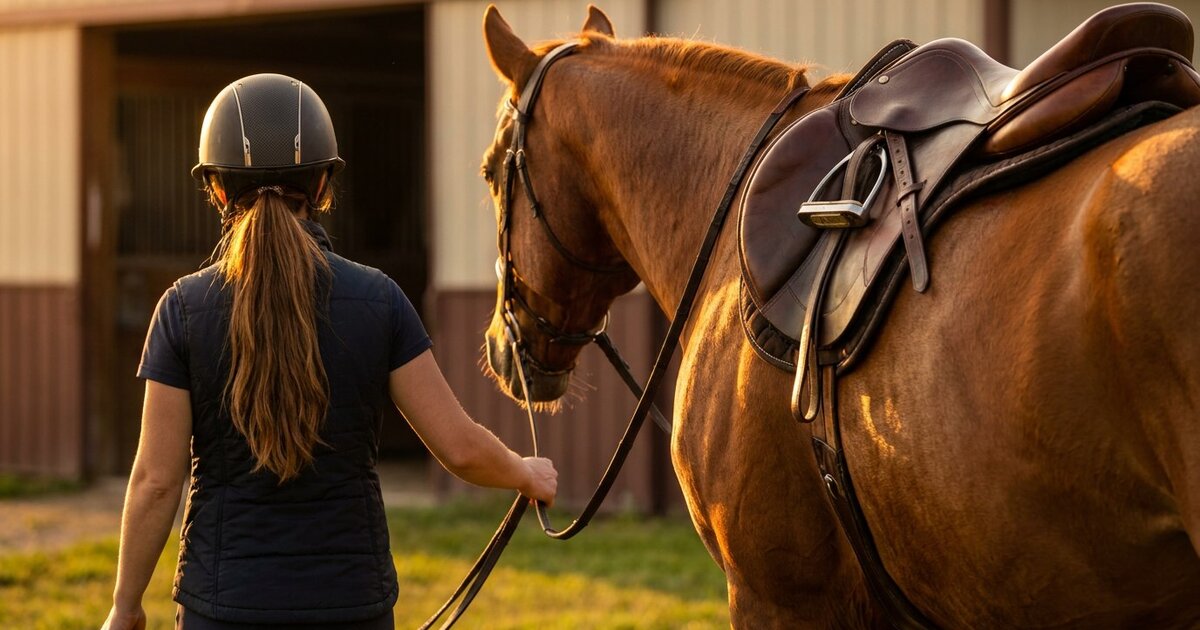
Your horse pins his ears when you bring the saddle out. He flinches during girthing. He's hollow through the back under saddle, refuses to step under behind, maybe bucks into canter transitions. You've tried different bits, worked on your position, even had the chiropractor out twice. And the whole time the problem has been sitting on his back for an hour every ride.
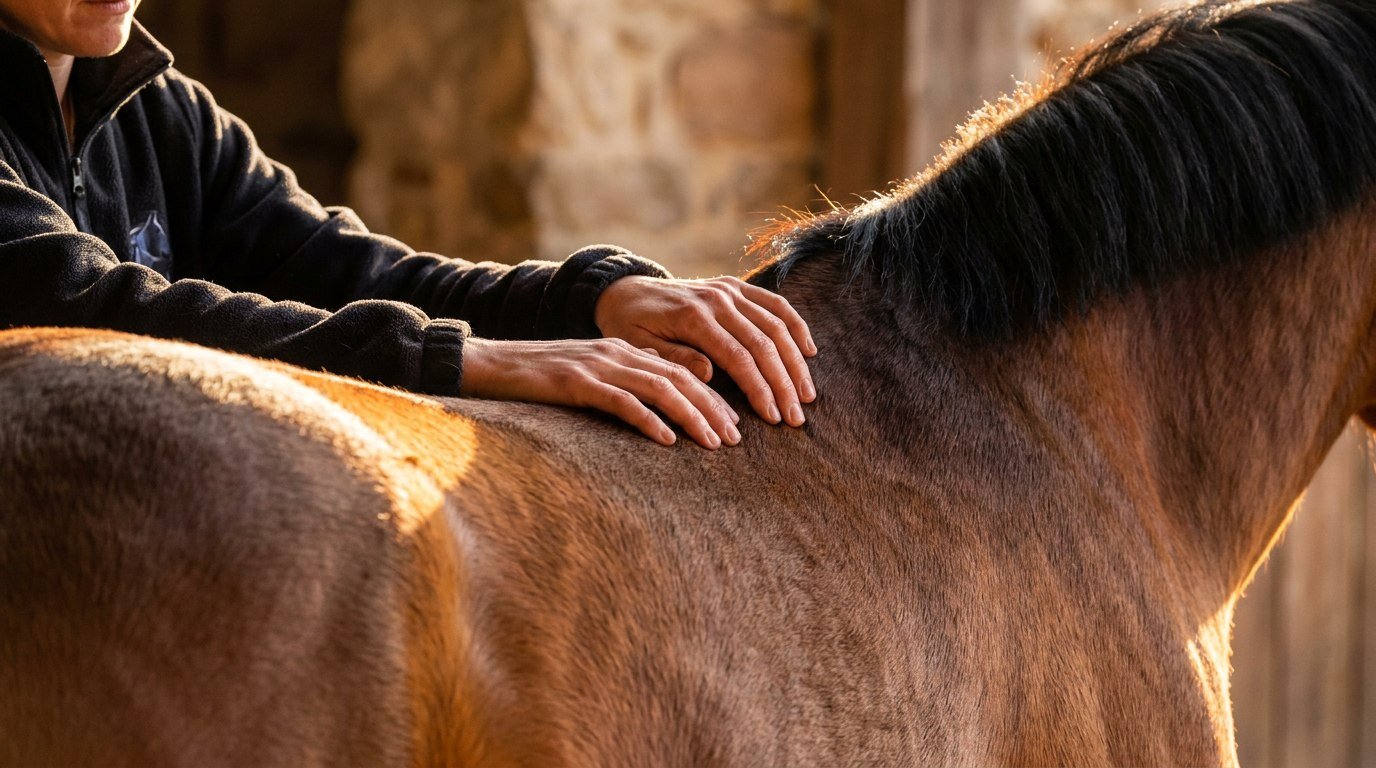
Bad saddle fit is stupidly common and shockingly destructive. It causes pain that horses can't articulate in words, so they articulate it in behavior that riders then label as "attitude" or "resistance." A horse cannot use his back properly if something is digging into it, bridging across it, or crushing the withers from above. The anatomy doesn't lie, even when the horse tries to cope.
The Tree: Where Fit Starts
Every rigid saddle has a tree. It's the internal skeleton, usually made of wood reinforced with steel or fiberglass, or sometimes fully synthetic. The tree determines the shape of the saddle, and if that shape doesn't match your horse's shape, no amount of padding or shimming will fix the fundamental mismatch.
Tree width is measured at the pommel, where two metal strips called the tree points angle downward on either side of the withers. These points sit in the muscular channel just behind the scapula. When the width is correct, the points rest parallel to the muscle without pinching or sitting wide and rocking on top of the spine. Too narrow, and the points dig into the muscle, compressing tissue and restricting shoulder movement. Too wide, and the saddle drops onto the withers, concentrates pressure on the spine, and creates instability.
Gullet width refers to the channel running along the underside of the saddle, above the horse's spine. This channel must be wide enough that no part of the saddle, panels included, contacts the spinous processes or the ligaments directly over them. A minimum of three fingers' width clearance is standard advice. Some horses with prominent spines or particularly well-muscled backs need more.
Wither Clearance: Not Just About Fingers
Everyone knows to check for wither clearance. Stick your fingers between the pommel and the withers. Two to three fingers is the general rule. But this check only tells part of the story.
A saddle can have beautiful clearance at the pommel and still press on the withers once a rider sits in it. Weight changes the equation. Always check clearance with someone mounted. The saddle will settle, the panels will compress, and the true fit reveals itself under load.
Also check clearance at the sides of the withers, not just the top. The tree points can pinch the lateral aspects of the wither even when the top has plenty of space. Run your flat hand under the pommel area from both sides. If your hand gets squeezed or you can feel the tree point pressing through the padding, that's a pressure point waiting to become a sore.
Panel Contact: Bridging and Rocking
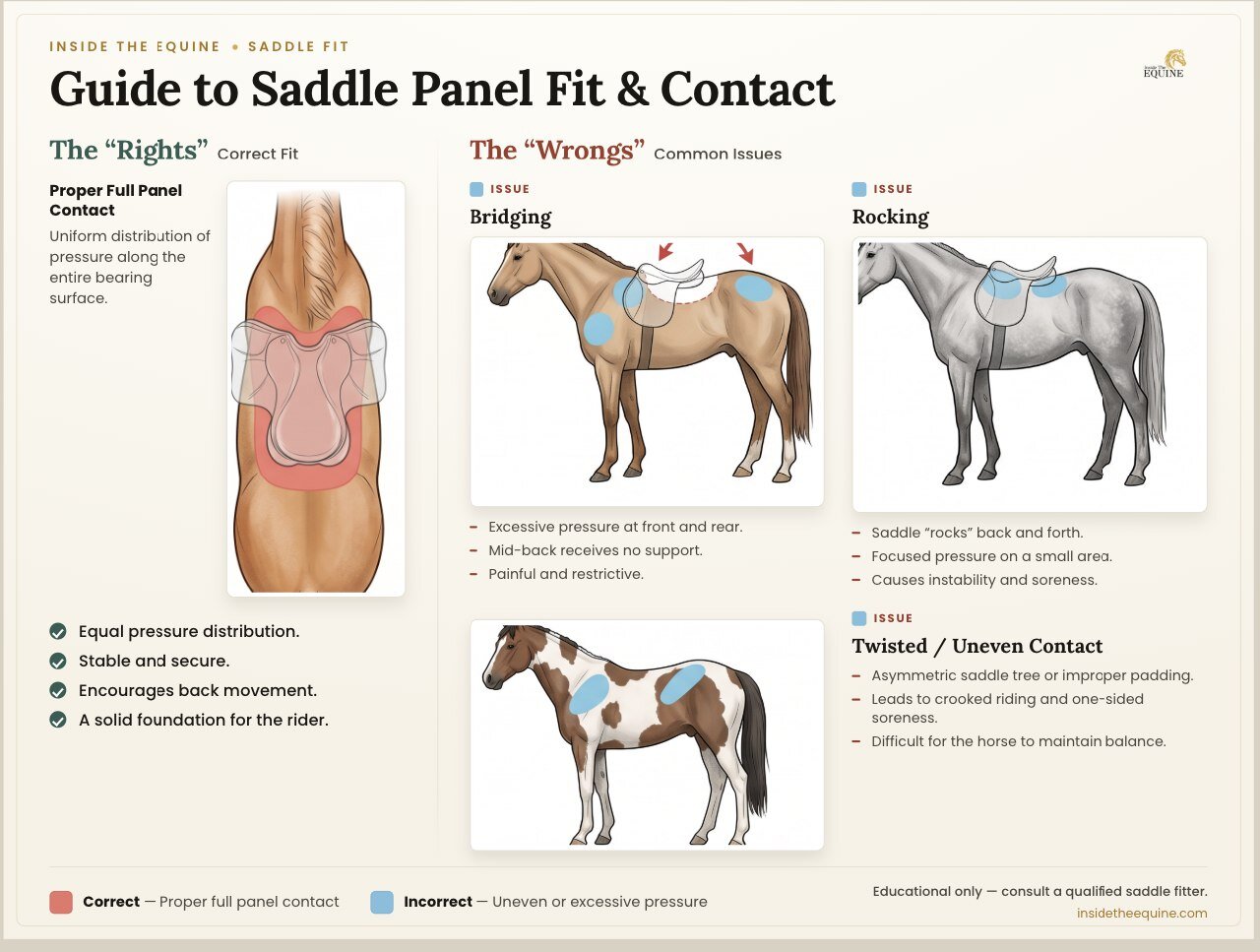
The panels are the cushioned undersides of the saddle that make contact with the horse's back. In a well-fitting saddle, the panels distribute the rider's weight evenly across the entire bearing surface. The pressure should feel uniform. No hot spots. No gaps.
Bridging happens when the saddle touches at the front and back but lifts away from the middle of the back. All the rider's weight concentrates on two small areas instead of spreading across the full panel. This creates intense pressure points at the pommel and cantle regions and leaves the middle of the back unsupported. Horses with long backs, swaybacks, or unusual topline shapes are especially prone to bridging.
Rocking is the opposite problem. The saddle sits solidly in the middle but the front and back lift up. It seesaws with every stride, creating instability and shifting pressure. Horses with short backs, high withers, or a pronounced uphill build sometimes experience this.
Both issues cause pain. Both cause compensatory movement patterns where the horse braces muscles to protect sore spots instead of swinging freely through the back. You can check for bridging or rocking by placing the saddle on the horse without a pad, pressing down at the pommel and cantle alternately, and looking for movement or gaps. A qualified fitter uses a pressure mapping system or templates to assess this with far more precision.
The Evidence Your Horse Leaves Behind
Horses tell you about saddle fit through their skin, their hair, their muscles, and their behavior. You just have to know what to read.
White spots. When sustained pressure damages hair follicles, the hair grows back white. These spots, typically appearing on either side of the withers or along the panel contact area, are scars from chronic pressure. They don't go away. If your horse develops white spots where the saddle sits, that's not a cosmetic issue. That's tissue that was compressed hard enough to kill the pigment cells in the follicles. By the time you see white hair, the damage has been ongoing for weeks or months.
Dry spots after work. Pull the saddle off after a ride and look at the sweat pattern on the horse's back. Ideally, the area under the panels should be evenly damp. Dry patches indicate areas of excessive pressure where blood flow was restricted enough to prevent sweating. Conversely, unusually wet areas surrounded by dry patches suggest uneven contact. The saddle is touching some areas heavily and missing others.
Muscle atrophy. This is the big one. Look at your horse's back from behind. The muscles on either side of the spine, the longissimus dorsi and the surrounding groups, should be full and symmetrical. If you see hollows or dips behind the shoulder blade where the tree points sit, that's atrophy from chronic pressure. The muscles have literally wasted away because the saddle prevented them from functioning normally. It's the equivalent of trying to do push-ups while someone stands on your shoulders. Eventually your body quits trying.
Atrophy can happen asymmetrically too. One side wastes more than the other, usually because the saddle shifts to one side due to the rider's crookedness or asymmetry in the flocking. This makes the fit progressively worse because now the saddle sits unevenly on an unevenly muscled back, which deepens the asymmetry. A vicious cycle.
Behavioral Red Flags
Pain makes horses do things riders find inconvenient. Some of the most common "behavioral problems" trace directly back to saddle fit:
Girthiness. The horse flinches, bites, or pins ears when you tighten the girth. Yes, some horses are just dramatic about it. But many are anticipating discomfort because a too-tight or poorly positioned girth (or a saddle that shifts when girthed) creates genuine pain.
Reluctance to move forward. A horse that won't go willingly off the leg might be avoiding the pain that comes when back muscles engage under a pinching saddle.
Bucking into canter. The canter requires significant back movement and engagement of the muscles under the saddle. If the saddle pinches or bridges during this more dynamic gait, the horse objects. Violently sometimes.
Refusing jumps. A saddle that shifts forward on landing or drives the tree points into the shoulder on the approach gives the horse a very rational reason to stop.
Head tossing and hollowing. When the back hurts, the horse inverts. Head goes up, back drops, hind legs trail out behind instead of stepping under. This is self-preservation, not disobedience.
When to Call a Fitter
Honestly? Before you have a problem. A professional saddle fit evaluation should happen when you buy a new saddle, when you buy a new horse, and then annually as a minimum because horses change shape. Young horses fill out. Older horses lose topline. Fitness levels fluctuate with training cycles. Seasonal weight changes shift everything. A saddle that fit in March might not fit in September.
Definitely call a fitter if you notice any of the physical signs described above. White spots, dry patches, atrophy, behavioral changes. Don't wait for it to get worse. And call one if your horse has had a significant change in workload, body condition, or if you've noticed the saddle sliding to one side consistently.
A good saddle fitter will evaluate the saddle both on and off the horse, check with and without a rider, assess the horse's back symmetry, and may use a pressure pad to map contact points. They should be willing to explain what they find and give you options rather than just pushing the most expensive solution.
Reflocking vs. New Saddle
Flocking is the stuffing inside the panels. Wool flocking can be adjusted by a fitter to change the contact pattern, add clearance, or correct minor asymmetries. If your saddle tree fits reasonably well but the panels have compressed unevenly or need reshaping, reflocking can solve the problem for a fraction of the cost of a new saddle.
But reflocking has limits. If the tree itself is wrong, too narrow, too wide, the wrong shape for your horse's back, no amount of restuffing will make it right. You can't pad your way out of a structural mismatch. And over-stuffing panels to compensate for a too-wide tree perches the rider up high with an unstable base. The panels themselves can also wear out or develop lumps that even fresh flocking can't smooth over.
Foam-paneled saddles typically can't be reflocked at all. Some newer designs use adjustable air or gel inserts. Each system has trade-offs, but wool remains the gold standard for customizable fit.
When a fitter tells you the saddle simply doesn't suit your horse's back shape, believe them. Pouring money into repeated adjustments on a fundamentally wrong tree is false economy. Better to sell it, find one that fits, and start fresh. Your horse's back will thank you by actually working properly for the first time in months.
Understanding the underlying anatomy of your horse's back helps you make sense of what a fitter is telling you and why certain issues matter more than others. The better you understand the structures underneath, the better advocate you become for your horse's comfort.
Frequently Asked Questions
How often should a saddle be professionally fitted?
At minimum, once a year. More frequently for young horses whose bodies are still changing, horses in intense work whose musculature shifts with fitness, or any horse that has had a significant change in weight or condition. Think of it like getting your own shoes checked. The structure you're fitting to doesn't stay static.
Can a saddle pad fix a badly fitting saddle?
A saddle pad can compensate for very minor issues, a thin shim for slight asymmetry, a bit of extra cushion for a mildly hard panel. But thick pads or multiple pads under a bad saddle actually make things worse. They raise the saddle higher, potentially reducing wither clearance, and the extra bulk can amplify pressure in areas that were already tight. Pads are not corrective devices for genuine fit problems.
Do treeless saddles solve fit issues?
They solve some and create others. Treeless saddles conform more closely to the horse's back shape, which eliminates tree-related pressure points. But without a rigid tree to distribute weight, the rider's seat bones can create concentrated pressure on the back muscles. They work well for certain horses and riders but aren't a universal fix. Wide-backed, well-muscled horses tend to do best in treeless designs.
What's the difference between a saddle fitter and a saddler?
A saddler makes and repairs saddles. A saddle fitter specializes in assessing the match between a particular saddle and a particular horse, often adjusting flocking and recommending changes. Some saddlers also fit, and some fitters also do leatherwork, but the skills are distinct. For fit evaluations, look for someone with formal training from organizations like the Society of Master Saddlers or equivalent credentials.
My saddle slides to one side. Is that a fit problem?
Usually, yes, but the cause might be the saddle, the horse, or the rider. An asymmetrically flocked saddle will shift. A horse with uneven muscling on either side of the spine will push the saddle to the less-developed side. And a rider who collapses one hip or carries more weight on one seat bone will pull the saddle over. Often it's all three feeding into each other. A fitter can identify the primary contributor.
- Society of Master Saddlers. "Saddle Fitting Standards and Best Practices." SMS UK.
- Harman, J. "The Horse's Pain-Free Back and Saddle-Fit Book." Trafalgar Square Books, 2004.
- Clayton, H.M. et al. "Measurement of Pressures on the Horse's Back Using a Saddle Pressure Device." Equine Veterinary Journal, 2013.
- Greve, L. and Dyson, S. "Saddle Fit and Management: An Investigation of the Association with Equine Thoracolumbar Asymmetries, Horse and Rider Health." PLoS ONE, 2015.
- American Association of Equine Practitioners. Position on Equine Welfare and Back Pain. AAEP.org.
Sources
- Society of Master Saddlers. "Saddle Fitting Standards and Best Practices." SMS UK.
- Harman, J. "The Horse's Pain-Free Back and Saddle-Fit Book." Trafalgar Square Books, 2004.
- Clayton, H.M. et al. "Measurement of Pressures on the Horse's Back Using a Saddle Pressure Device." Equine Veterinary Journal, 2013.
- Greve, L. and Dyson, S. "Saddle Fit and Management: An Investigation of the Association with Equine Thoracolumbar Asymmetries, Horse and Rider Health." PLoS ONE, 2015.
- American Association of Equine Practitioners. Position on Equine Welfare and Back Pain. AAEP.org.
Ready to evaluate saddle fit with confidence?
Our Tack course covers tree width, panel contact, and signs of a poor fit.
Explore the Tack CoursePro members only. Try Pro free for 7 days.