Weight Distribution and Soundness: How Horses Carry Their Weight
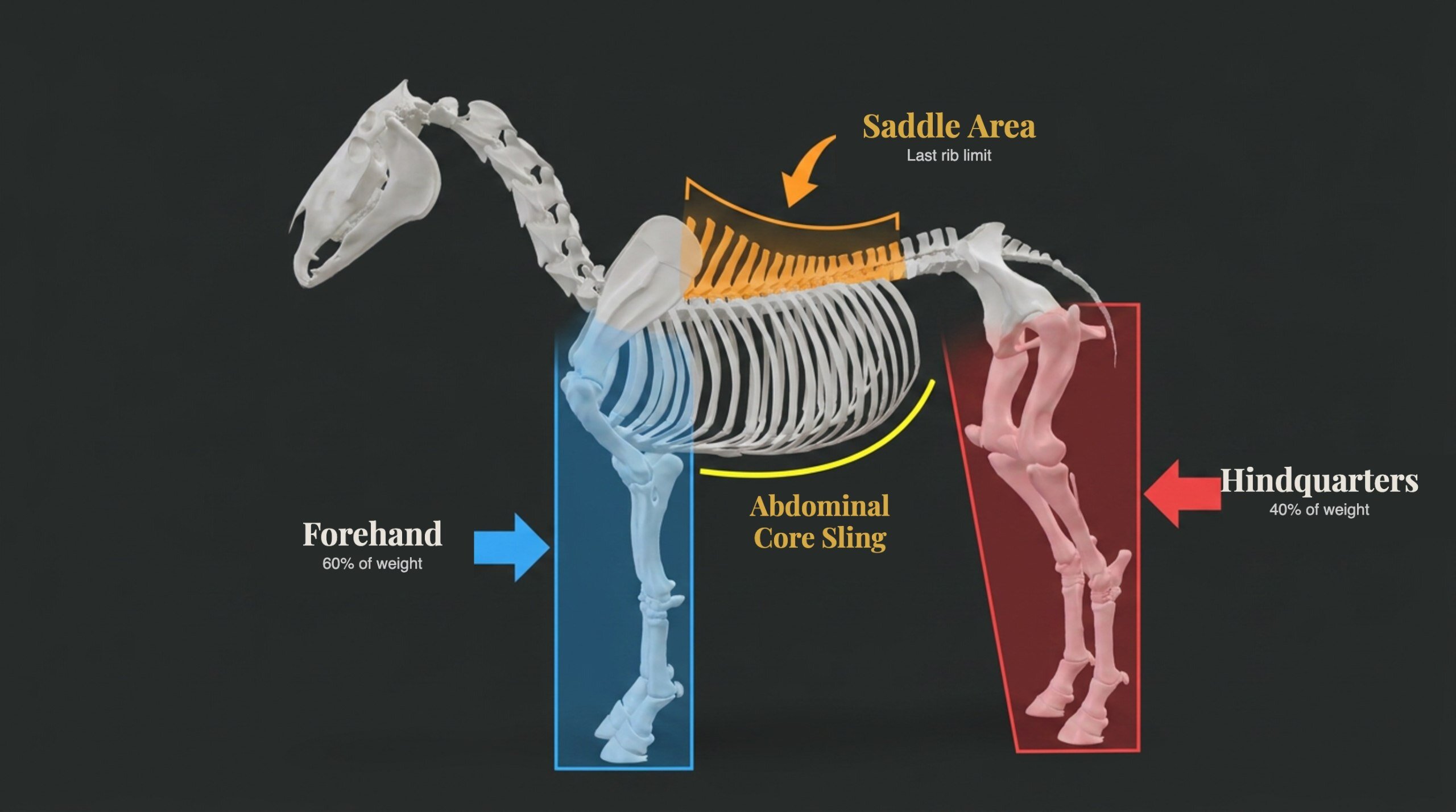
Here's something that trips people up when they first start really looking at horses: the front end carries more weight than the back. A lot more. We're talking roughly 60% of the horse's total body weight resting on those two front legs, and that number shifts constantly depending on what the horse is doing with its head, neck, and body.
Think about that for a second. Two relatively slender limbs are bearing the majority of a 1,000-pound animal's mass. And we haven't even put a rider on yet.
The 60/40 Split and Why It Matters
At rest, the average horse distributes weight in roughly a 60/40 ratio - front to hind. The head and neck act like a cantilever, pulling that center of gravity forward. This is why conformation matters so much. A horse built downhill - where the withers sit lower than the croup - pushes even more weight onto the forehand. Uphill builds do the opposite, and that's a big part of why certain breeds excel at collection-heavy disciplines.
During movement, everything changes. A horse at the trot shifts weight dynamically between diagonal pairs. At the canter or gallop, the leading front leg absorbs enormous concussive force - sometimes two to three times the horse's body weight during the stance phase. Research out of Utrecht and referenced by the AAEP has shown that peak vertical ground reaction forces on the leading forelimb at gallop can exceed 10,000 Newtons. That's not a trivial number.
Force plate studies conducted at Cornell's Equine Performance Testing Clinic have further demonstrated that even at the walk, subtle asymmetries in forelimb loading can be detected long before visible lameness appears. A horse might measure perfectly sound to the naked eye while the data screams that the left front is absorbing 6% less impact than the right. That discrepancy accumulates. Twelve thousand steps a day, every day, for months. The math catches up.
How the Horse Balances Itself
Horses don't just plod along with static weight on their legs. They're constantly making micro-adjustments. The stay apparatus - that brilliant system of tendons and ligaments in the forelimb - lets them lock their legs and stand with minimal muscular effort. But when moving, the horse uses its core, back, and neck to shift its center of mass.
Watch a horse doing a proper downward transition sometime. A well-trained one engages its hindquarters, shifts weight backward, and lightens the forehand. A green horse? It dumps onto the front end, hollows its back, and basically falls into the slower gait. Same horse, wildly different weight distribution patterns, and very different long-term soundness outcomes.
The neck plays a huge role here. When a horse raises its head and neck, the center of gravity shifts slightly rearward. When it drops the head to graze, more weight loads onto the front. This is partly why horses with ewe necks or other neck conformation issues can have trouble with balance under saddle - the mechanics of that weight-shifting lever are compromised.
Something most riders never consider: the tail. It weighs relatively little, sure. But horses use it as a counterbalance during sharp turns at speed, and the sacrocaudal musculature ties directly into the pelvic stabilizers. Researchers at UC Davis found that horses with docked or neurologically compromised tails showed measurable differences in hind-end proprioception during tight circling exercises. Not dramatic. But real.
Limb Loading and Lameness
Uneven weight distribution is one of the primary drivers of lameness. And it's a cycle that feeds itself. A horse with mild soreness in one front leg will shift weight to the other three limbs. The compensating limbs now bear more load than they were designed for, and over time, they develop their own problems. Veterinarians at Texas A&M's Equine Lameness Lab have documented this compensatory pattern extensively - what starts as a subtle right front issue can eventually show up as a left hind problem because the horse has been loading its diagonal pair unevenly for months.
Hoof balance feeds directly into this too. A horse with long toes and low heels on the front feet experiences delayed breakover, which increases strain on the deep digital flexor tendon and the navicular region. The weight doesn't land where it should. Over thousands of steps per day - horses take somewhere between 8,000 and 12,000 steps daily depending on turnout - those small imbalances compound into real damage.
The Merck Veterinary Manual notes that navicular syndrome remains one of the most common causes of chronic forelimb lameness in performance horses, and the biomechanical connection is not coincidental. Sixty percent of the body weight hammering through two front feet with suboptimal breakover geometry, stride after stride, year after year. The navicular bone and its associated bursa sit right in the crosshairs of that repeated insult. Farriery alone can't fix poor conformation, but it can shift the loading profile enough to buy a horse years of comfortable work.
The Rider's Influence
Adding a rider changes everything about weight distribution. A 150-pound rider sitting passively on a 1,000-pound horse increases forelimb loading by a disproportionate amount because the rider sits ahead of the horse's natural center of mass (unless they're sitting way back, which creates its own problems). Studies published through UC Davis have measured the impact of rider position on limb loading and found that an unbalanced rider - one who leans forward, sits crooked, or braces against the stirrups - can create asymmetric loading patterns that mimic low-grade lameness.
This is why good riding actually matters for soundness. It's not just about looking pretty. A rider who can sit in balance, engage their core, and follow the horse's movement distributes their weight more evenly across the horse's back and, by extension, across all four limbs. A rider who collapses one hip loads one side of the horse more than the other, every single stride.
Saddle fit compounds the equation. An ill-fitting saddle concentrates pressure into focal points along the thoracic spine instead of spreading it across the panels. Over weeks, the horse compensates by bracing through the thoracolumbar junction, which stiffens the back and reduces the ability to engage the hindquarters. The forehand gets heavier. The AAEP's lameness guidelines specifically mention saddle fit evaluation as part of a comprehensive workup for unexplained forelimb issues, and any experienced lameness vet will tell you they've resolved "mystery" front-end problems simply by changing the saddle.
Conformation and Predisposition
Some horses are built to handle asymmetric loading better than others. A horse with good bone - meaning adequate circumference of cannon bone relative to body weight - has more structural margin. Horses with limb deviations like being base-narrow or toed-out concentrate forces on specific areas of the hoof and fetlock, accelerating wear on those structures.
Hind limb conformation matters just as much. A post-legged horse - one with too-straight hind legs - can't flex and absorb shock through the hock as efficiently. The concussive force that should be dampened by joint flexion instead transmits straight up through the limb. Over time, you see bone spavin, stifle issues, and sacroiliac strain.
The fetlock joint deserves special mention. It's the most heavily loaded joint in the horse's body, and it hyperextends under weight - meaning it drops toward the ground during the stance phase of each stride. In a galloping Thoroughbred, the fetlock can drop so low that the ergot nearly touches the ground. The suspensory ligament and sesamoid bones take enormous strain at that moment. Horses with long pasterns and low-set fetlocks are at higher risk for suspensory injuries because the leverage on that system is greater.
Practical Takeaways
So what do you actually do with this information? A few things.
First, pay attention to hoof care. Regular, balanced trims keep the weight landing where it should. Don't let feet get long just because the horse isn't showing obvious problems - the damage is cumulative and often silent until it isn't.
Second, think about footing. Hard ground amplifies concussive forces. Deep footing increases tendon strain. Neither extreme is great for a horse already dealing with suboptimal weight distribution. Varied terrain and appropriate footing for the work being asked make a real difference over time.
Third, get your own riding assessed honestly. A crooked rider creates a crooked horse creates an unevenly loaded horse creates a lame horse. It's a direct pipeline, and it's one of the most fixable variables in the whole equation.
Fourth, condition the hindquarters deliberately. Transitions, hill work, cavaletti, backing. Anything that teaches the horse to carry more weight behind takes load off the front. This isn't just a training nicety; it's a soundness preservation strategy. The AAEP recommends progressive hind-end strengthening as part of rehabilitation protocols for horses recovering from forelimb injuries, precisely because redistributing that 60/40 ratio even a few percentage points rearward can reduce peak forces on compromised structures.
And finally, evaluate your horse's conformation with honest eyes. You don't need a perfect horse - those don't exist anyway. But understanding where your horse's structural weaknesses lie tells you where to expect trouble and how to manage the workload to prevent it. A horse built downhill with long pasterns and a heavy head is going to need more deliberate conditioning of the hindquarters and more careful management of forelimb soundness than a naturally uphill-built horse with short cannons and a light front end.
Weight distribution isn't glamorous. Nobody's posting about it on social media. But it's running quietly underneath every soundness issue, every training problem, and every performance plateau you'll ever encounter with horses.
🦴 See how weight distributes through the equine skeleton in our 3D Explorer. Check it out here.
Jaynee's Note: I got into the habit of watching horses stand square and noticing which leg they rest or shift off of. It's one of the earliest signs something's bothering them, long before an obvious limp shows up.
Frequently Asked Questions
How is weight distributed in a standing horse?
A horse at rest carries approximately 60% of its body weight on the front legs and 40% on the hind legs. This front-heavy distribution exists because the head, neck, and ribcage sit ahead of the center of mass. Collection in dressage shifts weight rearward, but even a highly collected horse rarely achieves a 50/50 distribution.
Why does weight distribution matter for soundness?
Because front-loading means the forelimbs absorb disproportionate concussion with every stride. This explains why front limb lameness (navicular, sole bruises, tendon injuries) is far more common than hind limb lameness in most disciplines. Understanding weight distribution helps riders and trainers make decisions that protect vulnerable structures.
Can a rider affect the horse's weight distribution?
Absolutely. A rider sitting upright in balance adds weight proportionally. Leaning forward shifts more weight onto the forehand. Riding in a proper half seat redistributes load. Correct riding that encourages hind-end engagement (collected work, transitions, hill work) can shift weight rearward and reduce front limb stress over time.
How does conformation affect weight distribution?
Long-backed horses tend to carry more weight on the forehand. Downhill-built horses (withers lower than croup) load the front legs more heavily. Uphill-built horses naturally distribute weight more evenly. Short-coupled horses with well-angulated hind legs are mechanically better positioned to carry weight behind.
Does hoof trimming affect weight distribution?
Yes. Hoof angles directly influence how load travels through the limb. A long toe/low heel trim (common in neglected hooves) increases strain on the deep digital flexor tendon and navicular region. Proper hoof balance ensures weight distributes evenly across the hoof capsule and up through the limb structures.
Sources
- Equine Lameness and Limb Loading Patterns - Texas A&M College of Veterinary Medicine
- Biomechanics of Equine Locomotion - American Association of Equine Practitioners
- Effects of Rider Position on Equine Limb Loading - UC Davis Center for Equine Health
- Equine Musculoskeletal System Overview - Merck Veterinary Manual
- Conformation and Soundness - Cornell University Equine Hospital
Ready to understand the structural basis of soundness?
Our Anatomy course connects conformation, biomechanics, and body systems.
Start the Anatomy CoursePro members only. Try Pro free for 7 days.