Strengthening Horse Legs and Tendons: What Works |
Search this question and you will find a hundred articles offering you five exercises to build stronger tendons.
Almost none of them will tell you the thing the research actually says, which is that in a mature horse, you cannot meaningfully make an energy-storing tendon stronger. Not with hill work, not with poles, not with supplements, not with anything.
That sounds like bad news. It is not. It is the single most useful fact an owner can have, because it changes what you spend your time on, and the things it points you toward genuinely do protect a leg.
Quick Answer
Bone and muscle strengthen in response to exercise throughout a horse's life. Elastic energy-storing tendons and articular cartilage adapt mainly during the first two years of life, and their capacity to respond to training after that appears to be limited. This means that in an adult horse, conditioning does not make the flexor tendons meaningfully bigger or stronger. What conditioning does is build the bone, muscle and fitness that reduce the load and the fatigue those tendons have to survive. Protecting a mature horse's tendons is mostly about gradual progression, good footing, avoiding fatigue, and not doing too much too soon.
What Actually Responds to Training
The musculoskeletal system is not one tissue. It is four, and they do not behave the same way.
| Tissue | Adapts to exercise? | When? |
|---|---|---|
| Bone | Yes, substantially | Throughout life |
| Muscle | Yes, substantially | Throughout life |
| Articular cartilage | Limited | Mainly the first ~2 years |
| Elastic (energy-storing) tendon | Limited | Mainly the first ~2 years |
That table is the whole article, and it is worth sitting with.
Dr. Hilary Clayton, one of the foremost researchers in equine biomechanics, puts it plainly: bones and muscles can be strengthened by exercise throughout the horse's lifetime, but cartilage and elastic tendons adapt only during the first two years of life, and after that they are susceptible to damage during exercise.
The reviewed literature goes further, and this part is genuinely counterintuitive. In an energy-storing tendon, getting bigger might actually make it worse at its job. A tendon like the superficial digital flexor tendon works as a spring. It stores energy on landing and returns it at push-off. Increase its cross-sectional area and you increase its stiffness, and a stiffer spring is a less effective spring. The tendon is not built to be thick. It is built to be elastic.
There is a hard corollary here that explains a great deal about the horses in your barn. The flexor tendons' limited response to increasing work and age is part of why tendon injury risk rises in older horses. The tissue does not keep adapting the way muscle does. It accumulates use.
So What Is Conditioning Actually Doing?
If you cannot thicken the tendon, what is the point of any of it?
Three things, and all three matter enormously.
It builds the structures that reduce the load on the tendon. A horse with a strong topline, a strong hindquarter, and good core stability carries himself differently. He loads the forelimb less, he balances better through turns, and he stays organized under his rider. Every bit of that is load the front tendons do not have to absorb. The muscles you can build are protecting the tendons you cannot.
It builds fitness, and fitness prevents fatigue. This is the one people underrate. A fatigued horse loses the coordinated muscular support that stabilizes the limb, so the soft tissue takes a bigger share of the load and takes it in worse positions. Most catastrophic soft tissue injuries do not happen on the first fence. They happen on the last one. Conditioning does not armor the tendon. It keeps the horse from arriving at the moment where the tendon is the only thing left holding the leg together.
It builds bone. Bone genuinely does remodel and strengthen in response to loading, throughout the horse's life. That is a real, direct, ongoing adaptation and it is worth training for.
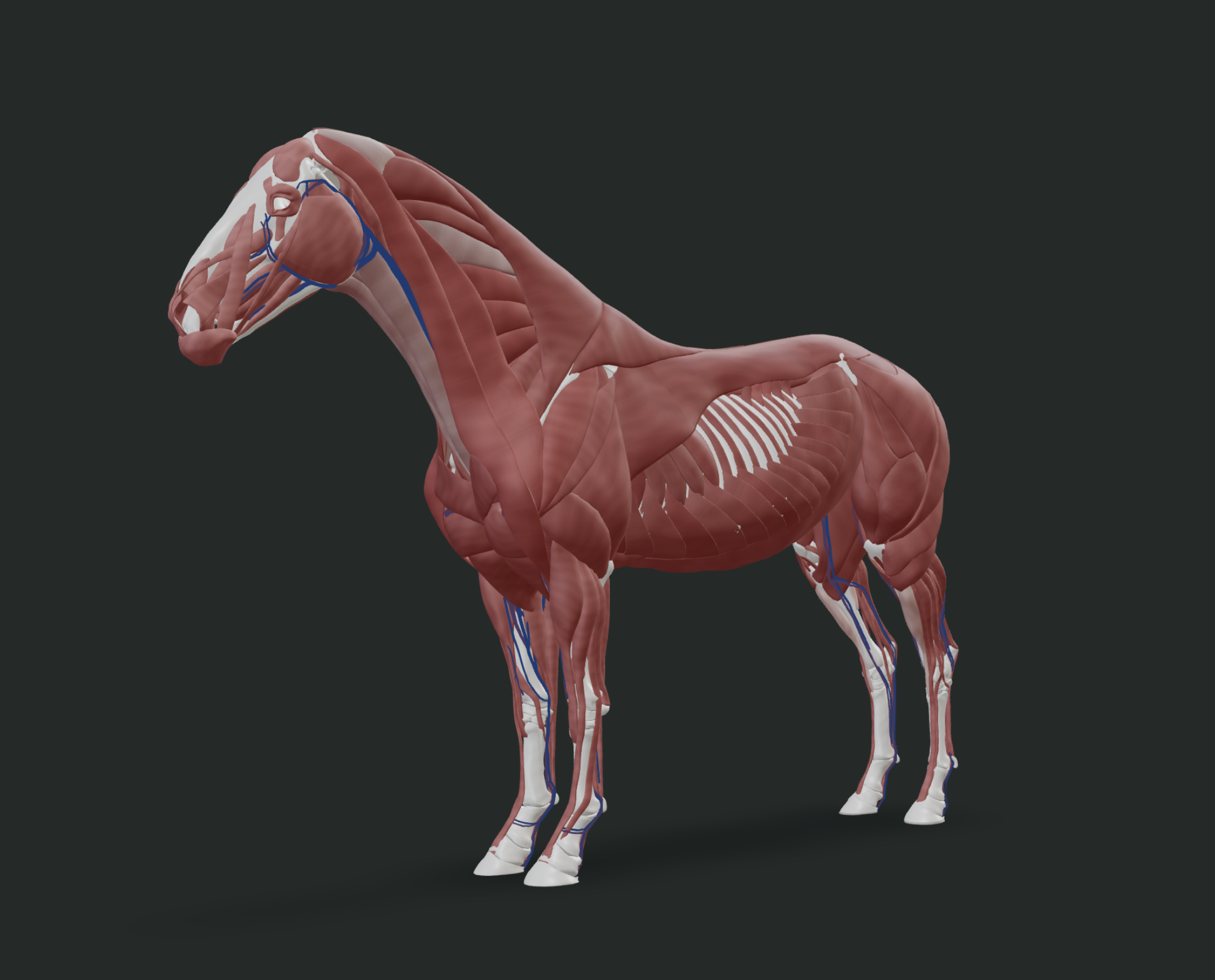
If you look at the muscular layer in the 3D explorer, the picture makes immediate sense. There is enormous muscle over the shoulder, the forearm, the hindquarter and the back. Then it simply stops above the knee and the hock, and the rest of the way down it is bone, tendon and ligament. Everything you can train sits above the thing you are trying to protect.
The Exercises That Genuinely Help
Straight lines, and a lot of them
Boring, and correct. Straight-line work on firm, level, consistent footing loads the limb symmetrically. Circles load it asymmetrically, and the smaller the circle, the more uneven the load through the fetlock and the suspensory apparatus.
This does not mean never do a circle. It means that if your horse's entire fitness program is 40 minutes of 20-metre circles in a deep arena, you have built a conditioning program that concentrates load exactly where soft tissue injuries happen.
Hill work
The most efficient conditioning tool most owners have and the one most often ignored.
Uphill work loads the hindquarter and the topline hard, which is precisely the musculature you want carrying more of the horse. Downhill work develops balance, coordination, and eccentric control, which is the ability to manage a load while lengthening, and that is a real protective skill.
The rules are the rules of all conditioning. Start with short sessions on gentle inclines. Prioritize footing over intensity, because a hill with slick or uneven ground is worse than no hill. Build gradually. Once or twice a week is plenty as a supplement to flat work.
Poles and cavaletti
Poles make a horse pick the limb up, place it deliberately, and engage through the back and hindquarter. They build strength and proprioception at low speed and low impact, which is a rare combination.
Ground poles on good footing are among the safest things you can do. Raised cavaletti increase the demand meaningfully, so raise them gradually and stop before the horse gets tired and starts hitting them, because a tired horse hitting poles is a horse learning to be careless.
Long, slow distance
The foundation of every good conditioning program and the one people skip because it is dull. Extended work at walk and steady trot, over varied terrain, over months. It builds bone, it builds cardiovascular fitness, and it builds the aerobic base that delays fatigue.
There is no shortcut here and no supplement that replaces it.
Turnout
Free movement, every day, as much as you can manage. It is the cheapest conditioning tool in existence and it is the one most modern management systems quietly remove.
What Damages Tendons
Knowing this list is worth more than any exercise on the list above.
Fatigue. The number one modifiable risk factor. Stop before the horse is done, not after.
Deep or uneven footing. Deep ground forces the fetlock to drop further on every stride, which stretches the suspensory apparatus and the flexor tendons further than they were designed to go. Uneven ground does the same thing unpredictably.
Hard ground at speed. Concussion. Firm is good for straight-line conditioning. Hard, at pace, is not.
Too much, too soon. Adaptation is slow. Bone takes months. Fitness takes months. If your horse has had six weeks off and you bring him back to full work in ten days, the tissue has not been given time to catch up with the demand, and every soft tissue structure in the leg is now the weak link.
Tight circles under load. Particularly on a young horse, particularly on deep footing, particularly when tired.
Ignoring the small stuff. Filling that comes and goes. A leg that is a little warm after work and was not last month. Slight shortness on one rein. The horse tells you before he breaks.
The Young Horse Window Is Real
Here is where the research becomes actionable in a way that is genuinely different from the rest of the internet.
If elastic tendon and cartilage adapt mainly in the first two years, then the amount and type of exercise a foal and yearling get has a lasting effect on soundness across the entire athletic career. Not on their two-year-old form. On their whole life.
What that appears to require is free movement: turnout, varied terrain, self-directed play, the kind of diverse and sometimes vigorous loading that builds cartilage and lets tendon mature under load. Not early hard training. Not stall confinement either. The foal raised in a small paddock with limited movement is having something taken from him that cannot be given back later.
This is one of the strongest arguments in the literature for turning young horses out and leaving them alone.
If Your Horse Is Currently Injured, Stop Reading This
Everything above is conditioning for a sound horse.
If your horse has a diagnosed tendon or ligament injury, none of this applies. Rehabilitation of an injured tendon is a different discipline with a different logic, it is built and adjusted by your vet on the basis of serial ultrasound, and doing hill work or poles on a healing lesion is how horses re-injure.
The guide to leg injuries and rehabilitation protocols covers what that process actually looks like, and why the timeline is measured in seasons rather than weeks. Talk to your vet. Not to an article.
Frequently Asked Questions
Can you strengthen a horse's tendons?
Only to a limited extent, and mainly when the horse is young. Research indicates that elastic energy-storing tendons adapt mainly during roughly the first two years of life and show limited capacity to increase in size or strength in response to training after that. In a mature horse, conditioning protects the tendons indirectly, by building the bone, muscle and fitness that reduce the load and fatigue the tendon has to withstand.
What is the best exercise for a horse's legs?
Long, slow distance work over varied terrain on good footing, supplemented with hill work and ground poles. Straight lines load the limb more evenly than circles. The most protective thing is not any single exercise but gradual progression over months, and stopping before the horse is fatigued.
Does hill work strengthen a horse's tendons?
Hill work does not meaningfully thicken the flexor tendons, but it is one of the best conditioning exercises available, because uphill work builds the hindquarter and topline that carry the horse, and downhill work develops balance and eccentric control. Both reduce the load the front tendons have to absorb. Start with short sessions on gentle inclines and good footing.
Why do older horses get more tendon injuries?
The flexor tendons show a limited adaptive response to increasing work and to age, which means they do not keep strengthening the way muscle does. Over years, they accumulate use rather than continuing to adapt to it. This is part of why tendon injury risk rises in older equine athletes.
Should young horses be exercised?
Yes, but as free movement rather than formal training. Cartilage and elastic tendon adapt primarily during the first two years of life, which means turnout and varied, self-directed movement in foals and yearlings has a lasting influence on soundness throughout the athletic career. Restricting a young horse's movement removes an adaptive window that does not reopen.
Do supplements strengthen tendons?
No supplement has been shown to substitute for appropriate loading. Tendon adapts, when it adapts at all, in response to mechanical load. Nutrition supports the tissue's ability to maintain and repair itself, but it is not a conditioning program. Discuss any supplement with your vet.
Ready to build your horse back stronger?
Our Lameness course covers conditioning, injury prevention, and evidence-based rehab.
Start the Lameness CoursePro members only. Try Pro free for 7 days.