Understanding the Trot: Biomechanics of the Two-Beat Gait
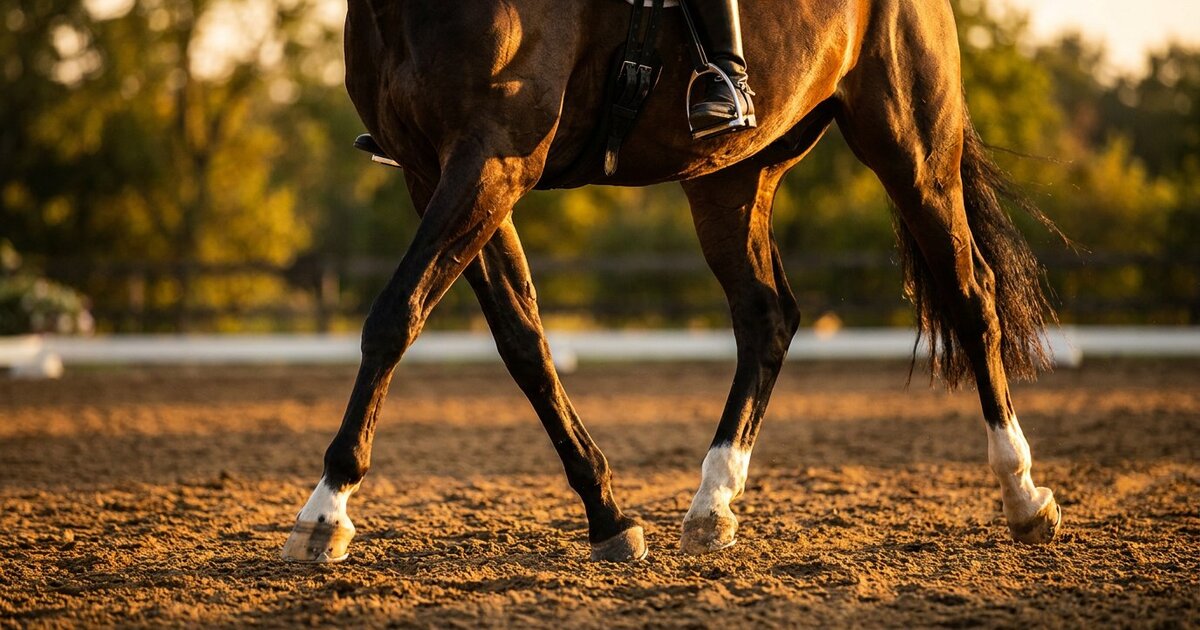
The trot is probably the most-ridden gait in the horse world, and for good reason. It's symmetrical, it's rhythmic, and it's where riders develop their feel, their balance, and, let's be honest, their sore muscles. Whether you're posting around the ring on your first lesson horse or sitting a collected passage at Grand Prix, you're working with the same fundamental mechanics. Two beats, two diagonal pairs, and a whole lot going on in between that most people never think about deeply enough.
Two Beats, Two Diagonals
The trot is a two-beat gait where the horse moves in diagonal pairs. Left front and right hind hit the ground at the same time (one beat), then right front and left hind hit together (second beat). Between each pair, there's a brief moment of suspension where all four legs are off the ground. That suspension phase is what gives the trot its bounce, and why beginner riders feel like they're on a jackhammer for the first dozen lessons.
Because the gait is symmetrical, the left diagonal does the same work as the right diagonal, making the trot the easiest gait for vets to evaluate lameness. Any asymmetry in the trot stands out immediately. When your vet says "trot him out for me on a straight line," this is what they're looking at. Does each diagonal pair move identically? If one side looks different from the other, something hurts. The AAEP lameness scale uses the trot as its primary evaluation gait for exactly this reason.
The regularity of the trot rhythm matters enormously. Each beat should be perfectly even, like a metronome. When a trot starts to sound uneven (listen to hoofbeats on pavement and you'll hear it immediately), that's either a lameness issue or a training problem creating irregular steps. Some riders inadvertently create rhythm problems by sitting heavier on one diagonal or applying uneven leg pressure. The horse accommodates by adjusting his stride, and suddenly you have an uneven trot that isn't lameness at all but rider-induced asymmetry.
Rising Trot: Your Best Friend
Rising trot, or posting trot depending on which side of the Atlantic you're on, is where the rider stands and sits alternately with each stride. You rise out of the saddle as one diagonal pair hits the ground and sit as the other pair lands. It looks simple. Deceptively so. It takes months to get the timing smooth and years to get it truly polished.
The purpose of posting isn't just rider comfort (though it certainly helps your spine). It takes your weight off the horse's back during every other beat, making it easier for the horse to swing through his topline and move freely. Research from Utrecht University on equine back kinematics demonstrated that the horse's thoracolumbar spine shows greater range of motion under a posting rider compared to a sitting one. For young horses, horses building fitness, and any horse doing extended trot work, posting is kinder to the back than sitting.
Now, diagonals. In rising trot, you should rise when the outside front leg goes forward. In practice, this means you're sitting when the outside front leg and inside hind leg are on the ground. Why does this matter? Because sitting on the inside diagonal puts a little extra weight on the inside hind, which encourages that leg to push more and helps the horse balance around turns. It's a subtle aid that becomes second nature.
How do you check your diagonal? Quick glance at the horse's outside shoulder. You should be rising as it moves forward and sitting as it comes back. After a while, you'll feel it without looking; there's a slight rocking in the horse's barrel that telegraphs which diagonal is grounded. And you should change your diagonal regularly on straight lines to avoid overworking one side. Typically every few minutes or when you change direction. Competitive endurance riders are religious about changing diagonals because over 50 miles, the cumulative asymmetry adds up.
Sitting Trot: The Real Challenge
Sitting trot is exactly what it sounds like. You stay in the saddle the whole time. No posting. Just absorbing the motion of the horse through your seat, core, and lower back. It sounds easier than posting because you're doing "less." In reality, it's harder. Way harder. And the difficulty isn't where most people think it is.
The challenge isn't just staying in the saddle. Any rider can grip their way through a sitting trot for a few strides. The challenge is sitting the trot WITHOUT gripping, without bouncing, without tightening your back, and without restricting the horse's movement. That requires genuine core stability, a supple lower back, and relaxed hip joints that can absorb the up-down motion like shock absorbers. Your pelvis has to move independently from your upper body, following the horse's motion while your shoulders stay quiet above. It's a dissociation that takes serious body awareness to develop.
Horses notice immediately when a rider can actually sit the trot versus when they're just surviving it. A rider who sits well allows the horse to lift his back, swing through his body, and move with expression. A rider who bounces and grips pushes the horse's back down, creating a hollow, tense frame that's terrible for both parties. The horse protects himself by bracing, which makes the trot harder to sit, which makes the rider grip more. A vicious spiral that starts with the rider's inability to absorb movement.
Tips for developing a good sitting trot: ride without stirrups regularly (start on a quiet horse, please), work on a lunge line so you can focus entirely on your body without worrying about steering, and practice on horses with different trot qualities. Some horses have trots that are easy to sit, short-backed, smooth-moving types. Others have trots that would rattle your teeth loose. You learn the most from the difficult ones, even if the experience is humbling. Pilates and dance both develop the kind of core control that transfers beautifully to sitting trot.
| Aspect | Rising (Posting) Trot | Sitting Trot |
|---|---|---|
| Rider motion | Rises out of the saddle every other beat | Stays seated, absorbing motion through core/hips |
| Best for | Everyday riding, long distances, young/developing horses | Collection work, advanced dressage, refined aids |
| Difficulty | Beginner-friendly with practice | Requires strong core and independent seat |
| Horse's back | Relieves back strain; recommended for developing horses | More demanding on the horse's back; requires a strong topline |
| When to use | Most general riding; default for green horses | When collection, half-halts, and subtle aids are needed |
Lengthening vs. Extension
This is where a lot of people get confused. Lengthening and extension are not the same thing, even though they look similar to the casual observer and the words get used interchangeably in a lot of barns.
A lengthening is when the horse stretches his stride to cover more ground while maintaining rhythm. The tempo stays the same, the beats don't come faster, but each stride covers more distance. The horse pushes more from behind and reaches more with his front legs. You see lengthenings in lower-level dressage tests, and they're a building block for true extension. Think of it as the horse taking bigger steps within the same metronome setting.
An extended trot takes the concept further. Maximum ground cover, maximum push from the hind end, with the horse's frame slightly longer and the foreleg reaching to the point where the hoof lands in line with the nose. The hind legs push off the ground with enormous power, the back swings, and the front end opens up to show what the horse is truly capable of. A good extended trot is one of the most impressive things you'll see in the sport. It looks like the horse is floating, each stride hanging in the air for an extra heartbeat.
The key distinction? Extensions require more engagement, more power, and more collection to come back from. A horse that can do a big lengthening might not be strong enough for a true extension. It takes years of progressive training to develop the hind-end strength and balance for genuine extension. You can't shortcut it with gadgets or force.
And here's the common mistake: riders who ask for "bigger trot" and just get faster trot. The horse runs, the rhythm quickens, the steps get shorter and quicker rather than longer and more powerful. That's not lengthening. That's rushing. If the tempo changes, you've lost the quality. Push the hind legs to reach further under, don't just squeeze for more speed. Your half halt is the tool that channels energy into stride length rather than tempo.
Collection at the Trot
The other end of the spectrum is collection. A collected trot has shorter, more elevated strides with increased flexion of the hind joints. The horse takes more weight behind, lightens the forehand, and the steps become rounder and more cadenced. The tempo might slow slightly, but the energy doesn't decrease. It gets redirected upward instead of forward, like compressing a spring.
Collection requires serious strength. A horse carrying more weight on the hind end is doing the equivalent of a human doing wall sits all day. The stifles, hocks, and hip joints all flex more deeply with each stride. This is why correct collection takes years to develop and can't be forced with heavy hands pulling the horse's head in. That approach just creates a short, tense, restricted trot that looks collected to the untrained eye but is biomechanically the opposite. The horse is compressed from front to back rather than carrying from behind.
True collection comes from behind. The rider's half-halts ask the hind legs to step more under and carry more, which naturally elevates the forehand. The horse feels lighter in front, more powerful behind, and the trot takes on a springy, dancing quality. That's the good stuff. That's what dressage judges reward and what trainers spend years cultivating. UC Davis research on equine biomechanics has confirmed that correctly collected horses show increased hock flexion and decreased forehand loading compared to working trot, validating what classical trainers have taught for centuries.
| Trot Variation | Description | Dressage Level |
|---|---|---|
| Working trot | Natural, balanced trot with moderate stride and impulsion | Introductory–Training |
| Lengthening | Increased stride length while maintaining rhythm; horse covers more ground | Training–First |
| Collected trot | Shorter, more elevated strides with increased engagement and self-carriage | Second and above |
| Extended trot | Maximum stride length with clear suspension; ground-covering and powerful | Third and above |
| Passage | Highly collected, elevated, cadenced trot with prolonged suspension | Grand Prix |
| Piaffe | Trot in place with maximum collection and elevation | Grand Prix |
Why the Trot Is the Training Gait
There's a reason trainers spend more time in trot than any other gait. Its symmetry makes it ideal for developing even strength and suppleness on both sides. You can feel asymmetry in the trot immediately. If the horse drifts one direction, falls in on one shoulder, or feels stiffer one way, the trot reveals it honestly.
The canter is asymmetrical by nature, so it's harder to use for straightness work. The walk is easy to disrupt with too much rider input and can deteriorate under pressure. The trot is the sweet spot: enough energy to work with, enough symmetry to diagnose problems, and enough variation (from collected to extended) to build the horse progressively through the training scale.
Transitions within the trot are where the real gymnasticizing happens. Collected to medium. Medium to extended. Extended back to collected. Each transition asks the horse to shift weight, engage differently, and rebalance. It's like interval training for equine athletes, building the strength and adjustability that underpin everything from a hunter course to a Grand Prix test.
So next time you're going around and around in rising trot wondering when you'll get to canter, remember: that trot work is building the foundation for everything else. Every stride of good, rhythmic, balanced trot is making your horse stronger, more supple, and more rideable. It's not boring. It's where the real work gets done, one diagonal pair at a time.
🔍 See the diagonal leg pairs and muscle groups powering the trot in our 3D Explorer. Check it out here.
Frequently Asked Questions
What is a trot in horses?
The trot is a two-beat diagonal gait where the horse moves opposite pairs of legs simultaneously (left front with right hind, then right front with left hind), separated by a moment of suspension where all four feet are off the ground. It is the most rhythmic and symmetrical gait, which is why veterinarians use it to evaluate lameness.
What is the difference between posting and sitting trot?
Posting (rising) trot means the rider rises out of the saddle on one diagonal beat and sits on the next, absorbing the bounce through the legs and core. Sitting trot means the rider stays in the saddle throughout, absorbing motion through a supple lower back and core. Posting is easier for beginners; sitting trot requires significant core strength and a following seat.
How fast is a horse's trot?
A typical working trot covers about 8 mph (13 km/h). Collected trot is slower at roughly 5-6 mph, while an extended trot can reach 10-12 mph. Standardbred trotters racing at speed can trot at 30+ mph, which is far beyond what any riding horse produces.
What does it mean to be on the correct diagonal?
At the posting trot, you should rise when the outside front leg goes forward and sit when it comes back. This is the 'correct diagonal' because it frees the horse's inside hind leg to step further under its body during turns. If you are rising when the inside front leg goes forward, you are on the wrong diagonal and should sit an extra beat to switch.
Why do some horses have a rough trot?
Conformation drives it. Horses with upright shoulders, short backs, and less angulation in the hind legs tend to have choppier, more vertical trots. Breeds like Arabians and Morgans sometimes produce a shorter-strided trot. Horses with long, well-angled shoulders and engaged hindquarters typically offer smoother, more ground-covering trots.
Sources
- Texas A&M College of Veterinary Medicine - Equine Locomotion Research vetmed.tamu.edu
- Cornell University - Equine Performance and Lameness vet.cornell.edu
- UC Davis Center for Equine Health - Biomechanics ceh.vetmed.ucdavis.edu
- American Association of Equine Practitioners - Gait Evaluation aaep.org
- Merck Veterinary Manual - Lameness in Horses: Gait Analysis merckvetmanual.com