Ewe Neck Conformation: Causes, Effects, and Corrective Exercises
If you've spent any time evaluating horses, you've probably heard someone describe a horse as having an "ewe neck" and watched everyone nod gravely, like the diagnosis just knocked twenty grand off the price. But what exactly makes a neck a ewe neck, and why does it actually matter beyond looking a bit odd? The answer goes deeper than aesthetics. Way deeper. It's about biomechanics, muscular development, and how the horse carries itself through every stride of every ride for its entire working life.
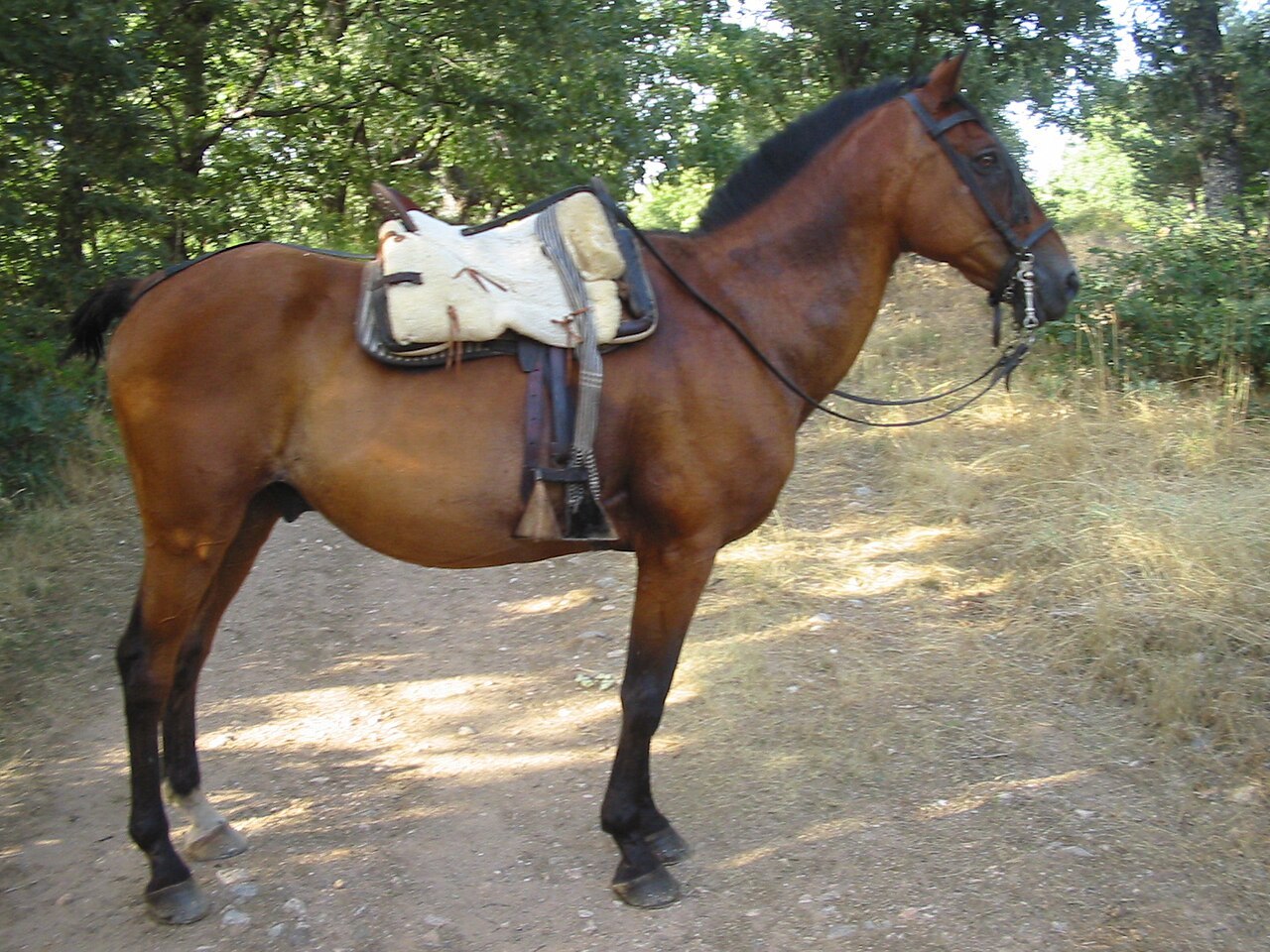
What Is a Ewe Neck?
A ewe neck, named after the shape of a female sheep's neck, is a conformation fault where the topline of the neck appears concave rather than convex. The muscles along the bottom of the neck, the brachiocephalicus and the ventral chain, are overdeveloped or dominant, while the muscles along the top, the nuchal ligament area, the splenius, and the rhomboideus, are underdeveloped and wasted. The result is a neck that dips along the crest and bulges underneath. From a distance it looks upside-down, like someone installed the neck wrong side up.
Some horses are born with this tendency. Certain bloodlines carry it as a structural predisposition, particularly in breeds where neck conformation wasn't historically prioritized in selection. Others develop it through years of going inverted, traveling with their heads high, backs hollow, and no engagement from behind, building the wrong muscles through thousands of repetitions of the wrong movement pattern. And honestly? A lot of the ewe necks you see at local shows are training artifacts, not genetic sentences. That's encouraging, because it means they can often be improved. Sometimes dramatically. Texas A&M's animal science department has documented cases where systematic retraining protocols produced measurable topline improvement within 90 days, though most horses require six months or more for significant visible change.
Why It Affects Performance
The neck isn't just along for the ride. It's a critical balancing mechanism, a counterweight, a lever arm that influences everything from stride quality to long-term soundness. As we discuss in our piece on weight distribution and soundness, the head and neck act like a pendulum that shifts the horse's center of gravity. When a horse telescopes its neck forward and down, it lifts the back, engages the hindquarters, and creates the conditions for real impulsion, the kind that comes from behind and pushes through the body rather than pulling from the front.
A ewe-necked horse has trouble doing this. The muscular patterning pulls the head up and the back down, like a seesaw stuck in the wrong position. The horse travels hollow, with the hind legs trailing out behind instead of stepping under the body. You get a stiff, choppy ride with minimal shock absorption through the back. For the rider, it feels like sitting on a jackhammer. For the horse, it means every stride sends concussive force through a rigid spine instead of a supple, shock-absorbing one. The Merck Veterinary Manual notes that horses traveling in chronic extension, the hallmark of the ewe-necked posture, show accelerated degenerative changes in the thoracolumbar vertebrae compared to horses working in correct frame.
Collection becomes extremely difficult, borderline impossible in severe cases. The horse literally can't flex at the poll and soften through the jaw because the wrong muscles are doing all the work. You'll see ewe-necked horses brace against the bit, root downward with sudden violent drops of the head, or throw their heads skyward to evade contact. None of this is attitude. It's physics. The musculature that should allow the horse to round and yield simply isn't developed enough to override the ventral pattern that's pulling everything into extension. Punishing the horse for these evasions is like yelling at someone for not running fast enough when they've got a sprained ankle. The hardware won't support the request.
Long-term, the hollow way of going associated with a ewe neck accelerates wear on the horse's entire body. The lumbar spine takes extra load it wasn't designed to absorb at that angle. The forelimbs absorb more concussion because the hindquarters aren't carrying their share of the weight. Cornell's equine hospital has published data showing that horses traveling in chronic dorsiflexion, essentially the inverted frame of a ewe-necked horse, are statistically more prone to kissing spines, suspensory apparatus breakdown, and premature arthritic changes in the front limbs. The neck shape isn't just cosmetic. It's predictive of where the veterinary bills will come from.
Other Common Conformation Faults
While we're talking about structural issues that affect how a horse moves and holds up over time, let's run through some other common faults. Every horse has something. The question is always whether the something matters for the job being asked.
Long Back
A horse with a long back has more distance between the last rib and the hip than is ideal. This creates a weaker coupling, a longer bridge span with less structural support, and makes it harder for the horse to transfer power from the hindquarters to the front end efficiently. Long-backed horses often struggle with collection and are more prone to back soreness under saddle because the muscles have to work harder to stabilize all that unsupported length. They can have lovely ground-covering strides at the trot, genuinely beautiful movement, but they pay for it in lateral stability and carrying power. The extra length also makes them harder to fit with saddles, since the weight-bearing surface needs to distribute the rider's load across a larger, less supported area. UC Davis saddle fit research has shown that long-backed horses are disproportionately represented in referral populations for back pain, and that correct saddle placement on these horses requires particular attention to panel length and balance point.
Short, Upright Pasterns
Short pasterns don't absorb concussion well. That's the bottom line. The fetlock joint doesn't have as much range of motion to flex and dampen impact, so more force transmits straight up through the cannon bone and into the knee or hock like a jackhammer hitting concrete instead of soil. These horses tend to feel rough to ride, particularly at the trot, and they're predisposed to arthritic changes in the lower joints earlier in life than their long-pastern counterparts. You see a lot of this in stock breeds that have been selected for other traits at the expense of pastern length. The tradeoff is that short pasterns do provide lateral stability, which is why you find them in cutting and reining horses where quick directional changes and stop-and-spin maneuvers matter more than shock absorption over long distances.
Sickle Hocks
When viewed from the side, a sickle-hocked horse shows too much angle in the hock joint. The cannon bone angles forward under the body instead of dropping straight down from the point of the hock like a plumb line. This geometry puts chronic strain on the plantar ligament and the caudal aspect of the hock. Curbs, those bowed swellings at the back of the hock that look like someone strung a guitar string under the skin, are a classic consequence. The AAEP lists sickle hocks among the conformational traits most strongly correlated with early-onset hock pathology. Sickle hocks aren't always a dealbreaker, plenty of successful performance horses have them, but they need careful management, smart conditioning work, and a realistic expectation that the hocks may need maintenance injections sooner than a straighter-legged horse would.
Mutton Withers
Flat, low, rounded withers, mutton withers, make saddle fitting a nightmare that never quite ends. Without defined withers to hold the saddle in place, everything slides. Forward, backward, sideways. You end up over-tightening the girth to compensate, which creates its own cascade of problems: restricted breathing, sore girth areas, and a horse that dreads being tacked up and swings its head around to bite during girthing. Breeds like Arabians and some Quarter Horses tend toward flatter withers, and their owners learn very quickly that saddle fit is an ongoing project requiring specialized equipment, creative padding solutions, and a fitter who actually understands the problem rather than just cranking the billets tighter.
Camped Out or Under
A horse that stands with its front legs too far forward is "camped out in front." Too far back, and it's "camped under." Both displace the weight-bearing column from its ideal position directly beneath the skeletal support structures. Camped-out horses load the heels excessively, predisposing to navicular-region pathology and heel pain. Camped-under horses overload the toe and put extra strain on the flexor tendons and their check ligaments. Neither is something you want to see, especially in a horse that's going to be asked for hard work over years. The hind leg equivalent, camped out behind or standing under behind, carries its own set of mechanical consequences for the stifle, hock, and sacroiliac joint. Texas A&M lameness researchers have noted that limb placement deviations compound over a career, with horses showing abnormal static posture developing clinical lameness at statistically higher rates than horses with neutral alignment.
Base-Narrow and Base-Wide
Viewed from the front, a base-narrow horse stands with its feet closer together than the width of its chest. Base-wide is the opposite. Base-narrow horses tend to wing outward in motion and are prone to interfering, where one limb strikes the opposite leg during travel, leaving marks, welts, and occasionally open wounds on the inside of the cannon bones or fetlocks. Base-wide horses paddle, swinging the lower limb outward in an arc that wastes energy and looks peculiar. Both deviations redistribute concussive forces unevenly through the joints and predispose to specific lameness patterns over time. Your farrier can sometimes mitigate the worst effects with corrective trimming and strategic shoe placement, but the skeletal architecture underneath remains what it is.
Genetics vs. Training
This is where people get confused, and where bad advice costs horses years of comfort. Some conformation faults are baked in, permanent features of the skeleton that aren't going anywhere. Skeletal structure doesn't change once the growth plates close. A horse with offset knees at five will have offset knees at fifteen. You manage it. You don't fix it. Pretending otherwise is denial wearing a riding helmet.
But muscular conformation faults? Those are malleable. A ewe neck developed from poor training can be significantly improved, sometimes almost entirely resolved, through correct work over time. Hill work, transitions, ground poles, and exercises that encourage the horse to reach forward and down can rebuild the topline systematically. Long and low work at the walk and trot, asking the horse to stretch into light elastic contact while engaging the hindquarters, gradually shifts the muscular balance from ventral dominance to dorsal support. It takes months, not weeks, and some setbacks along the way, but it's real structural change. The Merck Veterinary Manual acknowledges that muscular remodeling in response to altered movement patterns is well-documented in equine rehabilitation literature, with topline changes detectable via ultrasound within 60 to 90 days of consistent correct work.
The catch is that you have to identify which faults are skeletal and which are muscular. A horse that appears ewe-necked might actually have an acceptable skeletal structure buried under dysfunctional muscle patterns built over years of inverted work. Put your hands on the neck. Feel for the crest. Is there actual bone structure there that creates a decent shape underneath, or is the whole architecture inverted right down to the vertebral column? That distinction changes everything about your plan and your prognosis, and it's worth having your vet or a knowledgeable bodyworker assess if you're not sure.
Evaluating the Whole Picture
No horse has perfect conformation. Not one. The mythically perfect horse exists only in textbook illustrations and the imagination of people who haven't looked at enough real horses. What matters is the combination of faults and how they interact with the work the horse is asked to do. A slightly ewe-necked horse with great legs and feet might hold up better over a long career than a beautifully crested horse with upright pasterns and toed-out fronts. The pretty neck won't save the joints.
Context matters enormously. A trail horse doesn't need the same degree of collection as a dressage horse, so a mild ewe neck is less of a functional limitation on the trail. A horse doing reining needs completely different things from its hind end than a horse doing hunters. A broodmare's conformation influences what she passes to her foals more than how she performs under saddle. Match the horse to the job, and be honest about the limitations that conformation creates. Wishful thinking has never fixed a structural problem, and it's never going to start.
When you're evaluating a horse, whether you're buying, breeding, or just trying to understand what you're working with in your own barn, look at the whole animal. Study conformation systematically. Note the faults, yes, but also note the strengths. Then think about how those things interact under the demands of whatever job the horse is doing or will be asked to do. A horse with one glaring fault and ten solid qualities is still a useful, valuable, rideable animal. A horse with five moderate faults that all compound each other in the same direction might not hold up regardless of how much heart it has.
Because at the end of the day, conformation faults aren't moral failures. They're structural realities. And dealing with structural reality honestly, without pretending problems don't exist or catastrophizing the ones that do, is the foundation of every sound training and management program ever built. The horses that last the longest in any discipline are the ones whose people understood what they had, worked with it intelligently, and never asked for more than the skeleton and muscles could deliver.
🔍 See how neck conformation affects the whole topline in our 3D Explorer. Check it out here.
Frequently Asked Questions
Can a ewe neck be fixed?
Many ewe necks can be significantly improved through correct training, though the timeline varies. Horses with training-induced ewe necks often show visible topline improvement within 3 to 6 months of consistent work encouraging the horse to stretch forward and down, engage its hindquarters, and build the correct muscles along the top of the neck. Horses with a strong genetic predisposition may never develop a classically arched neck, but their way of going and muscular balance can still improve dramatically.
What exercises help improve a ewe neck?
Long and low work at walk and trot is the foundation. Encourage the horse to stretch its nose forward and down toward the ground while maintaining steady contact, which builds the topline muscles along the crest. Hill work, transitions, and lateral exercises like leg yields also help. Avoid draw reins or forced head positions, which build the wrong muscles and make the problem worse.
Is a ewe neck just a cosmetic problem?
No. A ewe neck affects how the entire horse moves. It forces a hollow back, limits hindquarter engagement, and increases concussive stress on the front limbs. Over time, this leads to faster wear on joints, increased risk of kissing spines, and chronic soundness issues. The neck shape directly influences the horse's long-term athletic ability and durability.
How can I tell the difference between a true ewe neck and a horse that's just inverted?
Feel the crest. A true ewe neck has a concave topline with minimal muscle along the crest even when the horse is relaxed and grazing. A horse that's simply traveling inverted under saddle will have some topline muscle but carries itself incorrectly during work. The distinction matters because an inverted horse with reasonable conformation will respond faster to retraining than one fighting genuine structural limitations.
- Equine Conformation Evaluation - Texas A&M Department of Animal Science
- Conformation and Lameness Predisposition - American Association of Equine Practitioners
- Equine Musculoskeletal Conformation - Merck Veterinary Manual
- Neck Conformation and Performance - Cornell University Equine Hospital
- UC Davis Center for Equine Health - Conformation, Soundness, and Saddle Fit Research ceh.vetmed.ucdavis.edu
Sources
- Equine Conformation Evaluation - Texas A&M Department of Animal Science
- Conformation and Lameness Predisposition - American Association of Equine Practitioners
- Equine Musculoskeletal Conformation - Merck Veterinary Manual
- Neck Conformation and Performance - Cornell University Equine Hospital
- UC Davis Center for Equine Health - Conformation, Soundness, and Saddle Fit Research ceh.vetmed.ucdavis.edu
Want to identify every conformation fault?
Our Conformation course teaches you to spot ewe necks, sickle hocks, and everything in between.
Start the Conformation CoursePro members only. Try Pro free for 7 days.