Appaloosa Coat Patterns: A Visual Guide to Every Pattern Type
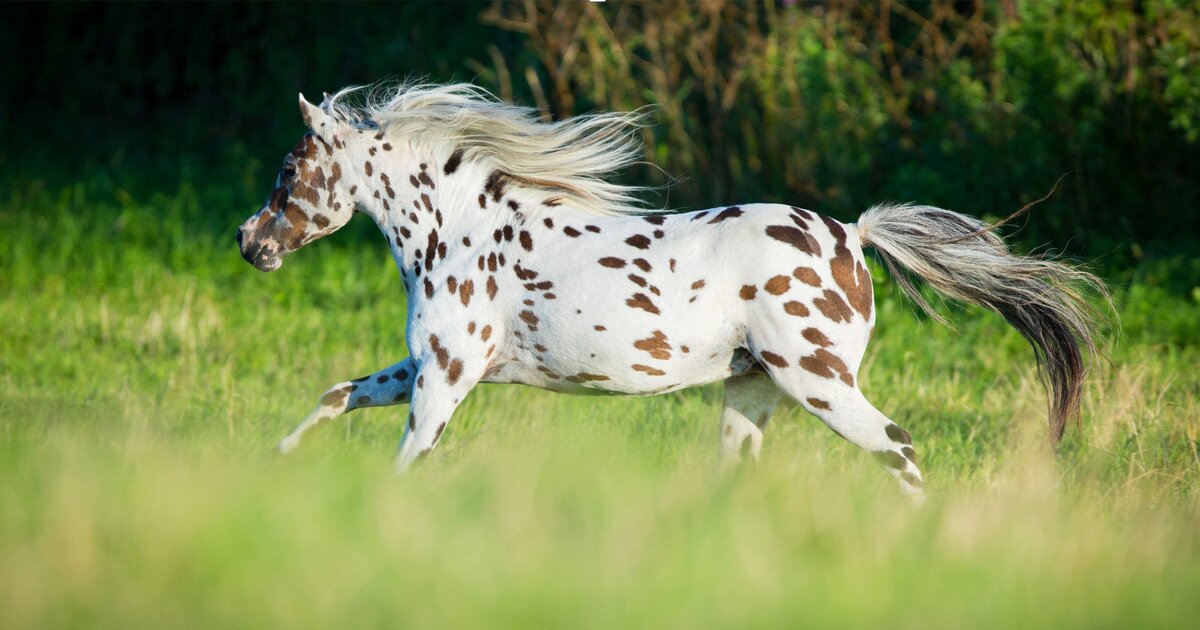
Every Appaloosa wears a different outfit. Not figuratively. The Leopard Complex gene literally rewrites each horse's coat across its lifetime, producing patterns so individual that no two Appaloosas on earth match. You can find nearly solid animals with a thumbnail-sized splash of white on one hip standing in the same field as full-body leopards who look like a Dalmatian got ambitious. And the wild part? That solid-looking three-year-old might be a varnish roan by age twelve.
The Nez Perce and the Spotted Horse
The Appaloosa traces directly to the Nez Perce people of the Palouse River region, spanning what is now Idaho, Washington, and Oregon. These were not casual horse keepers. The Nez Perce ran one of the most deliberate selective breeding programs on the North American continent, centuries before European settlers showed up with their stud books.
They gelded bad stallions. Traded off subpar stock. Selected hard for stamina, mountain-savvy feet, intelligence, speed, and those spotted coats. The spots were not decoration. The Nez Perce understood that color was heritable and folded that knowledge into breeding choices well before Mendel ever split a pea pod.
White settlers called them "Palouse horses" after the river. That became "a Palouse," then "Apalouse," and finally Appaloosa. The Appaloosa Horse Club was founded in 1938, initially based in Moro, Oregon. The headquarters moved to Moscow, Idaho, in 1947 under George Hatley. Idaho named the Appaloosa the official state horse in 1975.
Then there is the ugly history. During the Nez Perce War of 1877, the US Army chased Chief Joseph's band on a brutal 1,170-mile fighting retreat. When the Army finally won, they confiscated the horse herds and scattered them. Crossed them indiscriminately with whatever was nearby. An entire generations-long breeding program, gone. The modern Appaloosa descends from survivors of that dispersal, later bolstered by crosses to Quarter Horses, Arabians, and Thoroughbreds.
The Nez Perce tribe has been rebuilding. Their modern Horse Program crosses Appaloosas with Akhal-Tekes to recreate the spotted endurance horse their ancestors perfected. It is one of the more meaningful conservation breeding stories happening right now.
The Genetics Behind the Spots
One gene complex drives everything: Leopard Complex, abbreviated LP. A single copy of LP produces what breeders call "Appaloosa characteristics":
- Mottled skin around the muzzle, eyes, and genitalia
- White sclera visible around the iris, giving that distinctly human-looking eye
- Striped hooves with vertical light and dark bands on the hoof wall
- Progressive roaning where the base coat slowly lightens over the years
LP alone gives you those traits. But the showstopper patterns? Those require a second player: PATN1 (Pattern-1), a separate modifier gene. LP plus PATN1 together determine how much white appears and where it lands on the body.
One copy of LP, no significant PATN1? Probably a varnish roan or minimal expression. Two copies of LP (homozygous) plus PATN1? Full leopard territory. Homozygous LP without PATN1 can still produce progressive varnish or limited white patterning. Few-spot leopard. The stuff that stops traffic.
Breeders lose sleep over this. You can cross two wildly patterned parents and get a solid foal. Or mate two plain-looking horses and unwrap a full leopard. LP and PATN1 segregate independently, so every foal is a fresh spin of the genetic roulette wheel. UC Davis researchers are still mapping additional PATN loci beyond PATN1 that tweak expression. Only PATN1 currently has a commercial test. Probability tables help. Guarantees do not exist.
The Major Coat Patterns
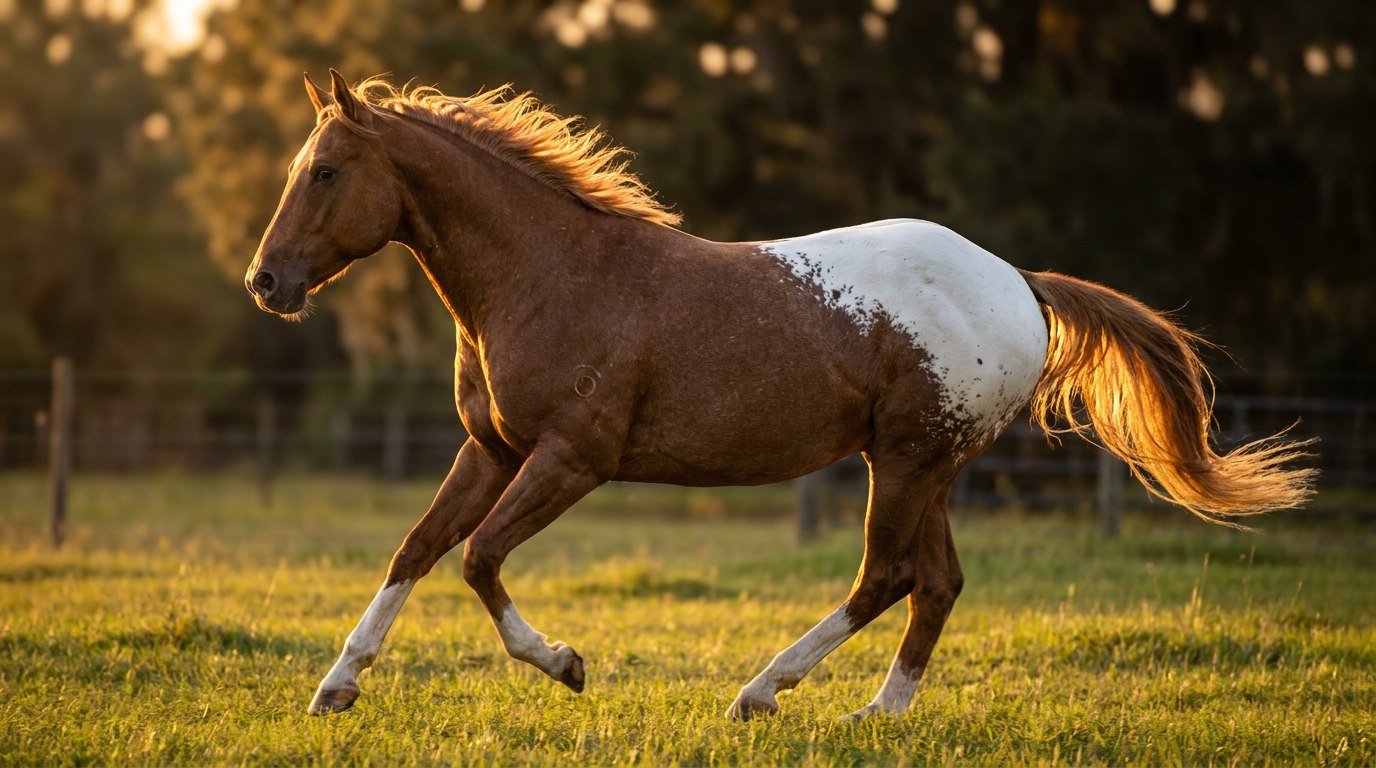
Blanket: White draped over the hips and hindquarters, extending forward to varying degrees. A "blanket with spots" has colored spots inside the white zone. A "blanket without spots" is clean white over the hip. This is the postcard pattern, the one most people picture when somebody says Appaloosa.
Leopard: White body, colored spots scattered from ears to tail. Spots reflect the base color: bay leopards wear reddish-brown spots, black leopards carry jet-black. Full leopards stopped early European explorers cold when they first encountered Nez Perce herds. Dramatic does not cover it.
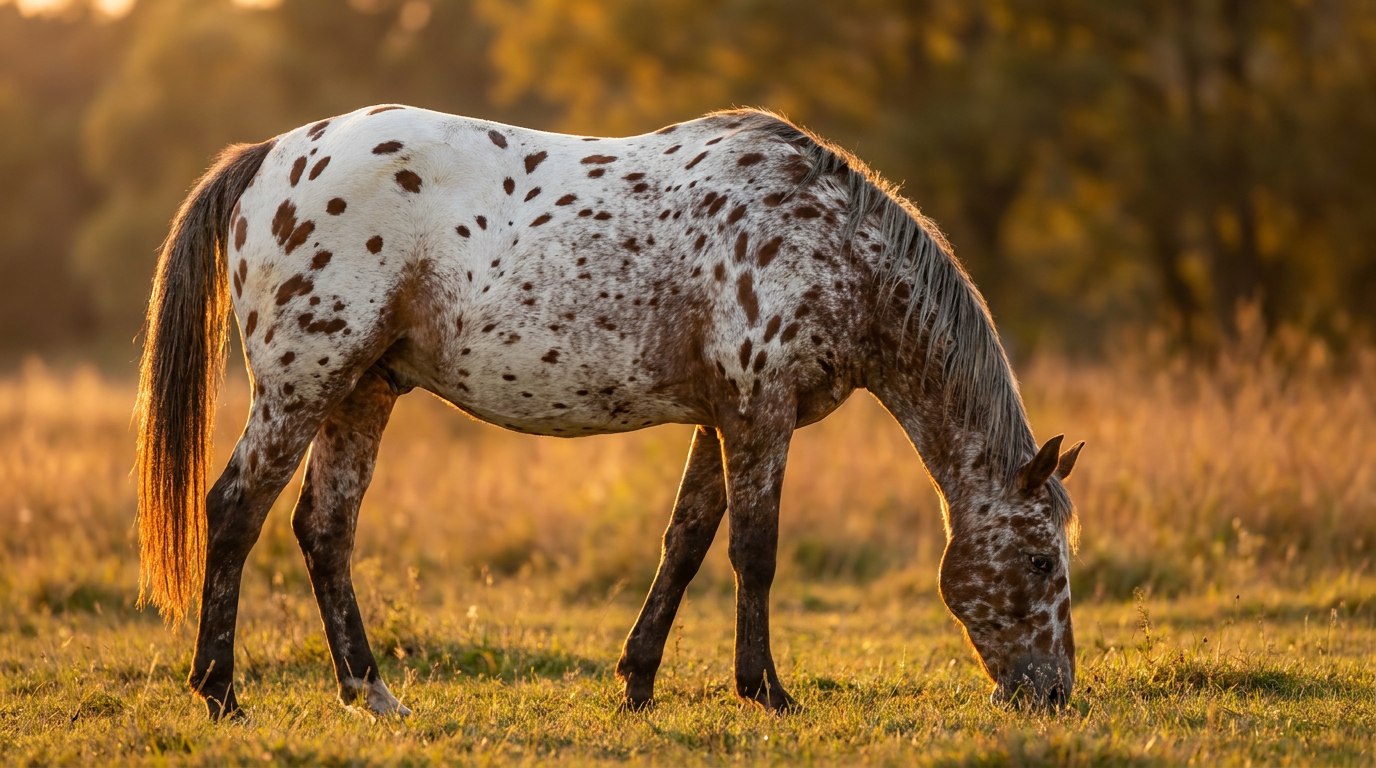
Few-spot leopard: Nearly all white with small spots clinging to bony prominences like the hips, face, elbows, and stifles. Genetically, few-spots are homozygous for LP, meaning they carry two copies and will always pass at least one to every foal. Breeders prize that genetic reliability. The trade-off is significant, though. More on that below.
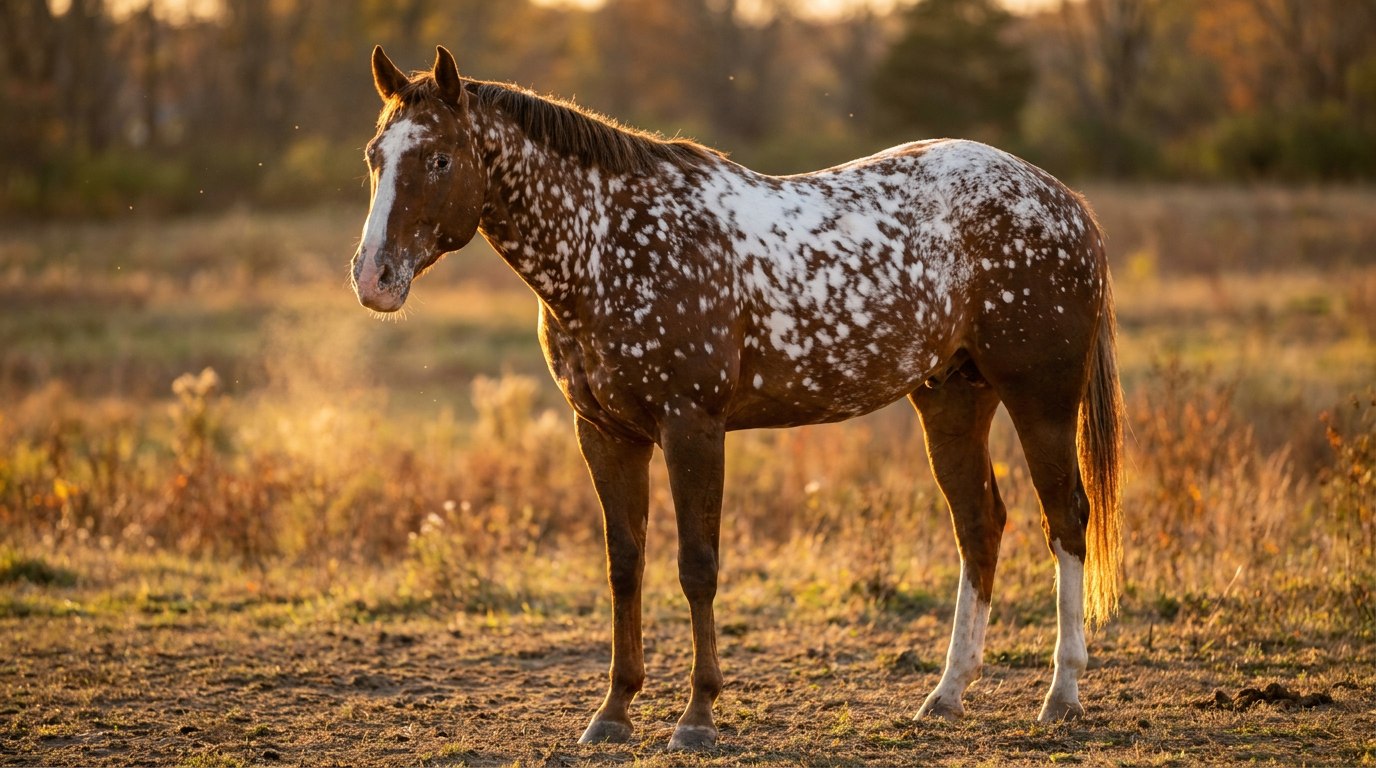
Snowflake: White flecks scattered across a dark base coat, often concentrated over the hips. Spots range from tiny specks to larger irregular splotches. Age intensifies this pattern aggressively. A yearling showing barely-there flecking might be covered in white by ten.
Snowcap: A clean, solid white area over the hips with no spots inside it. Sharp edges where white meets base coat. Think of it as a blanket pattern turned up to high-contrast mode.
Varnish roan: This one confuses people. The horse is born looking normal. Over years, white hairs infiltrate the base coat progressively. Bony prominences (face, point of hip, point of shoulder, legs) hold onto dark color longest, creating an eerie "reverse shadow" effect. An old varnish roan can appear almost entirely white with dark points. Not the same as true roan genetically, despite looking similar at a glance.
Frost: Smaller, more uniform white specks than snowflake, giving a dusted-sugar look. Honestly, the line between frost and snowflake is blurry. Plenty of registration applications use the terms interchangeably.
Marble (varnish roan): Marble is another name for the same pattern as varnish roan, not a separate type. The term is often used when the horse has reached an advanced stage of progressive depigmentation, lightening to near-white while retaining color only on bony prominences. Gets mistaken for gray constantly, but grays lose dark points too. Varnish roans keep them.
Rare and Unusual Patterns
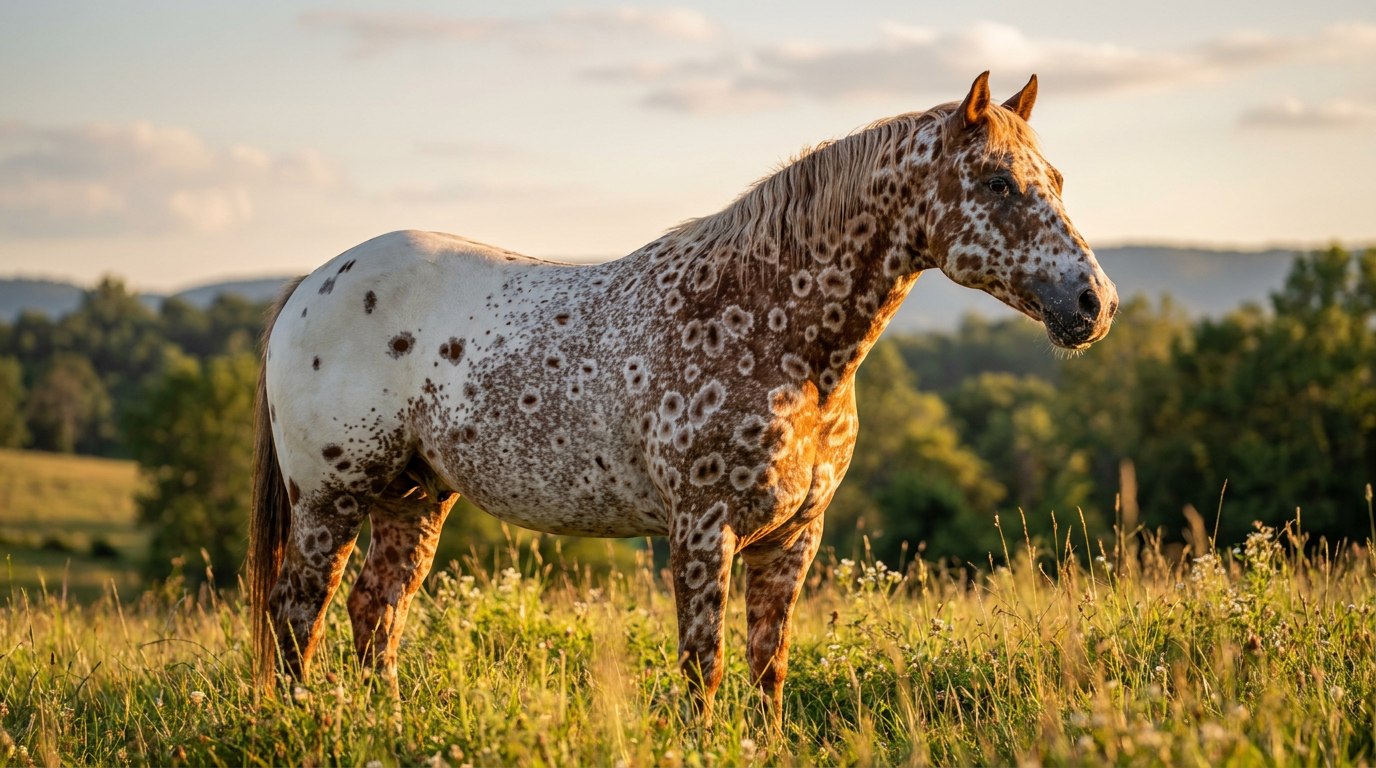
Peacock leopard: One of the rarest expressions of the LP gene. Peacock leopard horses display pigmented spots surrounded by a distinct lighter halo, creating an eye-spot effect that resembles a peacock feather. This is a descriptive phenotype rather than a separate genetic mechanism. It most often appears on leopard or heavily spotted blanket patterns and is highly individual. No two peacock leopards look the same, and the pattern cannot be reliably bred for.
Patterns Change Over Time
This catches new Appaloosa owners off guard. Hard.
Most horse colors stabilize after the foal coat sheds. Appaloosa patterns do not. A foal born solid bay might sprout a blanket by three and look like a varnish roan by twelve. A snowflake yearling could mature into a full leopard. LP expression is progressive, which means the horse you buy at five genuinely might look like a different animal at fifteen.
That creates an identification problem. Your registration papers say "bay blanket," but your twenty-year-old horse is now mostly white with faint dark points. The papers are not wrong. The horse just kept changing. Microchips and brands beat color descriptions for reliable ID in this breed, every single time.
Season adds another variable. Summer coats show more dramatic patterning. Winter coats mute everything. Clipping a fuzzy winter horse can reveal detail that was invisible under the fluff. Smart breeders photograph foals multiple times across the first year to document pattern development for registration.
Night Blindness: The LP Trade-Off
Homozygous LP horses (two copies of Leopard Complex) carry a significantly higher risk of Congenital Stationary Night Blindness, or CSNB. Normal daylight vision, severely impaired vision in low light. Few-spot leopards and some near-leopards are the most commonly affected.
CSNB is not progressive. It will not worsen over time. But a horse that panics in its stall after dark, refuses to load in a dim trailer, or stumbles through shaded trail sections might not be "spooky." That horse might genuinely be unable to see. I have watched people sell perfectly good horses as behavioral problems when the real issue was CSNB that nobody tested for.
The mechanism involves abnormal signaling in retinal cells responsible for scotopic (low-light) vision. Bellone et al. published the definitive work in 2013, linking a retroviral insertion in TRPM1 to both LP spotting and night blindness. The same gene that makes the pattern also breaks the night vision. Genetics is blunt like that sometimes.
Management is straightforward once you know. Leave barn lights on overnight. Avoid sudden bright-to-dark transitions. Keep pasture layouts consistent. Skip dusk trail rides and heavily shaded ravines. CSNB horses adapt remarkably well when their owners actually understand what is going on. A genetic test for LP zygosity through UC Davis costs under $50 and tells breeders exactly what they are working with before making pairing decisions. It is also worth noting that homozygous LP horses carry an elevated risk for equine recurrent uveitis (ERU), an inflammatory eye condition unrelated to CSNB but worth monitoring in heavily patterned animals.
Registration and the Color Question
The Appaloosa Horse Club walks a tightrope around color. Registration requires visible Appaloosa characteristics (mottled skin, striped hooves, visible sclera) or identifiable coat patterning. Horses that meet parentage rules but show no visible characteristics receive Non-Characteristic (N) registration, with restrictions on breeding and showing. Advancement from N to Regular (#) registration is possible through documented characteristics or LP testing under current ApHC rules.
This gets messy in practice. Two registered Appaloosa parents can produce a solid bay foal with zero visible LP traits. That foal might still carry LP and produce dramatically spotted offspring. Genetic testing through UC Davis now lets breeders verify LP status regardless of what the eye can see, which has cleared up enormous amounts of confusion in breeding programs.
Beyond the Spots
The coat gets all the attention. Fair enough. But Appaloosas are genuine athletes with strong Quarter Horse influence: competitive in reining, roping, barrel racing, trail classes. Plenty hold their own in English disciplines and endurance riding too. The breed tends toward sensible and willing, though individual temperament varies widely given the diverse genetic background.
Some Appaloosas register as "solid," carrying LP characteristics like mottled skin and striped hooves but without flashy pattern expression. These horses are every bit as much Appaloosa as the full leopards. They drew a different card from the same deck. Their skeletal structure, their minds, their heart for the job are all breed-typical regardless of surface appearance.
What makes Appaloosa patterns worth understanding goes beyond aesthetics. Every spotted horse in a pasture is a living link to Nez Perce breeding traditions, to Pacific Northwest ecology, and to ongoing genetic research into how mammals express color and pattern. The coat tells a story that stretches back centuries, and it is still being written.
🔍 Want to explore how coat color relates to skin and muscle structure? Check it out here.
Frequently Asked Questions
Do Appaloosa spots change as the horse ages?
Yes. Appaloosa patterns are progressive and can shift significantly throughout the horse's life. A solid-looking foal may develop a blanket by age three and transition to a varnish roan by twelve. This is normal LP gene expression, not a sign of any health problem.
What causes night blindness in Appaloosas?
Congenital Stationary Night Blindness (CSNB) is linked to homozygous LP status, meaning the horse carries two copies of the Leopard Complex gene. A retroviral insertion in the TRPM1 gene disrupts retinal cells responsible for low-light vision. It affects few-spot leopards and some near-leopard patterned horses most frequently. The condition is not progressive and can be managed with lighting accommodations.
Can two solid-colored Appaloosas produce a spotted foal?
Absolutely. Both parents can carry LP and PATN genes without showing dramatic external patterning. When those hidden genes combine in a foal, the result can be a full leopard or blanket pattern. Genetic testing through UC Davis can confirm LP and PATN status regardless of visible expression.
What is the difference between varnish roan and true roan?
They look similar but are genetically unrelated. True roan (controlled by the Rn gene) produces an even mix of white and colored hairs across the body from birth and stays relatively stable. Varnish roan (controlled by LP) is progressive, starting with the base color and lightening over years, with dark color retained longest on bony prominences like the face, hips, and legs.
How do I register a solid-colored horse with Appaloosa parents?
The Appaloosa Horse Club allows registration of solid-colored offspring from two registered Appaloosa parents, but these horses receive a different classification. They may face restrictions in certain breeding and show contexts. Genetic testing to confirm LP carrier status is recommended, as these horses can still produce patterned offspring.
Sources
- UC Davis Veterinary Genetics Laboratory - Leopard Complex and PATN Testing ucdavis.edu
- Cornell University - Equine Coat Color Genetics cornell.edu
- Merck Veterinary Manual - Congenital and Inherited Ocular Disorders in Horses merckvetmanual.com
- Texas A&M College of Veterinary Medicine - Equine Ophthalmology tamu.edu
- AAEP - Equine Vision and Eye Health aaep.org
- Appaloosa Horse Club - Official Registration Handbook and Rules appaloosa.com
- Bellone, R.R. et al. "Evidence for a Retroviral Insertion in TRPM1 as the Cause of Congenital Stationary Night Blindness and Leopard Complex Spotting in the Horse." PLoS ONE, 2013.