Western vs English Riding: Key Differences in Tack, Position, and Training
If you have spent any time around horses, you have probably heard the question: "Are you Western or English?" It is one of the first things riders ask each other, almost like a secret handshake. But the truth is, Western and English riding are not rival camps. They are two branches of the same tree, shaped by different histories, different jobs, and different goals.
Whether you are a lifelong barrel racer curious about dressage or an eventer wondering what reining is all about, understanding both traditions makes you a better horseperson. So let's break down the real differences, from the tack on your horse's back to the way you sit in the saddle.
A Brief History: How We Got Here
English riding traces its roots to European military and aristocratic traditions. Classical dressage was originally developed to train warhorses, and the lighter English saddle evolved for cavalry officers who needed agility and close contact with their mount. Over centuries, this tradition branched into disciplines like show jumping, eventing, and modern dressage.
Western riding, on the other hand, grew out of the Spanish vaquero tradition brought to the Americas. Ranch work demanded a saddle that could hold a rider comfortably for 12-hour days and anchor a rope to a steer. The horn, the deep seat, and the wider stirrups all came from practical necessity, not fashion. Today, Western riding encompasses disciplines from reining and cutting to trail riding and ranch versatility.
Despite their different origins, both traditions share a common goal: effective communication between horse and rider. The methods just look a little different.
Saddle Differences: More Than Just a Horn
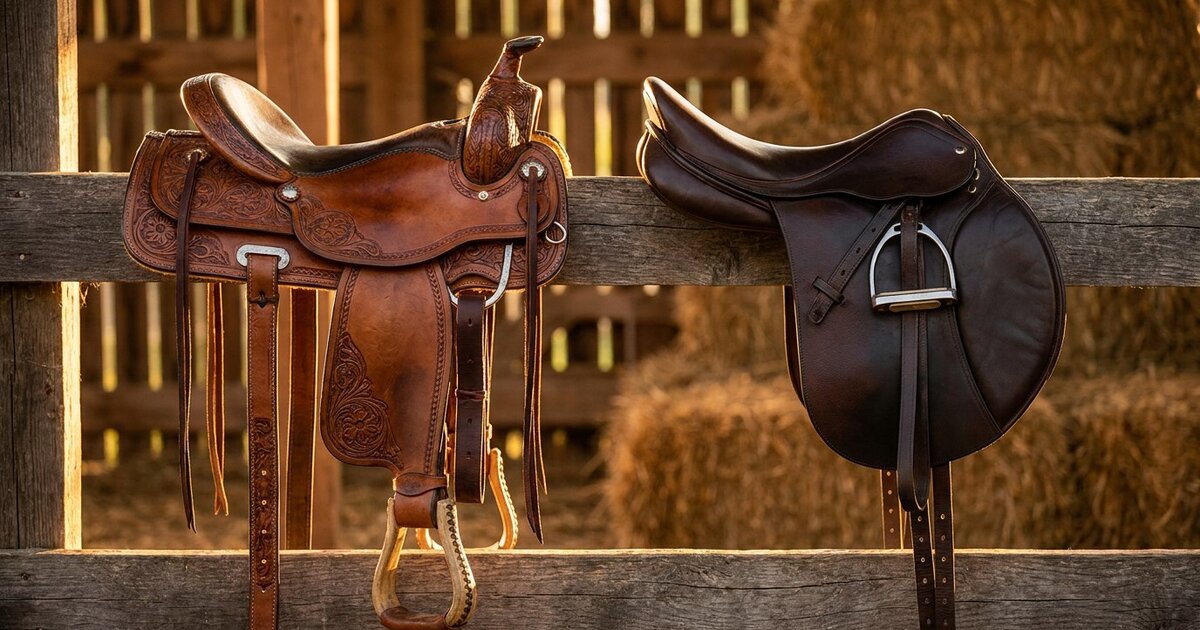
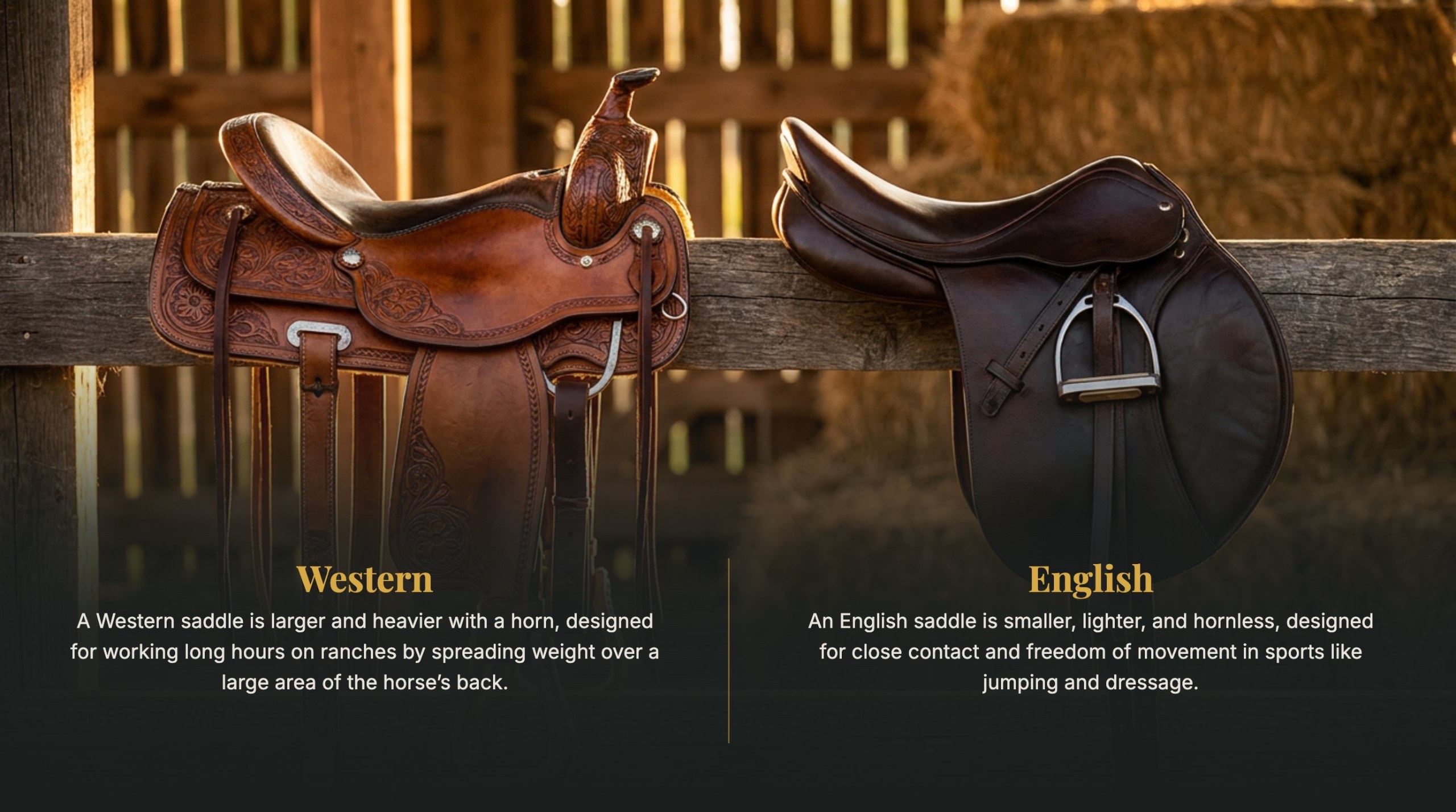
The saddle is the most visible difference between Western and English riding, and it is not just cosmetic. Each design reflects a completely different job description.
A Western saddle typically weighs 25 to 45 pounds. It features a horn for dallying a rope, a deep seat that cradles the rider, wide skirts that distribute weight over a larger area of the horse's back, and fenders that protect the rider's legs. The tree (the internal frame) is usually made of wood covered in rawhide or fiberglass, and it sits on top of a thick pad. This design is built for stability and long hours in the saddle. If you want to understand how saddle weight and surface area affect your horse's thoracic vertebrae, it is worth exploring how pressure distributes across the back.
An English saddle, by contrast, weighs 10 to 20 pounds. There is no horn, the seat is flatter, and the overall profile is much closer to the horse's body. This minimal design gives the rider more direct feel of the horse's movement, which matters in disciplines where subtle aids and quick position changes are essential. English saddles come in specialized shapes: deep-seated dressage saddles, forward-cut jumping saddles, and flatter all-purpose models.
Both styles demand proper fit. A poorly fitted saddle, whether Western or English, creates pressure points that can cause soreness, muscle atrophy, and long-term damage. Check out our guide on saddle fit basics for a deeper look at how fit affects your horse's comfort and performance.
Bridles, Bits, and Headgear
The differences in headgear between Western and English riding reflect each tradition's approach to communication with the horse.
English bridles typically use a cavesson noseband and come in snaffle or double-bridle configurations. A snaffle bridle has a single bit with direct rein action, meaning the pressure goes straight to the corners of the horse's mouth. A double bridle, used in upper-level dressage, adds a curb bit and curb chain for more refined communication. English riders generally maintain steady, elastic contact with the horse's mouth through the reins.
Western bridles often have no noseband at all. Young horses typically start in a snaffle with two hands on the reins, similar to English riding. As training progresses, Western horses transition to a curb bit (often a shanked bit) and are ridden one-handed with neck reining. The finished Western horse responds to the lightest touch of the rein on its neck, with little to no contact on the mouth. Some Western disciplines also use hackamores or bosals, which apply pressure to the nose and chin rather than the mouth.
The end goal in both traditions is a horse that responds to light, clear cues. They just take different paths to get there.
Rider Position: Where Your Seat Bones Go
Rider position is where you can really see the philosophical differences between Western and English riding.
In English riding, the ideal position places the rider's ear, shoulder, hip, and heel in a vertical line (when viewed from the side). The stirrups are shorter, the rider's knee is more bent, and the upper body adjusts depending on the discipline. A dressage rider sits tall and deep with a long leg. A jumping rider shortens the stirrups further and folds forward into a two-point position over fences. In all cases, the English rider maintains contact with the horse's mouth through elastic, following hands. Understanding how your position affects weight distribution and soundness is key to riding well in any English discipline.
In Western riding, the stirrups are longer, the leg hangs more naturally underneath the rider, and the seat is deeper. The rider sits back slightly, with a relaxed, upright posture. The rein hand (usually the left) stays low and quiet, and the free hand rests on the thigh or holds the tail of the reins. Western riders aim for a "quiet seat" that moves with the horse without interfering.
Here is the thing many people miss: both positions are designed to keep the rider balanced over the horse's center of gravity. The biomechanics are more similar than they appear. A balanced rider is a balanced rider, regardless of what saddle they are sitting in. The horse's lumbar vertebrae bear the rider's weight in both styles, and a crooked or unbalanced seat causes the same problems whether you are wearing chaps or tall boots.
Training Philosophy: Two Roads, Same Destination
The training philosophies behind Western and English riding overlap more than most people realize, but they do have distinct emphases.
English training traditionally follows a progressive scale of training (the German Training Scale is the most widely referenced): rhythm, suppleness, contact, impulsion, straightness, and collection. The goal is to develop the horse's natural movement to its fullest potential, building carrying power and self-carriage over time. Dressage is sometimes called "the foundation of all English riding," and even jumping trainers use flatwork rooted in dressage principles. For a closer look at what collection actually means and how it develops, see our article on collection in dressage.
Western training, rooted in the vaquero tradition, follows a similar progression but uses different language. A young horse starts "green" in a snaffle, learning to give to pressure, move off the rider's leg, and carry itself in balance. Over months or years, the horse progresses to a curb bit and eventually responds to neck reining and subtle weight shifts. The ideal finished Western horse is light, responsive, and can work cattle or navigate obstacles with minimal visible cues from the rider.
Both traditions value softness, responsiveness, and the horse's willingness to carry itself in balance. A well-trained reining horse and a well-trained dressage horse have more in common than you might think: both collect, both engage their hindquarters, and both respond to aids that are nearly invisible to an observer.
Common Disciplines in Each Style
Each tradition has spawned a wide range of competitive and recreational disciplines. Here is a quick overview:
English Disciplines
- Dressage: The art of training the horse to perform precise movements in response to subtle aids. Competitions range from introductory level through Grand Prix.
- Show Jumping: Horse and rider navigate a course of fences, judged on speed and faults (knocked rails, refusals). Understanding distances between fences and stride calculations is critical at every level.
- Eventing: A three-phase competition combining dressage, cross-country jumping, and show jumping. Often called the triathlon of equestrian sport.
- Hunter: Judged on the horse's way of going, manners, and style over fences, rather than speed.
- Polo: A team sport played on horseback, requiring speed, agility, and precise ball-handling.
Western Disciplines
- Reining: Sometimes called "Western dressage," reining showcases sliding stops, spins, lead changes, and circles at various speeds. It tests precision and responsiveness.
- Cutting: The horse separates a cow from the herd and prevents it from returning, working largely on its own instincts with minimal rider input.
- Barrel Racing: A timed speed event where horse and rider navigate a cloverleaf pattern around three barrels.
- Team Roping: Two riders work together to rope a steer, one catching the head and the other the heels.
- Trail Class: Horse and rider navigate obstacles like gates, bridges, and ground poles, judged on the horse's willingness and manner.
- Ranch Versatility: A newer discipline that tests practical ranch skills including cutting, reining, fence work, and ranch riding.
Which Is Better? (Spoiler: Neither)
This is the question that starts arguments at feed stores and on internet forums, and the honest answer is: neither style is inherently better. They are different tools for different jobs.
If you want to work cattle, ride trails for hours, or compete in reining, Western riding makes sense. If your goals involve jumping, dressage, or eventing, English riding is your path. Many riders do both, and cross-training between disciplines can actually make you a more well-rounded horseperson.
The best riders in both worlds share the same qualities: a balanced, independent seat; soft, educated hands; clear communication with the horse; and a deep understanding of equine biomechanics. A great rider can get on any horse, in any saddle, and make it work.
What matters far more than which style you choose is how well you do it. A rough rider is a rough rider regardless of discipline, and a good rider is a good rider whether they are in a cutting saddle or a dressage saddle. If you are curious about how your horse's body responds to different riding styles, our 3D Explorer can help you visualize the skeletal structures involved.
How Anatomy and Biomechanics Differ Between the Two
From the horse's perspective, the biomechanical demands of Western and English riding have some meaningful differences.
In English riding, especially in collected work and jumping, the horse shifts more weight to its hindquarters and lifts through the thoracic sling (the muscles that suspend the torso between the front legs). The shorter stirrups and more forward rider position (particularly in jumping) change how the rider's weight distributes across the horse's back. Collected dressage work asks the horse to flex the lumbosacral joint and engage the abdominal muscles to "round" the topline.
In Western riding, the longer stirrup and deeper seat tend to place the rider's weight slightly further back. The heavier saddle distributes pressure over a wider area, which can be an advantage for long rides but also means fit is critical. In reining, the horse performs dramatic stops that load the hindquarters intensely, requiring significant strength in the stifles, hocks, and gluteal muscles. Cutting horses make rapid lateral movements that stress the suspensory ligaments and digital flexor tendons.
In both styles, the horse uses the same fundamental anatomy. The longissimus dorsi muscle supports the rider's weight, the thoracic and lumbar vertebrae bear compressive forces, and the hindquarters generate propulsion. The key difference is emphasis: English disciplines tend to ask for more sustained collection and elevation, while Western disciplines often demand bursts of speed, quick stops, and lateral agility.
Regardless of discipline, proper conditioning, correct saddle fit, and a balanced rider are what keep the horse sound and comfortable.
Frequently Asked Questions
Is Western or English riding easier for beginners?
Many beginners find Western riding easier at first because the larger saddle feels more secure and the deeper seat helps with balance. However, both styles require skill and practice to do well. The best choice depends on your goals and what instruction is available in your area.
Can you switch between Western and English riding?
Absolutely. Many riders compete in both styles, and cross-training is common. The fundamentals of balance, timing, and communication transfer between disciplines. Your horse may need time to adjust to different tack and cues, but most well-trained horses can work in either style.
Is a Western saddle better for the horse's back?
Not necessarily. A Western saddle distributes weight over a larger surface area, which can reduce pressure per square inch. However, it is also heavier. A well-fitted English saddle with appropriate padding can be just as comfortable for the horse. Fit matters far more than style.
Why do Western riders use one hand on the reins?
One-handed riding developed from ranch work, where the rider needed a free hand to rope cattle, open gates, or handle equipment. The horse is trained to respond to neck reining, turning away from the pressure of the rein laid against its neck.
Do Western and English horses need different conditioning?
To some extent, yes. A reining horse needs explosive power in the hindquarters for stops and spins, while a dressage horse needs sustained engagement and carrying power. However, the foundation of good conditioning, including cardiovascular fitness, core strength, flexibility, and correct muscular development, is the same across all disciplines.
Sources
- United States Equestrian Federation (USEF). "Disciplines." usef.org
- American Quarter Horse Association (AQHA). "Western Riding Disciplines." aqha.com
- Clayton, H.M. The Dynamic Horse: A Biomechanical Guide to Equine Movement and Performance. Sport Horse Publications, 2004.
- German National Equestrian Federation. The Principles of Riding. Kenilworth Press, 2017.
- Loving, Nancy S. All Horse Systems Go: The Horse Owner's Full-Color Veterinary Care and Conditioning Resource. Trafalgar Square Books, 2006.
Written with AI · Reviewed by Jaynee Bell