Horse Markings Explained: A Complete Guide to Face and Leg Markings
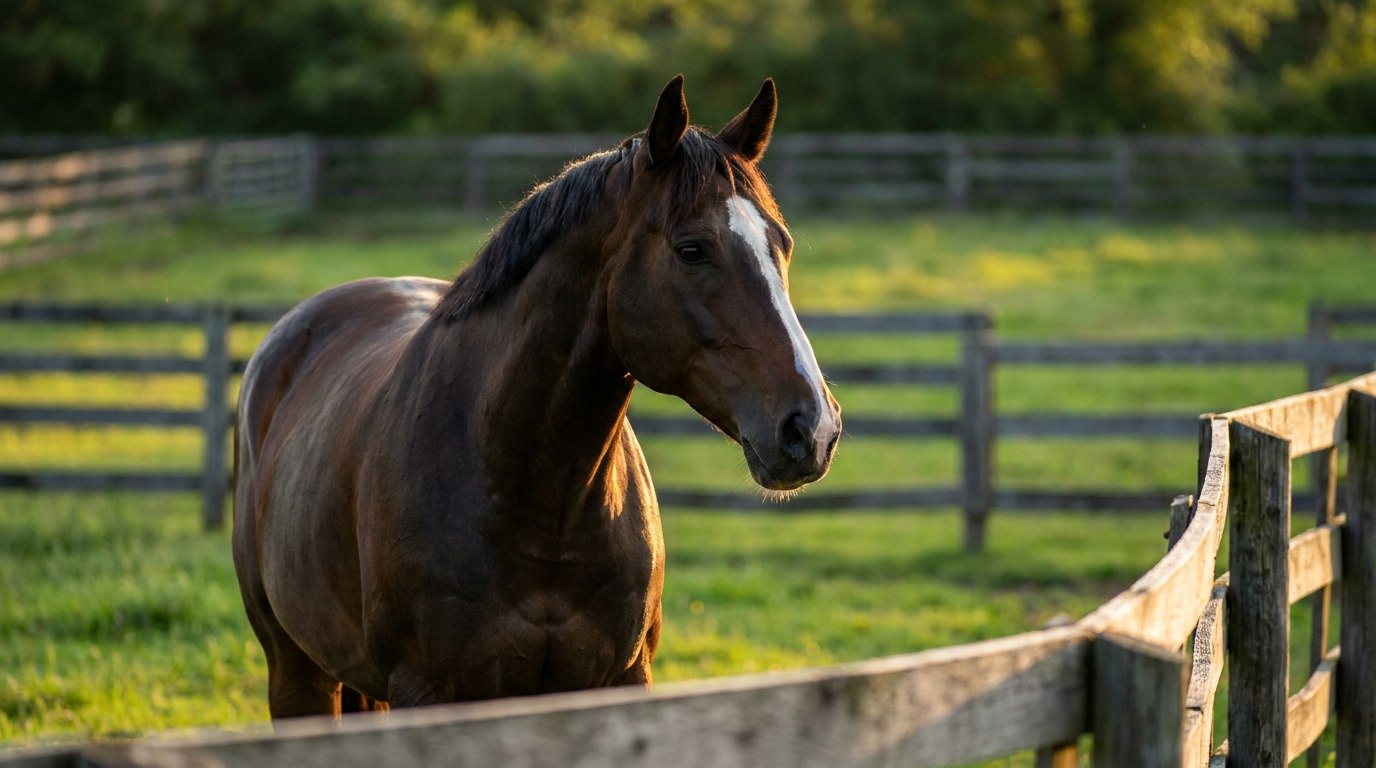
Every horse has a unique combination of white markings on its face and legs. These markings are not just cosmetic details. They are recorded on registration papers, used for identification, and occasionally linked to health considerations that every horse owner should understand.
Whether you are filling out a registration form, describing a horse to a potential buyer, or simply trying to sound like you know what you are talking about at the barn, understanding the correct terminology for horse markings matters. Most people can point to a blaze or a sock, but the full vocabulary of equine markings goes much deeper than that.
How Horse Markings Form
White markings on horses result from the absence of pigment in specific areas of skin. During embryonic development, pigment-producing cells called melanocytes migrate from the neural crest to the skin. Where melanocytes fail to reach or establish themselves, the skin lacks pigment, and the hair growing from that skin grows in white.
This is not the same mechanism that produces white coat colors in breeds like Grays or Cremellos. Markings are localized areas where pigment simply never arrived during development. The underlying skin in these areas is pink rather than dark, which has practical implications for sun sensitivity and skin health.
Markings are determined genetically, though the exact patterns are not perfectly predictable. Two horses with identical genetics could theoretically produce slightly different marking patterns because of the randomness in melanocyte migration. However, once a horse is born, its markings remain essentially the same for life. They do not grow, shrink, or change shape, which is exactly why they work so well for identification.
Face Markings
Face markings are described based on their size, shape, and location on the horse's head. The terminology is standardized across most breed registries, though minor variations exist between organizations.
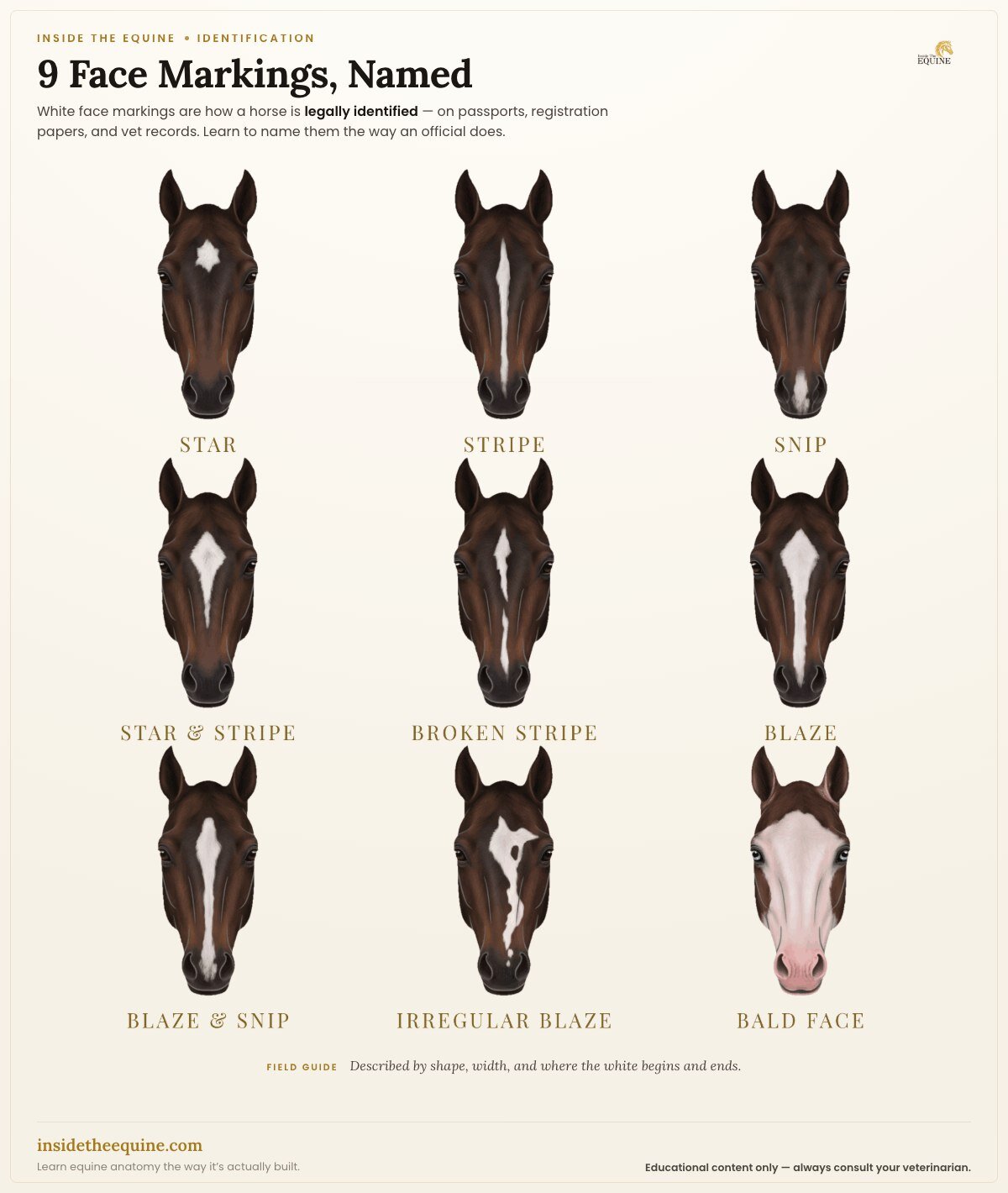
Star. A white mark on the forehead, between or above the eyes. Stars can range from a tiny spot no bigger than a thumbprint to a broad irregular shape covering most of the forehead. They can be round, oval, crescent-shaped, or completely irregular. When documenting a star, registries note its size, shape, and exact position.
Strip (or Stripe). A narrow vertical band of white running down the bridge of the nose. A strip is narrower than a blaze and typically stays between the edges of the nasal bones. It may connect to a star above or a snip below, or it may appear on its own. Some strips are perfectly straight while others deviate to one side.
Blaze. A wide band of white running down the center of the face from the forehead toward the muzzle. A blaze is wider than a strip and typically extends past the edges of the nasal bones. It is one of the most common and recognizable facial markings. A blaze can be even and symmetrical or irregular with uneven edges.
Bald Face. An extremely wide blaze that extends past the eyes and covers most or all of the front of the face. Bald-faced horses often have blue eyes on the side where the white marking extends around the eye. The extensive pink skin on a bald face makes these horses particularly susceptible to sunburn, and many owners apply sunscreen or use fly masks with UV protection.
Snip. A small white mark on the muzzle, usually between or just below the nostrils. Snips can be tiny dots or larger patches. They sometimes connect to a strip or blaze coming down the face, and sometimes they appear completely on their own with no other facial white.
Combinations. Many horses have connected markings described together. A horse might have a "star and strip connected" or a "star, strip, and snip." When markings are not connected, they are described separately: "star and separate snip." Precise language matters on registration papers because these descriptions serve as a permanent identification record.
Leg Markings
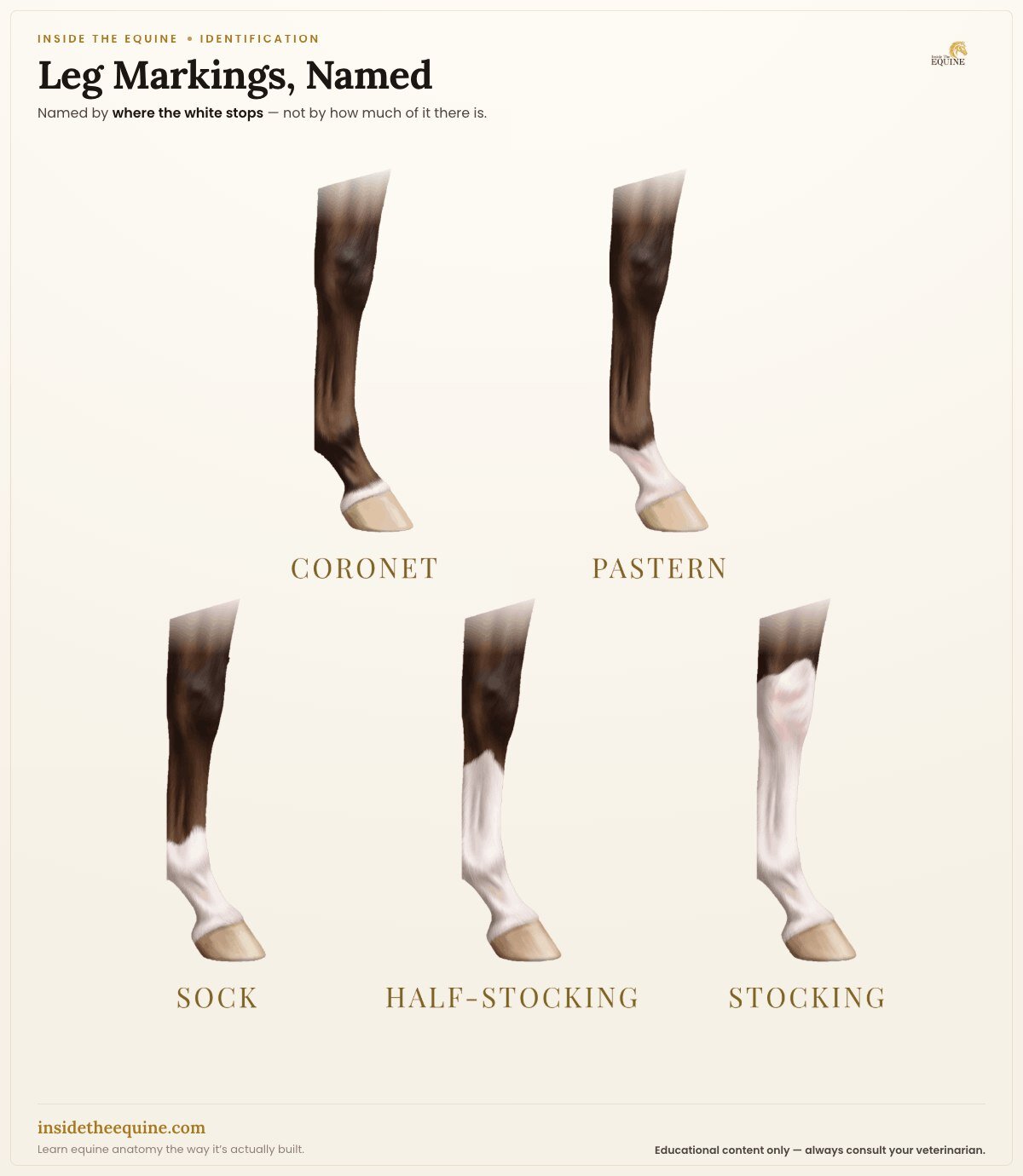
Leg markings are described by how high the white extends up the leg from the hoof. Like face markings, leg markings are caused by the absence of pigment and feature pink skin underneath the white hair.
Coronet (or Coronet Band). A thin line of white just above the hoof, at the coronary band. This is the smallest leg marking and can sometimes be so subtle it is easy to miss. It may appear as a narrow, even ring or as an irregular patch.
Pastern. White that extends from the hoof up to and including the pastern area but does not reach the fetlock joint. This marking covers the area roughly between the hoof and the first joint above it.
Sock (or Ankle). White that extends from the hoof up to and including the fetlock joint. The term "sock" is widely used in casual conversation, while some registries use more precise anatomical descriptions. Socks are extremely common, particularly on the hind legs.
Half Stocking (or Boot). White that extends from the hoof up to roughly the middle of the cannon bone, between the fetlock and the knee or hock. This marking falls between a sock and a full stocking in height.
Stocking. White that extends from the hoof up to or above the knee (carpus) on the front legs or the hock on the hind legs. Full stockings are dramatic and eye-catching. Some stockings extend well above the knee or hock, sometimes reaching the elbow or stifle. The higher the white extends, the more pink skin is exposed.
Ermine Spots. Small dark spots that appear within white leg markings, usually at the coronary band. These are isolated patches where melanocytes did establish themselves within an otherwise unpigmented area. Ermine spots are common and are noted on registration papers as additional identifying features.
Markings and Identification
Before microchips became standard, horse identification relied almost entirely on written and drawn descriptions of markings. Registration papers include detailed diagrams of a horse's face and all four legs, with every marking carefully outlined and described. This system worked because markings do not change over a horse's lifetime.
Even with modern identification technology, markings remain a primary visual tool. When you are buying a horse, one of the first things you should do is compare the animal's actual markings against what appears on its registration papers. Mismatches can indicate anything from a clerical error to a deliberate misrepresentation.
Veterinarians also document markings on health records and Coggins test paperwork. If your horse ever goes missing, a detailed description of its markings is one of the most useful pieces of information you can provide.
Whorls, or hair patterns where the coat changes direction, are another identification feature often documented alongside markings. While not technically "markings" in the white-pattern sense, whorls are unique to each horse and appear on registration diagrams.
Health Considerations
White markings are not purely cosmetic. The pink skin beneath white hair lacks the melanin that provides natural sun protection, making these areas more vulnerable to several conditions.
Sunburn. Horses with extensive white facial markings, especially bald-faced horses, are prone to sunburn on the nose and around the eyes. Chronic sun exposure to unpigmented skin increases the risk of squamous cell carcinoma, a type of skin cancer. Fly masks with UV protection, equine-safe sunscreen, and turnout management can help reduce this risk.
Photosensitivity. Some skin conditions cause heightened sensitivity to sunlight, and these reactions preferentially affect pink-skinned areas. Liver disease, certain toxic plants, and some medications can trigger photosensitization where the unpigmented skin under white markings blisters and peels while dark-skinned areas remain unaffected.
Scratches (Pastern Dermatitis). The pink skin under white leg markings, especially socks and stockings, is generally considered more susceptible to scratches, also called mud fever or greasy heel. The lack of pigment may make this skin slightly more reactive, though management factors like wet conditions and poor hygiene play a much larger role than skin color alone.
Hoof Color. White leg markings typically correspond to lighter-colored hooves. A leg with a stocking will usually have a lighter (more yellowish or white) hoof wall, while a dark leg produces a darker hoof. There is a longstanding belief that white hooves are weaker than dark ones, but research has not consistently supported this. Hoof quality depends far more on nutrition, environment, and genetics beyond just pigmentation.
Markings vs. Coat Patterns
It is important to distinguish between markings and coat color patterns. Markings are the small to moderate areas of white on an otherwise colored horse. Coat patterns like tobiano, overo, and sabino in Paint and Pinto horses or the spotted patterns of Appaloosas are a different genetic mechanism entirely.
That said, some coat pattern genetics can influence markings. The sabino gene, for example, can produce anything from slightly higher-than-normal white leg markings and a wider blaze all the way to a nearly all-white horse, depending on how many copies and modifiers are present. Some horses that appear to have "normal" markings are actually minimally expressing a coat pattern gene.
Gray horses present another unique situation. All gray horses are born a darker color and progressively lighten over time. Their markings, which were visible when they were young, gradually become invisible as the entire coat turns white or flea-bitten gray. The markings are still technically there; the surrounding coat has simply caught up.
Frequently Asked Questions
Do horse markings change over time?
No. A horse's white markings are established at birth and remain the same throughout its life. The shape, size, and location do not change. This is why markings are reliable for identification purposes. The only exception is that gray horses' markings become invisible as their entire coat lightens, but the underlying pattern remains.
Are white hooves really weaker than dark hooves?
This is a common belief, but research has not consistently shown a significant difference in strength or quality between light and dark hooves. Hoof health depends far more on nutrition, moisture balance, trimming or shoeing practices, and overall genetics. Treat all hooves the same regardless of color.
What is the difference between a blaze and a bald face?
A blaze is a wide vertical stripe of white down the center of the face, but it stays within the general boundaries of the face. A bald face is much wider, extending past the eyes and sometimes covering nearly the entire front of the head. Bald-faced horses often have blue eyes and require extra sun protection due to the extensive pink skin.
Can two solid-colored parents produce a foal with white markings?
Yes. White markings are influenced by multiple genes and are not perfectly predictable. Two horses with minimal markings can produce a foal with more extensive white, and two horses with prominent markings can produce a foal with very little. The randomness of melanocyte migration during development adds another layer of unpredictability.
Do certain breeds have more markings than others?
Yes. Clydesdales, for example, are known for their prominent white facial markings and leg stockings with feathering. Arabians tend to have smaller, more refined markings. Thoroughbreds commonly have stars and socks. Breed-specific genetics influence the likelihood and extent of white markings, though individual variation within any breed is wide.
Quick Reference Table
| Marking | Location | Description | Identification Notes |
|---|---|---|---|
| Star | Forehead | White mark between or above the eyes | Varies from small dot to large irregular patch; describe shape and position |
| Stripe | Face (bridge of nose) | Narrow white line down the face | Narrower than a blaze; may be connected to star or isolated |
| Blaze | Face (bridge of nose) | Wide white band from forehead toward muzzle | Wider than a stripe; should cover most of the nasal bone width |
| Bald Face | Entire face | Very wide white extending past the eyes to the sides | Often associated with blue eyes; common in Paints and pintos |
| Snip | Muzzle | Small white mark between or on the nostrils | Can be a dot or a strip; may connect to a stripe or stand alone |
| Coronet | Coronary band | Thin white band just above the hoof | Lowest and smallest of leg markings; easily missed under feathering |
| Pastern | Pastern area | White from coronet to top of pastern | Also called a partial sock; note exact height for identification |
| Sock | Below the knee/hock | White from hoof to below the knee or hock | Sometimes called a half-stocking; note any irregular edges |
| Stocking | Up to or past the knee/hock | White from hoof to the knee or hock or higher | Tallest common leg marking; describe exact height |
Sources
- Sponenberg, D.P. "Equine Color Genetics." 4th Edition. Wiley-Blackwell, 2017.
- Stachurska, A. "Inheritance of Primitive Markings in Horses." Journal of Animal Breeding and Genetics, 1999.
- American Association of Equine Practitioners. "Horse Identification and Markings." AAEP.org.
- Jockey Club. "Rules and Regulations for Registration: Identification Standards." The Jockey Club, 2023.
- Knottenbelt, D.C. "Pascoe's Principles and Practice of Equine Dermatology." 2nd Edition. Saunders, 2009.