Standardbred Horse Breed Profile: Born to Trot and Pace
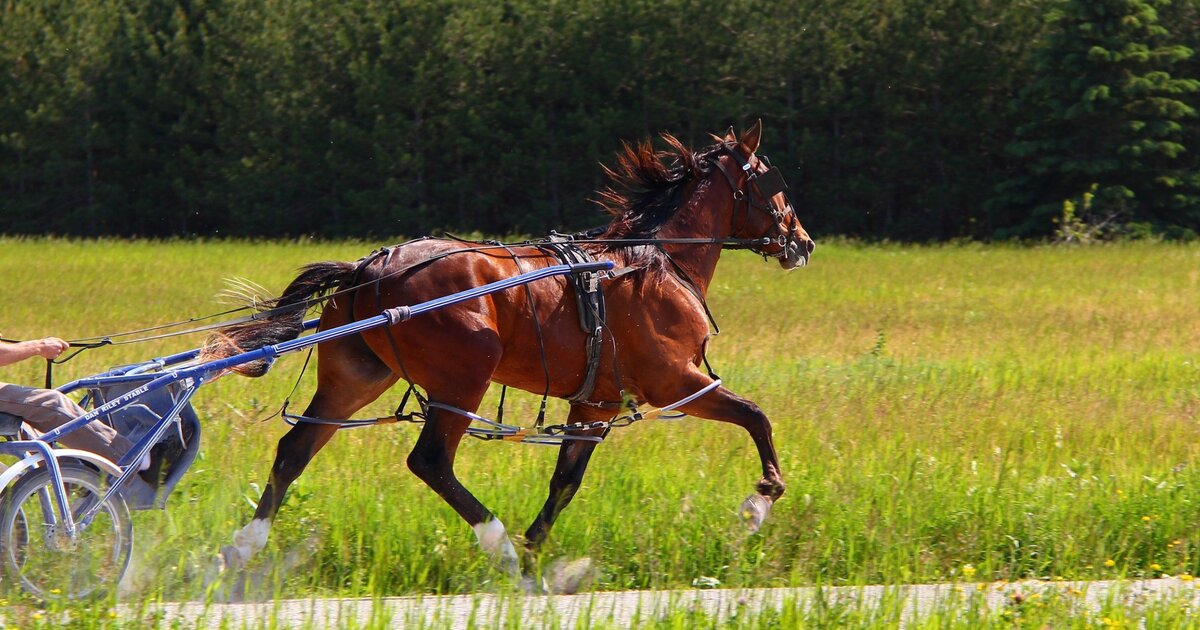
If you've ever driven past a county fairground on a summer evening and heard the thunder of hooves on a small oval track, you've probably seen Standardbreds at work. They're the harness racing breed, the horses that trot or pace at speeds that would make most riding horses trip over their own feet, pulling a driver in a tiny two-wheeled cart called a sulky. And when their racing careers end, many of them become some of the best pleasure horses, trail mounts, and riding partners you could ask for. They're one of the equine world's best-kept secrets.
| Trait | Details |
|---|---|
| Height | 15–16.2 hands |
| Build | Long body, powerful hindquarters, strong sloping croup, deep chest |
| Colors | Bay, brown (most common); black, chestnut; occasional gray, roan |
| Foundation Sire | Hambletonian 10 (born 1849) |
| Primary Use | Harness racing (trot or pace) |
| Temperament | Calm, patient, willing, unflappable |
| Lifespan | 25–30 years |
| Second Careers | Trail riding, pleasure driving, dressage, therapeutic riding, endurance |
A Breed Built on Speed at the Trot
The Standardbred originated in the United States in the late 18th and early 19th centuries, bred specifically for harness racing. The foundation sire is Hambletonian 10, born in 1849 in Chester, New York. Virtually every modern Standardbred traces back to this one stallion. Hambletonian was by a Thoroughbred stallion out of a crippled mare named the Kent Mare, and he stamped his offspring with an extraordinary ability to trot at speed.
The breed name itself tells you the selection criteria. To be registered, a horse originally had to meet a "standard" time for trotting or pacing a mile. If you couldn't hit that time, you weren't a Standardbred. You were just a horse. That ruthless performance-based selection produced animals with incredible cardiovascular systems, efficient gaits, and the mental toughness to race hard week after week. No style points. No beauty scores. Just the clock.
The breed drew on Thoroughbred blood heavily, along with contributions from the Morgan, Canadian Pacer, Narragansett Pacer, and Norfolk Trotter. The resulting horse is leaner and rangier than a Quarter Horse, more substantial than a Thoroughbred, and built from the ground up for sustained speed in harness.
Trotters vs. Pacers
This is the fundamental division within the breed, and it matters because the two gaits are biomechanically different.
Trotters move in diagonal pairs: left front and right hind together, then right front and left hind. This is the same basic trot every horse does, just performed at racing speed. A top trotter can hit a mile in under 1:50. That's about 33 mph at the trot, which is absurd when you think about it. Most riding horses canter slower than a Standardbred trots.
Pacers move in lateral pairs: left front and left hind together, then right front and right hind. This produces a distinctive side-to-side rolling motion. Pacing is slightly faster than trotting at the elite level, and pacers outnumber trotters in North American racing by a significant margin. Many pacers wear hobbles, lightweight straps connecting the legs on each side, to help maintain the pacing gait at high speed and prevent them from breaking into a gallop.
Interestingly, some Standardbreds are natural pacers while others are trained into it. The genetics of gait preference in horses is an active area of research, with a specific mutation in the DMRT3 gene linked to the ability to perform lateral gaits at speed. UC Davis researchers helped identify this gene variant, and most Standardbreds carry it. The discovery reshaped our understanding of how gait is inherited across all breeds, not just Standardbreds.
| Feature | Trotter | Pacer |
|---|---|---|
| Gait pattern | Diagonal pairs (LF+RH, RF+LH) | Lateral pairs (LF+LH, RF+RH) |
| Speed (elite) | Mile under 1:50 (~33 mph) | Slightly faster than trotters |
| Prevalence | Minority in North American racing | Majority in North American racing |
| Equipment | Standard harness | Often wear hobbles to maintain gait |
| Motion | Up-and-down rhythm | Distinctive side-to-side roll |
Conformation and Appearance
Standardbreds aren't going to win any beauty contests against Friesians or Arabians, and that's fine. They're built for function, and they look like it. The typical Standardbred stands 15 to 16.2 hands, with a long body, powerful hindquarters, and a strong, sloping croup. The shoulder is well-angled, the chest deep, and the legs clean with good bone.
The head is often plain, longer than elegant, sometimes with a Roman nose. The expression is typically kind and intelligent, if not classically pretty. Bay and brown are the most common colors, followed by black and chestnut. Grays and roans appear occasionally. The overall impression is of an honest, workmanlike horse. Not flashy, but clearly athletic.
Their legs deserve special mention. Harness racing selects mercilessly for soundness: a horse that can't stay sound through dozens of races doesn't make the breeding shed. The result is a breed with some of the toughest, cleanest legs in the horse world. Sound feet, dense bone, strong tendons. When you find a retired Standardbred with leg issues, it's usually from the racing itself rather than inherent structural weakness.
The hindquarters tell the real story of this breed's power. Standardbreds carry more muscle mass through the gaskin and stifle region than most light breeds, reflecting generations of selection for explosive drive from behind. That's where the speed comes from. Not the front end. The engine is all in the back.
Off-Track Standardbreds: The Hidden Gem
Here's where this breed gets really interesting for the average horse person. Thousands of Standardbreds retire from racing every year. Some are five or six years old. Some are younger. And unlike off-track Thoroughbreds, which can be hot, sharp, and forward to the point of being challenging for amateur riders, retired Standardbreds often have a temperament that's almost shockingly easy to work with.
Think about what a racehorse's daily life involves: being handled, bathed, loaded on trailers, standing in cross-ties, having legs wrapped, being exposed to crowds and loudspeakers and other horses in close quarters. A Standardbred that has raced for several years has seen everything. Very little spooks them. They're used to humans, used to routine, and generally calm in their disposition.
The AAEP's racehorse aftercare resources note that Standardbreds present among the lowest retraining failure rates of any off-track breed, attributing this to the combination of temperament, soundness, and prior handling that most racing Standardbreds bring into their second careers.
The main retraining challenge is teaching them to be riding horses. They've spent their careers in harness, not under saddle. Many have never carried a rider. The transition involves starting them almost like a young horse under saddle: groundwork, building topline, learning to balance with a rider's weight. Most adapt surprisingly quickly. Their intelligence and willingness to work make the retraining process smoother than many people expect.
Pacers specifically may need time learning to trot under saddle since their default gait is the pace. Some convert easily; others require patient work to develop a balanced, rhythmic trot. Trotters typically pick up ridden work faster since the trot translates directly from harness to saddle.
Several organizations now focus specifically on Standardbred adoption and retraining. The New Vocations Racehorse Adoption Program, the Standardbred Retirement Foundation, and numerous smaller groups work to place retired Standardbreds in second careers. Adoption fees are typically modest, making them accessible to riders on a budget.
What They Excel At in a Second Career
Trail riding. Seriously, if you want a bombproof trail horse, find a well-retrained Standardbred. Their unflappable nature, stamina, and ground-covering gaits make them outstanding trail partners. They can go all day without tiring, they handle terrain changes with ease, and they generally don't care about the plastic bag in the ditch or the deer that jumps out of the bushes.
Pleasure driving is an obvious second career. They already know how to work in harness, just at a more relaxed pace. Many Standardbreds transition beautifully into pleasure and competitive driving, bringing their natural forward energy and smooth gaits to a less intense setting.
Dressage at the lower levels works well for Standardbreds with good trot work. Their natural impulsion and work ethic serve them well, though the breed's longer frame can make collection more challenging than it is for warmbloods specifically bred for the sport. Don't expect Grand Prix, but Training through Second Level? Absolutely achievable with a talented individual.
Competitive trail and endurance riding leverage the Standardbred's legendary stamina. They may not have the metabolic advantages of Arabians at the elite level, but for mid-distance work and competitive trail, they're excellent. Their cardiovascular conditioning from racing gives them a baseline of fitness that many breeds simply don't possess.
Therapeutic riding programs value Standardbreds for the same reasons trail riders do: calm temperament, steady movement, and tolerance of unpredictable rider behavior. Texas A&M's equine-assisted therapy research has highlighted the Standardbred's characteristically rhythmic gait as beneficial for riders with neurological conditions, where consistent movement patterns drive therapeutic outcomes.
Health and Longevity
Standardbreds are generally robust horses with good longevity. Twenty-five to thirty years is common with proper care. Their racing heritage selected for cardiovascular health and metabolic efficiency.
Specific health considerations include the wear and tear from racing. Some retired Standardbreds arrive with joint issues, particularly in the hocks and stifles, from the repeated stress of high-speed work on oval tracks. The constant left-turn loading pattern of track work creates asymmetric joint stress that shows up as bone spavin or OCD lesions more frequently on one side than the other. Thorough prepurchase veterinary exams are essential when adopting off-track horses. Radiographs of the lower legs and hocks are worth the investment.
Dental care is standard equine protocol: annual exams with floating as needed. Hoof care is typically straightforward since the breed tends to have good feet, though some ex-racers transition from shoes to barefoot work well while others continue to need shoeing. Racing Standardbreds often wear specialized shoes with trailers, toe grabs, or other modifications that alter hoof mechanics, so the transition to a normal barefoot or shod trim takes a few cycles.
Keep an eye on gastric health. Like all racehorses, Standardbreds are at higher risk for gastric ulcers due to the stress of racing and training. Cornell's equine gastric ulcer research found prevalence rates exceeding 80% in actively racing Standardbreds, with many still harboring subclinical ulceration months after retirement. If your newly adopted Standardbred seems girthy, picky about food, or has a dull coat, an ulcer check is worthwhile. Many respond dramatically to treatment and become different horses once the ulcers heal.
The Case for the Standardbred
They're not glamorous. They won't turn heads at a breed show. But Standardbreds offer something that's genuinely rare in the horse world: a tough, sound, sensible horse with real athletic ability and a kind temperament, available at a price point that makes horse ownership accessible. If more people knew what retired Standardbreds could offer, the adoption programs wouldn't be able to keep them in stock. Next time someone asks you what breed to buy for a first horse on a reasonable budget, tell them to look at a Standardbred. They'll thank you later.
🔍 Compare the Standardbred build and gait mechanics in our 3D Explorer. Check it out here.
Frequently Asked Questions
What is the difference between a trotter and a pacer?
Trotters move in diagonal pairs (left front/right hind together), while pacers move in lateral pairs (left front/left hind together). Pacers are generally faster and dominate American harness racing. The gait tendency is genetic, though some horses can be trained or converted between gaits.
Do Standardbreds make good riding horses?
Absolutely. Off-the-track Standardbreds (OTTSBs) are increasingly popular as riding horses. They tend to be calm, sensible, and forgiving. Many successfully transition to trail riding, dressage, and even jumping. They need retraining since racing is done in harness, not under saddle, but their temperament makes the process relatively smooth.
How fast can a Standardbred go?
The fastest pacers cover a mile in about 1 minute 46 seconds, which translates to roughly 34 mph. Trotters are slightly slower, with top mile times around 1 minute 49 seconds. These speeds are maintained over a full mile, which is remarkable for a gaited distance.
Are Standardbreds prone to any health issues?
They are generally hardy, but tying up (exertional rhabdomyolysis) is common, especially in fillies. Some bloodlines carry a predisposition. Respiratory issues from barn environments and bone/joint stress from early training also occur. Overall, they are considered a sound, durable breed.
How much does a retired Standardbred cost?
Adoption fees from Standardbred rescue organizations typically run $500-2,500. Horses directly off the track can sometimes be acquired for minimal cost or even free if the trainer is looking to place them. Retrained OTTSBs with riding skills sell for $3,000-10,000+ depending on training level.
Sources
- Texas A&M College of Veterinary Medicine - Racehorse Health and Retirement tamu.edu
- Cornell University - Equine Gastric Ulcer Research cornell.edu
- UC Davis Center for Equine Health - Gait Genetics and DMRT3 Research ucdavis.edu
- AAEP - Racehorse Welfare and Second Careers aaep.org
- Merck Veterinary Manual - Gastric Ulcers in Horses merckvetmanual.com