Riding in the Heat: When It Is Too Hot to Ride Your Horse
You tack up on a July morning, the thermometer reads a reasonable 82 degrees, and by the time you finish a 30 minute school your horse is blowing hard and slow to recover. The temperature looked fine. What got you was the humidity, and the fact that a working horse is basically a furnace with legs. Knowing when it is genuinely too hot to ride is not about being soft on your horse. It is about respecting that a horse's cooling system has hard limits, and crossing them can turn a normal ride into an emergency in under half an hour.
How does a horse actually get rid of heat?
A horse cools itself mainly by sweating, and evaporation of that sweat off the skin is what pulls heat away from the body. (For a deeper look at how horses regulate body temperature, see our full guide.) In good conditions, sweat evaporation accounts for roughly 65 percent of the heat a horse loses during exercise, which makes it by far the most important cooling tool the animal has. The problem is that a working horse generates an enormous amount of heat in the first place.
When muscles do work, only about 20 to 30 percent of the energy they burn becomes movement. The other 70 to 80 percent is released as heat. A horse carries a huge muscle mass relative to its skin surface, so all that heat has to escape through a comparatively small radiator. At maximum effort, if a horse could not dump any heat at all, its core temperature would climb by roughly 1 degree Celsius every minute. A fit horse can reach a dangerous temperature faster than riders expect.
To keep up, a hard working horse can lose 2 to 4 gallons of sweat in a single hour, and every drop of that has to evaporate to do its job. This is where humidity becomes the enemy.
Why humidity is worse than heat
Sweat only cools when it evaporates. When the air is already saturated with moisture, evaporation slows to a crawl and sweat just runs off the horse or sits on the coat doing nothing. So a horse can be soaked and still overheating. That is the trap of a humid day: the temperature reads mild and the horse looks like it is sweating fine, yet its core temperature keeps climbing because the sweat is not evaporating. A dry 95 degree day can be safer for hard work than a muggy 82 degree one.
The temperature-plus-humidity rule: is it too hot to ride?
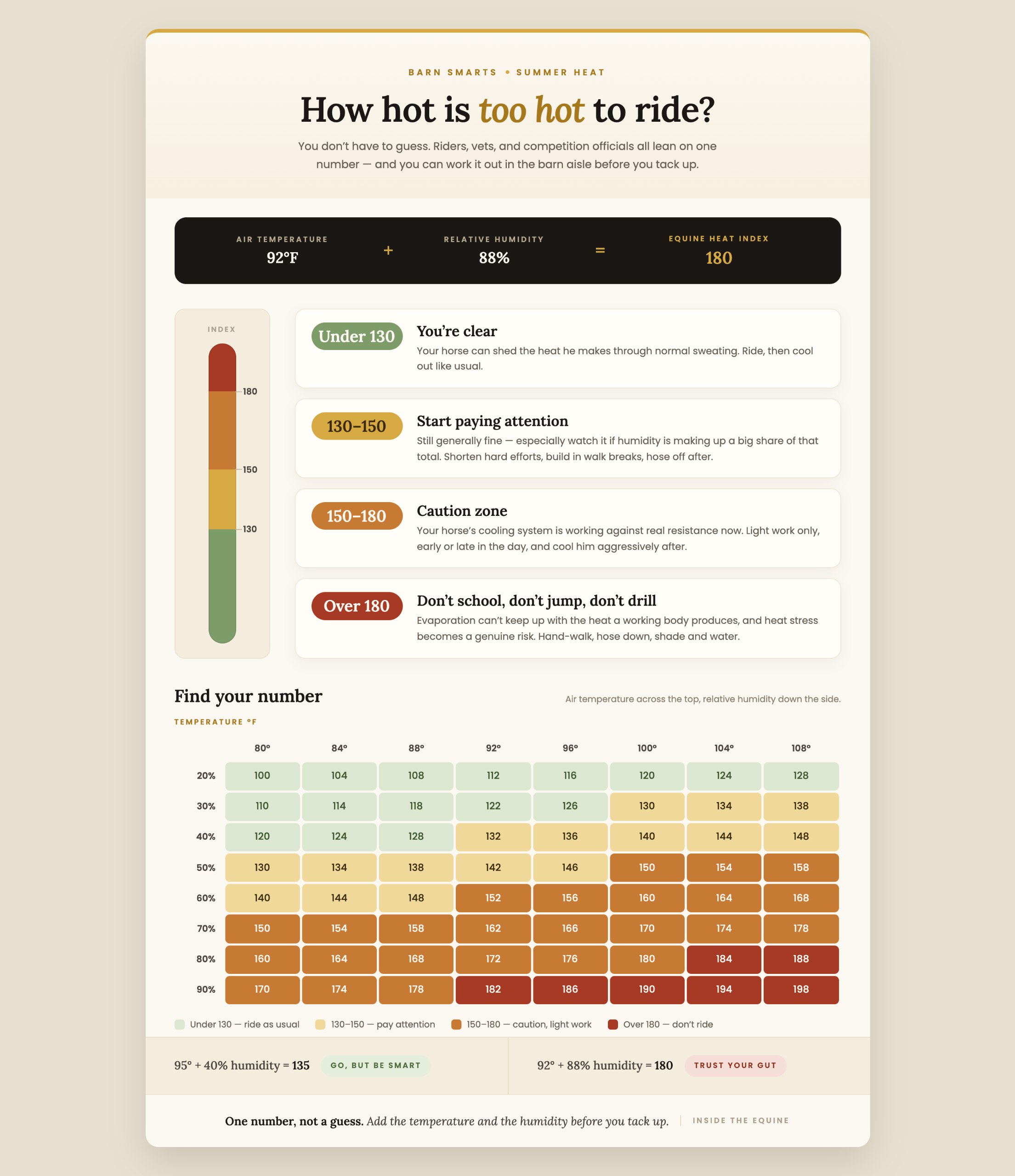
The most useful field guideline comes from equine extension programs and is refreshingly simple. Add the air temperature in Fahrenheit to the relative humidity as a percentage, and read the combined number. This single figure captures the real problem better than temperature alone because it accounts for whether sweat can actually evaporate.
| Temp (F) + Humidity (%) | What is happening | Riding guidance |
|---|---|---|
| Below 130 | Cooling systems work well | Ride as normal |
| 130 to 150 | Cooling efficiency decreasing | Ride, but watch an unfit or unacclimated horse closely |
| 150 to 180 | Cooling greatly reduced, worse if humidity is more than half the total | Light work only, avoid hard or sustained riding |
| Above 180 | Cooling fails, heat builds faster than it can leave | Do not ride, can be fatal for a stressed horse |
A worked example makes it clear. At 88 degrees with 70 percent humidity you are sitting at 158, in the danger band even though 88 does not sound extreme. The extension guidance is direct: avoid riding when the combined number climbs over 150, especially if your horse is not acclimated to the heat. Pay attention to the humidity share too, because a 150 built from 90 degrees and 60 percent humidity is harder on a horse than the same 150 built from 110 degrees and 40 percent humidity.
What does heat stress look like?
Heat stress announces itself through signs you can learn to read in the saddle and on the ground. Catching it early is the whole game, because the gap between uncomfortable and dangerous is narrow. Watch for these:
- A rectal temperature above 103 degrees Fahrenheit (a horse's resting temperature normally sits near 99 to 101)
- A heart rate or breathing rate that does not come down with rest, or a respiratory rate above 40 breaths per minute that stays high after 10 to 30 minutes of standing quietly
- Profuse sweating, or alarmingly, a horse that suddenly stops sweating
- Droopy ears, dullness, and obvious fatigue
- A skin pinch on the neck or shoulder that stays tented for several seconds, signaling dehydration
When heat stress tips into heatstroke, the picture gets worse fast. Rectal temperatures climb above 106 degrees, heart and breathing rates fail to drop within about 20 minutes after work stops, and the horse may become distressed and vocal, weak, uncoordinated, or collapse. This is a genuine emergency. Stop, start cooling immediately, and call your veterinarian without waiting to see if the horse improves on its own.
anhidrosis: when a horse cannot sweat at all
Some horses lose the ability to sweat properly, a condition called anhidrosis, and it is one of the most dangerous problems on this list because it disables the primary cooling system. Since sweat evaporation handles around 65 to 70 percent of a horse's heat loss, a horse that cannot sweat has almost no way to cool itself once it heats up.
Anhidrosis shows up primarily in hot, humid climates such as Florida and the Gulf Coast states, and it affects both locally bred and imported horses. Studies put prevalence between 2 and 6 percent of horses overall. Signs include a fast respiratory rate and failure to cool down after work, and in chronic cases dry, flaky skin (often on the forehead), hair loss, and reduced appetite. If your horse works hard on a hot day and barely sweats while its breathing stays elevated, treat that as a red flag, and do not ride a non-sweating horse in the heat.
What is the fastest way to cool a hot horse?
Cold water, applied continuously and generously, is the fastest safe way to cool an overheated horse, and recent research has overturned a couple of long-held barn beliefs about how to do it. Douse the head, neck, back, rump, and the large vessels of the legs and ribs with a steady stream of cold water, and keep reapplying.
The scraping myth
For decades riders were taught to scrape the water off immediately, on the theory that a film of water left on the coat warms up and insulates the horse, trapping heat. Research has dismantled that idea. Work presented at the Equine Science Society symposium by researcher Hyungsuk Kang and colleagues found that scraping provides no cooling benefit, and that when water was scraped off, the horses' temperatures actually rose. Constant contact between cold water and skin conducts heat away faster than waiting for water to evaporate. So reapply cold water every minute or so for the first several minutes rather than fussing over scraping.
The cold-water-causes-harm myth
The other stubborn belief is that very cold or icy water shocks the horse, causes cramping or tying up, triggers laminitis, or clamps down skin blood vessels so hard that cooling backfires. Equine scientist Dr. David Marlin, who has advised the FEI and the International Olympic Committee on equine cooling since the mid 1990s, is blunt that none of this holds up. Cold and even ice water on a hot horse does not cause muscle damage, laminitis, or shock, and the colder the water, the faster the core temperature comes down. This approach was validated at hot, humid Olympic Games and now underpins modern competition cooling protocols. Do not hold back on cold water for fear of harming the horse.
Hydration and electrolytes on hot days
Water replacement is the other half of heat management, and horses need far more of it than people assume. A 1,000 pound horse needs a minimum of about 6 gallons a day at rest, and in high heat and humidity that can double or triple to around 12 to 18 gallons. Offer clean, cool water (45 to 64 degrees) with unlimited access before, around, and after work. It is a myth that letting a hot horse drink causes colic, so do not withhold water from a horse that wants it.
Because sweat carries out large amounts of sodium, chloride, and potassium, a heavily sweating horse loses electrolytes as well as fluid, and plain water alone will not fully replace them. Electrolyte supplementation can help, but with one rule: a horse has to drink water to actually use supplemented electrolytes, so always offer plain water alongside anything you add. Your veterinarian can help you match a plan to your horse's workload and climate.
Timing rides and managing the heat
The simplest way to stay on the safe side of the temperature-plus-humidity number is to ride when it is smallest, which usually means early morning or late evening. Midday in summer is often the worst combination of heat and glare, so it is the block to avoid for anything strenuous. A few more habits keep horses out of trouble:
- Check the combined heat index for the actual hour you plan to ride, not the daily high
- Give an unfit or newly relocated horse time to acclimate, since heat tolerance builds over one to two weeks of gradual exposure
- Scale the work to the day: shorter sessions, more walk breaks, and lower intensity when the number climbs
- Keep shade and cold water on standby, and cool the horse promptly rather than letting it stand and stew after work
- Know your individual horse, since heavy, older, or thick-coated horses and known non-sweaters heat up faster
None of this means summer riding is off the table. It means reading the real conditions, respecting a cooling system that has limits, and keeping cold water ready so you can work through the season without ever putting your horse in the danger zone.
Frequently Asked Questions
What temperature is too hot to ride a horse?
Temperature alone is not the right measure. Add the air temperature in Fahrenheit to the relative humidity percentage. Below 130 is fine, 130 to 150 calls for caution with unfit horses, and above 150 you should avoid hard work. Above 180 the horse cannot cool effectively and riding can be dangerous.
Why does humidity matter more than heat?
Horses cool mainly by evaporating sweat, and evaporation only works when the surrounding air can absorb more moisture. In high humidity, sweat runs off or sits on the coat without evaporating, so the horse keeps overheating even while soaking wet. A mild, muggy day can be more dangerous than a hot, dry one.
Should I scrape water off my horse after hosing?
No, scraping is not necessary and can slow cooling. Research found that scraping water off provided no benefit, and horses' temperatures rose when the water was removed. Continuous contact between cold water and skin cools better, so reapply cold water rather than stopping to scrape.
Is cold or icy water safe for a hot horse?
Yes. The belief that cold or ice water causes cramping, tying up, laminitis, or shock is not supported by the evidence. Experts who advise the FEI and Olympic committees confirm cold water is safe, and the colder the water, the faster the core temperature drops. This method is used at major competitions in hot climates.
What are the first signs a horse is overheating?
Watch for a breathing or heart rate that stays elevated after you stop, a rectal temperature above 103 degrees, droopy ears and dullness, and a skin pinch that stays tented. A horse that suddenly stops sweating in the heat is a serious warning sign. If breathing and heart rate do not fall within about 20 minutes, call your veterinarian.
Can I give my hot horse water right after riding?
Yes. The idea that a hot horse drinking water will colic is a myth. Offer clean, cool water freely during and after work. A hard working horse in heat may need 12 to 18 gallons a day, and heavy sweaters also benefit from electrolytes, provided plain water is always available alongside them.
Sources
- University of Minnesota Extension. Caring for horses during hot weather. extension.umn.edu.
- University of California Davis Center for Equine Health. Keeping Horses Healthy in Hot Weather. ceh.vetmed.ucdavis.edu.
- University of Florida College of Veterinary Medicine, Large Animal Hospital (2025). Equine Anhidrosis. largeanimal.vethospitals.ufl.edu.
- Lewis, S. (2022). Hosing Hot Horses Post-Exercise: Scrape Off Water or Reapply? (research by H. Kang et al., Equine Science Society symposium). The Horse.
- Marlin, D. Common cooling myths explained (FEI and International Olympic Committee equine cooling guidance). Your Horse.
- Marlin, D. & Nankervis, K. Thermoregulation and exercise-associated heat illnesses in the horse. Equine Exercise Physiology (review).