The American Mustang: Breed Profile of the Free-Roaming Horse
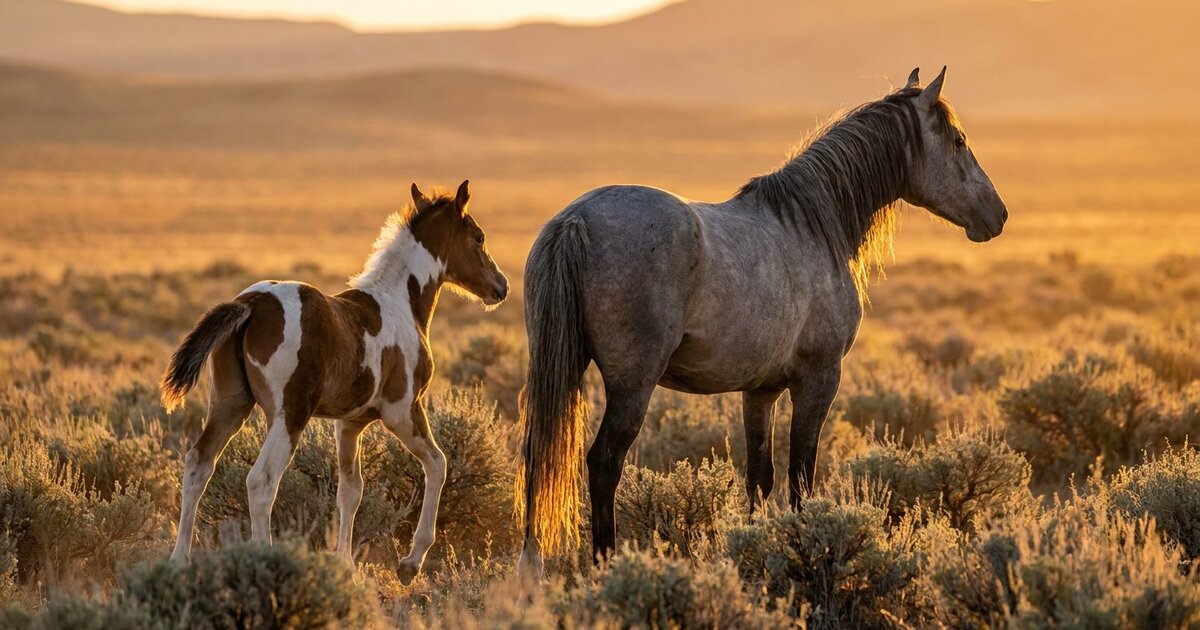
Say the word "mustang" and most people picture a band of horses cresting a ridge at a dead gallop, manes flying, dust behind them. That image is real, but it hides a more interesting story. The American mustang is not a single, tidy breed with a stud book and a fixed color chart. It is a free-roaming survivor, descended mostly from Spanish colonial horses that escaped or were traded away centuries ago, then hardened by generations on some of the harshest land in the West. Today its fate is tangled up in federal law, gathers, and adoption programs that spark real debate. Here is the honest version. For more details, see our guide on Arabian Horse Breed Profile. For more details, see our guide on Suffolk Punch Breed Profile. For more details, see our guide on Standardbred Horse Breed Profile. For more details, see our guide on American Quarter Horse Breed Profile. For more details, see our guide on Thoroughbred Breed Profile.
Where did the American Mustang come from?
The mustang traces back to horses the Spanish brought to the Americas beginning in the 1500s. The word itself comes from the Spanish "mesteno," meaning a stray or ownerless animal. As Spanish settlements, missions, and later ranches spread across the Southwest, horses escaped, were traded, raided, or turned loose, and free-roaming herds took hold across the plains and Great Basin. These animals reshaped the cultures of many Native nations, who became some of the finest horse people in the world within a couple of generations.
Over the following centuries the gene pool widened. Ranch horses, cavalry remounts, draft crosses, and assorted loose stock all mixed into the wild bands. By 1900 an estimated two million mustangs roamed the West, a number that collapsed over the next several decades as horses were rounded up for slaughter, ranch use, and pet food. So while the foundation is strongly Spanish, the modern mustang is genetically a melting pot, which is exactly why a few isolated herds matter so much to people who care about the old bloodlines.
Is the Mustang a breed or a type?
Strictly speaking, the mustang is a type, not a conventional breed. There is no single registry controlling all mustang breeding the way the Jockey Club governs Thoroughbreds, because these horses breed themselves on open range with no human selection. What natural selection favors is survival: sound feet, an efficient metabolism, good sense, and stamina. Those traits show up again and again regardless of what a given horse looks like.
That said, a few registries and preservation groups do exist for specific bloodlines, and mustangs adopted from public land come with federal paperwork rather than a breed pedigree. It helps to think of "mustang" as a heritage stamped onto a horse, with several distinct strains under that umbrella.
What does the Wild Free-Roaming Horses and Burros Act of 1971 do?
The Wild Free-Roaming Horses and Burros Act, signed by President Nixon on December 15, 1971, made it a federal crime to harass, capture, or kill wild horses and burros on most public land, and it put their management under the Bureau of Land Management (BLM) and the U.S. Forest Service. The law famously calls these animals "living symbols of the historic and pioneer spirit of the West" and directs the government to protect them where they were found roaming at the time the act passed.
The law did not appear out of nowhere. It was driven largely by Velma Bronn Johnston, better known as "Wild Horse Annie," whose campaign against brutal roundup methods generated one of the largest letter-writing efforts by schoolchildren in American history. The act has been amended several times since, including provisions that allowed the adoption program and set limits on how many animals a person can adopt. Almost every modern controversy about mustangs is really an argument about how to carry this law out.
How many mustangs are there, and how are the herds managed?
As of March 1, 2025, the BLM estimated roughly 73,130 wild horses and burros roaming public rangelands across ten Western states. The agency manages them within designated Herd Management Areas (HMAs) and sets a combined "appropriate management level," or AML, of about 25,592 animals, the number it believes the range can sustain alongside wildlife, watersheds, and livestock. In plain terms, the on-range population sits at roughly three times the BLM's target, and that gap is the source of nearly every fight over mustang policy.
An HMA is simply a mapped area where a wild horse or burro herd is allowed to live and be managed. When a herd grows beyond its AML, the BLM removes "excess" animals, historically through helicopter and bait-trap gathers, and moves them into off-range corrals and pastures, from where they are offered to the public through adoption and sale. The agency also uses fertility control such as the PZP vaccine on some herds, though how heavily to rely on birth control versus removals is hotly contested among advocates, ranchers, and scientists.
It is worth being honest about the tension. Advocates argue the AML numbers are too low and favor livestock, while range scientists and the BLM argue that unchecked herds outstrip forage and water and eventually starve. Both sides describe a real problem, and there is no painless answer, which is why the program stays in the headlines decade after decade.
What does a Mustang look like, and how tough is it?
Because mustangs come from such a mixed, unmanaged gene pool, there is no single "correct" look, but there are strong tendencies. Most stand between about 13.2 and 15 hands and weigh somewhere in the 700 to 900 pound range depending on the herd and the country they came from. You will find nearly every coat color and pattern, from bay and black to dun, roan, pinto, and grulla.
The real signature of the mustang is not color, it is toughness. Generations of natural selection on rough ground tend to produce a compact, well-balanced horse with a short back, strong loins, dense bone, and famously hard, well-shaped hooves. Many can work barefoot over terrain that would leave a softer-footed horse sore. They are also known as "easy keepers," holding weight on modest forage, an asset that can tip into a liability if an owner overfeeds them and triggers metabolic problems. Talk with your veterinarian about a diet suited to that thrifty metabolism.
Temperament
Temperament varies by individual and herd, but a well-started mustang is often described as intelligent, curious, sure-footed, and intensely bonded to its person once trust is earned. That same intelligence means they read handlers quickly and do not forgive rushed or rough training. For a patient, experienced horse person, the loyalty and try can be extraordinary.
How does adopting and gentling a Mustang work?
You adopt a mustang from the BLM, either online, at in-person adoption events, or at holding facilities. Standard adoption fees start low, often around a $25 minimum bid, but the bigger financial piece is the Adoption Incentive Program launched in 2019. It pays qualified adopters $1,000 to take an untrained wild horse or burro, part after adoption and the rest after the animal is titled. More than 17,000 animals have been placed through that incentive.
Adoption is not the same as ownership on day one. You take an untitled animal into your care, provide adequate facilities (the BLM sets minimum fence and shelter standards), and after roughly one year of compliance a veterinarian or BLM official signs off and title transfers to you. Adopters are generally limited to four animals per year, and that one-year window exists precisely because gentling a wild horse takes time.
Gentling a mustang
Gentling is the process of turning a genuinely wild animal into a handleable partner, and it rewards patience over pressure. The broad arc most trainers follow looks like this:
- Let the horse settle. A newly adopted mustang needs quiet, safe space and time to observe you without being crowded.
- Approach and retreat. Trainers move toward the horse, then step away the instant it relaxes, teaching that calm behavior makes pressure disappear.
- First touch, then the halter. Contact usually starts on the neck and shoulder, building toward haltering and leading over days or weeks.
- Handling and desensitizing. Picking up feet, accepting a farrier and vet, loading in a trailer, and tolerating everyday sights and sounds.
- Under saddle, eventually. Riding comes only after solid groundwork is in place.
For years, much of this halter-starting was done at scale through the Mustang Heritage Foundation's Trainer Incentive Program (TIP), which paid approved trainers to gentle wild horses and place them, alongside its Extreme Mustang Makeover competitions showcasing 100-day transformations. Policy in this space shifts, though: in 2023 the BLM chose not to renew its long-running partnership with the Foundation, and the TIP wound down. If you are exploring gentled-mustang options, check current BLM and Mustang Heritage Foundation listings rather than assuming any single program is running.
What are the famous Mustang strains?
A handful of isolated herds retained strong Spanish colonial ancestry, and these strains, the closest living link to the horses the conquistadors brought over, are the ones collectors and preservationists prize.
The Kiger mustang was discovered in 1977 in the remote Beaty Butte area of southeastern Oregon, when the BLM found a group of strikingly uniform, dun-colored horses with obvious Spanish type. To protect the bloodline, the herd was split between the Kiger and Riddle Mountain Herd Management Areas. Kigers are known for dun coloring in every shade, primitive markings like dorsal stripes and zebra bars on the legs, and a refined "Barb" head.
The Pryor Mountain mustang ranges across the Montana-Wyoming border on one of the ranges set aside specifically for wild horses. DNA work associated with geneticist Dr. Gus Cothran tied these horses to Spanish Barb ancestry, including a rare genetic marker found in early Spanish imports. They tend to stand about 14 to 14.2 hands and carry a reputation for hard feet and surefooted stamina.
The Spanish Mustang is a formally preserved bloodline rather than a place-based herd. The Spanish Mustang Registry was founded in the 1950s by Robert Brislawn of Wyoming, who gathered horses he judged to be true Colonial Spanish types before those bloodlines vanished. Fewer than 3,000 Spanish Mustangs exist today, treasured for the very qualities that let their ancestors survive: soundness, endurance, and the ability to thrive where other horses would fail.
| Strain | Home range | Signature traits |
|---|---|---|
| Kiger | SE Oregon (Kiger and Riddle Mountain HMAs) | Uniform dun, primitive markings, Barb-type head |
| Pryor Mountain | Montana-Wyoming border range | Spanish Barb DNA, ~14 to 14.2 hands, very hard feet |
| Spanish Mustang | Preserved bloodline (registry, not one range) | Colonial Spanish type, extreme hardiness, fewer than 3,000 left |
Frequently Asked Questions
Are mustangs wild horses or feral horses?
Technically they are feral, meaning they descend from domesticated horses that returned to living free rather than from a never-domesticated wild species. In everyday language and in federal law they are called wild horses. Either way, a mustang born on the range has had no human handling and behaves as a genuinely wild animal.
How much does it cost to adopt a mustang?
Base adoption fees through the BLM often start around a $25 minimum bid. Through the Adoption Incentive Program, qualified adopters can actually receive $1,000 for taking an untrained wild horse or burro, paid in stages before and after the animal is titled. The real cost is the time, facilities, and skill needed to gentle and keep the horse.
Can a beginner train a mustang?
An untouched mustang straight off the range is not a good match for a first-time trainer. These horses need someone who reads equine body language well and stays calm and consistent under pressure. Beginners who want a mustang are usually better served adopting one that has already been gentled and started by an experienced trainer.
Do mustangs make good riding horses?
Yes. Once gentled, mustangs are used for trail riding, endurance, ranch work, and arena disciplines, and their tough feet and stamina make them excellent on long or rugged rides. Their intelligence and loyalty build a strong partnership, provided training is patient and consistent.
What is the difference between a Kiger and a regular mustang?
A Kiger is a specific mustang strain from southeastern Oregon selected and protected for its strong Spanish ancestry and uniform dun coloring. A "regular" mustang comes from the broad, mixed gene pool of the general wild population and can be almost any color or type. All Kigers are mustangs, but only a small, distinct herd qualifies as Kigers.
Sources
- Bureau of Land Management. Wild Horse and Burro Program: About the Program, Program History, and Program Data (2025 population estimates, as of March 1, 2025). U.S. Department of the Interior, blm.gov.
- Wild and Free-Roaming Horses and Burros Act of 1971, Public Law 92-195, as amended. U.S. Congress / Bureau of Land Management.
- Bureau of Land Management. Celebrating Five Years of the Adoption Incentive Program (2024). blm.gov.
- Oklahoma State University Department of Animal and Food Sciences. Breeds of Livestock: Mustang Horses and Kiger Mustang Horses. breeds.okstate.edu.
- Spanish Mustang Registry. History and Breed Overview. spanishmustang.org.
- Mustang Heritage Foundation. Trainer Incentive Program and program history; and reporting on the 2023 end of the BLM partnership. mustangheritagefoundation.org; Horse Network.